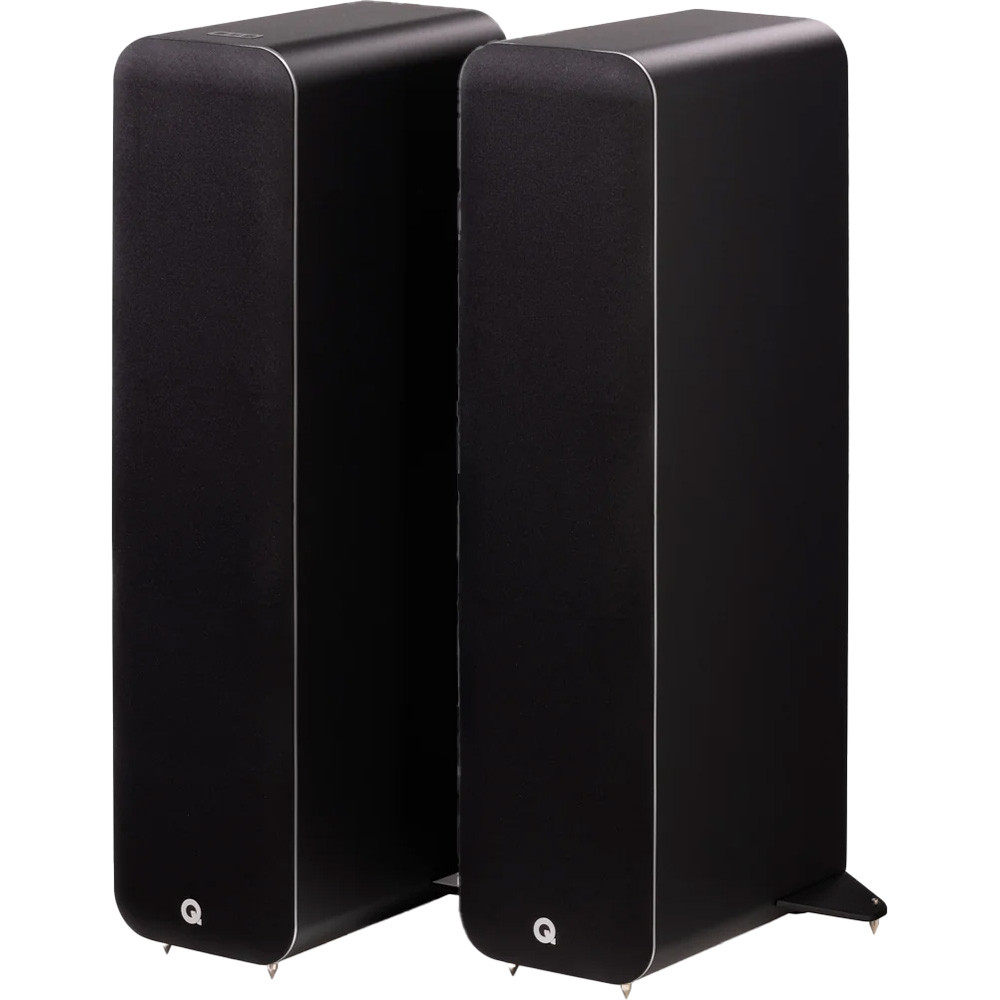
Q Acoustics M40 offers an appealing middle ground between separate hi-fi boxes and a single wireless speaker. It provides two compact floorstanding cabinets, built-in amplification and several source connections. The important wording is powered Bluetooth stereo: wireless does not mean that the cabinets communicate without a cable, and the system does not include a Wi-Fi music platform. Its strongest role is a relatively simple room system for someone who wants genuinely separated left and right speakers.
Research-based review. This assessment draws on manufacturer documentation and the original independent evaluations linked below. Audio Review has not performed a hands-on test of this model.
Micro-towers and the simplified stereo system
The M40’s compact floorstanding format avoids the usual question of where to put bookshelf speakers and their stands. It still needs a sensible position for each cabinet, with space around the rear ports and a listening arrangement that allows the two channels to form a stereo image. Small towers do not become placement-independent simply because the amplifier is built in.
The powered cabinet contains the electronics and drives the companion through a speaker cable. Plan that cable route as well as the mains connection and source leads. This is simpler than a conventional amplifier and passive-speaker stack, but it is not a cable-free room. Measure the intended positions before buying, particularly if the television or computer sits far from the cabinet that will contain the inputs.
Sound quality and the balance of published opinions
What Hi-Fi? presents the M40 as smooth and easy to accommodate while wanting more drive and excitement. Other original reviews are more enthusiastic about its complete-system appeal. Taken together, this supports a qualified recommendation rather than a claim that the M40 is universally the liveliest or most revealing option at the price.
Our interpretation is that it suits listeners who value a comfortable, integrated room system and do not want to assemble separate electronics. Audition familiar rhythmic material as well as voices and quieter recordings. Check whether the presentation keeps you engaged at normal home levels. If you prefer a more forceful or forward balance, compare another system rather than assuming you will learn to prefer a character that initially feels too restrained.
Bluetooth is useful, but it is not Wi-Fi streaming
Bluetooth with compatible aptX facilities provides an easy phone connection. The active codec still depends on the source, so an iPhone or another device may use a different supported route. A codec list is not a guarantee that every phone transmits in the highest advertised format.
There is no built-in network platform for direct service browsing or multiroom music. You can add an appropriate external streamer, but that changes the box count, control routine and total cost. If you already own a suitable source, the M40’s inputs can be a strength. If you expected to select music directly through a speaker app without another sender or streamer, compare a network-enabled system before committing.
Wired sources and the television limitation
Optical, USB and analogue line connections cover several common sources. They should be chosen by role: a computer can use the supported USB audio path, while an appropriate optical source provides another digital route. An analogue line input accepts an already suitable signal; it is not a phono stage for a bare turntable cartridge.
There is no HDMI ARC connection. A television may still work through an available optical or analogue output, but power, volume and source behaviour will not necessarily match an HDMI-controlled soundbar. Check the television’s supported audio format and level-control options. This is especially important if other household members expect one remote to manage everything. A system can sound convincing with TV audio while still requiring a different daily control routine.
Placement, bass and adding another component
The rear-ported cabinets deserve a practical placement trial. Distance from boundaries and the listening position can change bass balance substantially, so begin with the maker’s guidance rather than assuming the most visually convenient corner is acoustically ideal. Keep both speakers reasonably consistent in their relationship to the room where possible.
A subwoofer connection provides an expansion route, but adding a sub is not the first answer to every bass complaint. Identify whether the issue is insufficient extension, a position-dependent dip or excessive boom before spending more. A subwoofer also adds its own placement and level decisions. The appeal of the M40 is a relatively coherent system; expansion should solve a defined problem rather than recreate a complicated set of boxes without a clear benefit.
Value and a realistic ownership comparison
Compare the total system, including stands where another design needs them, any external streamer and the connections required by your television. The M40 can be good value when its floorstanding form and source selection remove purchases you would otherwise make. It is less persuasive if the missing HDMI or network platform forces you into an awkward workaround from the start.
Physical controls and a straightforward source arrangement can be an advantage for a room used by several people. Try that routine during a demonstration instead of only listening to a salesperson’s source. Check the current local warranty and the cost of the alternatives you actually like. The best purchase is the system that fits the room, musical preference and everyday operation together, rather than the one with the largest amplifier figure on its product page.
Alternatives to consider
KEF LSX II: LSX II takes a more network-oriented compact-system approach and offers a different TV connection package. Compare the full input and app workflow, while allowing for the stands or furniture required by its smaller bookshelf cabinets.
Edifier R1280DBs: The Edifier is a lower-cost powered bookshelf alternative for a simpler source setup. It is useful for checking whether you need the M40’s floorstanding form and larger system scale, rather than assuming a higher price is necessary for every room.
Q Acoustics M40 key specifications
- System
- Powered stereo micro-towers
- Enclosure
- Two-way ported
- Drivers per cabinet
- Two 125 mm mid/bass units and one 22 mm tweeter
- Amplification
- Q Acoustics states 2 × 100 W built-in amplification
- Analogue inputs
- RCA line and 3.5 mm line
- Digital inputs
- Optical and USB Type B
- Digital input limit
- Up to 24-bit/192 kHz on supported wired paths
- Bluetooth
- 5.0; aptX, aptX HD, aptX Low Latency, SBC and AAC
- Network Wi-Fi streaming
- Not built in
- HDMI ARC
- None
- Phono stage
- Not built in
- Speaker link
- Cable between powered and companion cabinet
- Subwoofer connection
- Supported
- Dimensions (W × H × D)
- 250 × 710 × 296 mm with stabilisers
- Amplified speaker weight
- 12.4 kg
Verdict
M40 is a practical way to obtain separated stereo from compact floorstanding cabinets without a separate integrated amplifier. Its wired source options and Bluetooth make it flexible, and the published sound assessments support an accessible, room-friendly proposition with a more qualified view of ultimate drive.
Be precise about what is missing: there is no HDMI ARC, onboard Wi-Fi platform or cartridge-level phono input, and a cable joins the cabinets. Compare the KEF LSX II for a different integration approach or the Edifier R1280DBs for a simpler lower-cost system. Choose the M40 when its physical format, presentation and complete source arrangement suit the room, rather than treating wireless as a promise that all the usual system connections disappear.
Primary documentation and independent reviews
Q Acoustics UK official M40 product information · What Hi-Fi? original M40 review · AVForums original M40 system evaluation · TechRadar original M40 review
Editorial record
Sources and updates
Product specifications and factual claims were checked against Official Q Acoustics M40 product page ↗. Scores and buying advice follow our category-specific editorial methodology.
- Published
- November 17, 2026
- Last updated
- November 17, 2026