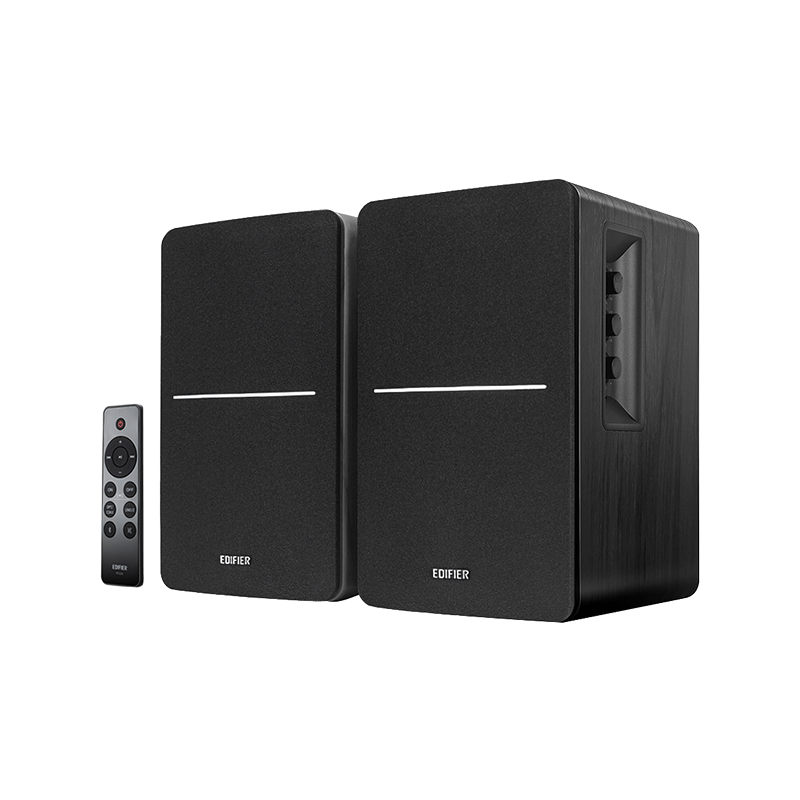
The Edifier R1280DBs is a powered stereo pair rather than a single smart speaker. Its main attraction is a straightforward combination of amplification, Bluetooth and wired inputs at the speakers themselves. That can make a compact system easier to assemble, provided the buyer understands the cable between the speakers and the distinction between line input and phono input.
Edifier R1280DBs — A stereo pair offers real placement choices
Edifier documents a two-way arrangement with four-inch mid/bass drivers and half-inch silk-diaphragm tweeters, with 21 W plus 21 W RMS output. The power figure describes the manufacturer’s rating, not an independent maximum-volume test. Speaker placement and listening distance remain important.
Unlike a single-box speaker, the pair can be separated to create distinct left and right positions. Use a stable surface or suitable stands and keep both speakers reasonably balanced relative to the listener. Positioning them at very different heights or distances can undermine the main benefit of having two enclosures.
Powered does not mean cable-free
The system contains amplification, so it does not need a separate speaker amplifier for ordinary use. It still requires mains power and the documented connection between the active and companion speaker. Bluetooth removes a source cable; it does not remove every wire in the system.
Do not connect an external amplifier’s speaker-level output to the RCA line input. Those are different signal levels and roles. A line-output source, appropriate DAC or preamplifier is the normal wired partner. Keep the source volume and speaker control arrangement clear to avoid unexpectedly loud playback when changing devices.
Several inputs, but no cartridge preamplifier
The official page lists Bluetooth, dual RCA line inputs, optical and coaxial digital input. A compatible digital source can connect directly without a separate DAC, while analogue sources need to provide the correct line level.
A turntable is suitable only after phono amplification, either built into the deck or supplied separately. An RCA-shaped connector does not mean the speakers accept a raw cartridge signal. Similarly, digital coaxial RCA and analogue RCA connections are not interchangeable despite their similar appearance. Match the socket label and signal type at both ends.
Subwoofer expansion and everyday value
The final s in R1280DBs is important when comparing listings: this model provides a subwoofer output. Check the exact product rather than assuming every R1280DB-family speaker has identical connections. A suitable powered subwoofer can extend the system, but placement and level matching still require care.
Edifier supplies side-panel and remote control, which can be more convenient than reaching behind a desk. Consider how often sources will change and whether the speakers will sit within reach. For television use, optical can be useful, but the absence of HDMI ARC means the control routine may differ from a soundbar.
The documented feature set is focused on local stereo playback rather than network grouping. If multiroom streaming is essential, include an appropriate external source or consider another platform. We have not measured frequency response, noise or distortion, so the review does not establish studio-monitor accuracy or a sound-quality advantage over larger speakers.
What to expect in a real setup
Can I connect a turntable directly? Only when it supplies a suitable line-level output. A turntable with a raw cartridge output needs a phono stage before the speakers.
Does Bluetooth eliminate the cable between the speakers? No. Bluetooth is the source connection. Follow the manual’s powered-speaker and companion-speaker wiring arrangement.
A powered stereo pair still has a wiring plan
R1280DBs provides an integrated amplifier and two speakers, not a pair that needs another conventional speaker amplifier. Follow the designated inter-speaker connection and mains arrangement. Do not feed a power amplifier’s speaker outputs into a line input. Identify the source output and speaker input by their signal roles, not simply by whether a connector can be adapted to fit.
Place the two cabinets to suit the listening position and keep their output clear of the monitor or furniture. A real stereo pair offers useful separation choices, but those are weakened if both boxes are crowded together behind a screen. Try the normal desk posture and listening distance before making large tone-control changes. A room or desk-related bass difference is not automatically a fault in the source.
TV, vinyl and digital sources
For television optical playback, check the actual output format accepted by the speaker and the TV setting used. A successful picture from a console does not prove every soundtrack is delivered appropriately. Keep the normal volume-control routine clear because an optical connection need not behave like an HDMI-CEC system. Test the actual remote arrangement before declaring the installation finished.
The RCA inputs expect line level, so a turntable without a suitable phono stage needs that function elsewhere. A cable adapter cannot add equalisation or microphone gain. Include the stage in the complete vinyl-system budget. The subwoofer output also needs an appropriate powered subwoofer and a deliberate integration plan rather than a passive speaker plugged into another socket.
Value as a complete small system
Test Bluetooth with the normal phone and local inputs with the sources actually owned. Keep tone settings and playback level comparable when evaluating another speaker. The quoted response range and amplifier figure are manufacturer information, not independent measurements of neutrality or maximum clean output here.
For used stock, confirm the exact DBs model, inter-speaker lead, remote, controls and applicable support within the return period. Similar Edifier names can describe different connections. R1280DBs is strongest when its actual input set and stereo format replace equipment the owner would otherwise need at the complete price. A network-streaming or phono feature absent from the specification should not be assumed because another active speaker provides it.
Alternatives to consider
KEF LSX II LT: A different, more integrated network-stereo approach to investigate if current budget and streaming needs extend beyond simple local inputs.
Sonos Era 100: A different single-box ecosystem option when network integration matters more than a wired stereo pair at this price level.
Edifier R1280DBs key specifications
- System
- Powered stereo bookshelf pair
- Rated output
- 21 W + 21 W RMS
- Mid/bass drivers
- 4 inches
- Tweeters
- 0.5-inch silk diaphragm
- Inputs
- Bluetooth, dual RCA line, optical, coaxial
- Subwoofer output
- Yes
- Controls
- Side panel and remote
- Quoted frequency range
- 51 Hz–20 kHz
- Net system weight
- 4.9 kg
Verdict
The R1280DBs makes sense as a clear, uncomplicated powered stereo rather than a miniature home-theatre platform. Its varied inputs and subwoofer output are practical strengths. Confirm source levels, placement and the daily control routine before buying; sound preference and usable volume still require a real audition.
Primary documentation
Specifications and feature descriptions were checked against the following official documents on 6 November 2026. Compatibility advice is our interpretation of those documented capabilities; it does not establish measured sound quality. Regional bundles, software features and service availability can change, so verify the exact European model and current support information before purchase.
Editorial record
Sources and updates
Product specifications and factual claims were checked against Official Edifier R1280DBs product page ↗. Scores and buying advice follow our category-specific editorial methodology.
- Published
- November 7, 2026
- Last updated
- November 8, 2026