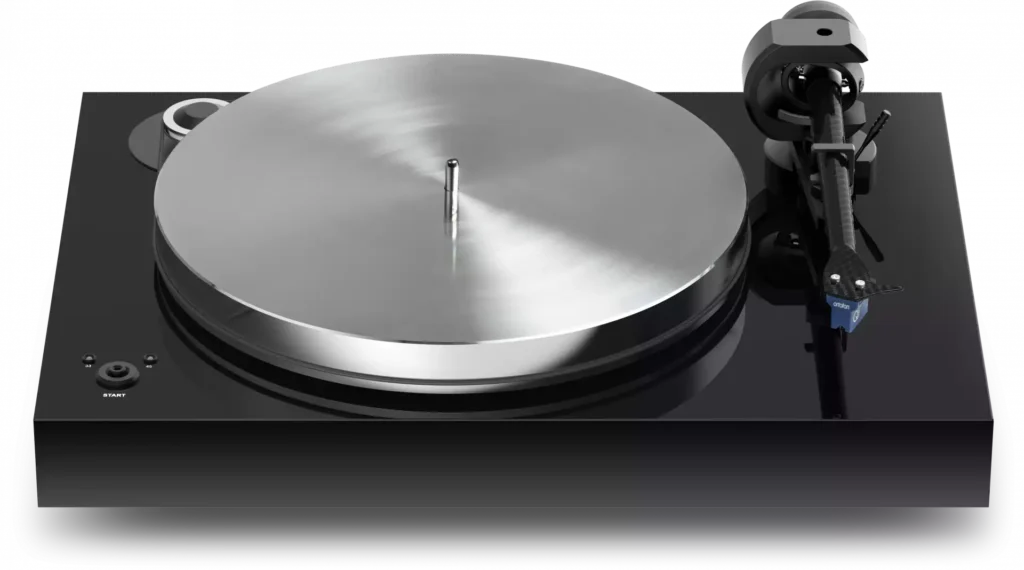
Pro-Ject X8 brings a substantial platter, a dedicated carbon arm and moving-coil package into a relatively restrained-looking turntable. Its appeal is a serious analogue foundation rather than a long list of automatic conveniences. The original Quintet Blue evaluation is encouraging, but the required phono equipment and installation deserve equal attention. This review keeps the original X8 package distinct from changes in current naming or retailer bundles, and treats its balanced connection as a specific system option rather than assuming a connector alone transforms the result.
Research-based review. This assessment draws on manufacturer documentation and the original published evaluations linked below. Audio Review has not performed a hands-on test of this model.
The original listening evidence favours scale and separation
Hi-Fi News’ original assessment describes a clean, spacious and detailed presentation from the Quintet Blue package, with convincing musical scale. It also stops short of calling demanding passages the last word in control. That is strong support for an audition, with a useful reason to include dense music rather than only flattering acoustic material.
Choose records that test different priorities in the actual system. A solo instrument can show continuity and tonal comfort, while a layered mix reveals whether the music remains easy to follow. Listen at ordinary levels as well as a brief louder passage. The package’s cartridge and phono stage are central to the comparison, so distinguish a complete-system preference from a claim about the deck in isolation. A different cartridge on a rival may be an entirely reasonable purchase comparison without proving one drive mechanism superior. The most useful result is consistent engagement across the collection. An impressive opening should develop into a reason to finish the side, rather than simply demonstrating detail on a specially selected recording.
The mass-loaded design needs a proper home
The original specification gives a total mass of fifteen kilograms and a platter of approximately 5.1 kilograms. The platter’s magnetic bearing support is not the same thing as magnetic feet: the feet use TPE damping and height adjustment.
Check the support’s capacity and stability before delivery. Allow room to assemble the deck safely and keep the separate parts protected while following the instructions. Plan the position before lifting a substantial component into an awkward recess. A suitable installation also allows comfortable access to the arm and cover. High mass does not remove every potential vibration issue in a room, so evaluate the actual location at the intended listening level. If footfall or furniture movement is apparent, address the support first. The engineering is attractive when it becomes part of a practical listening arrangement. It is less useful when the owner must compromise everyday handling or cannot accommodate the product safely and comfortably in the available space.
The cartridge package and phono stage belong together
The original X8 is offered with an Ortofon Quintet Blue MC package as well as without a cartridge. It has no built-in phono preamplifier. Confirm the actual bundle rather than assuming the model name establishes everything needed to play a record.
Identify a suitable MC phono input and its available settings before comparing prices. A standard line input is not a substitute, and an existing MM-only stage should not be assumed to suit the fitted cartridge. Ask for a complete matched demonstration if this is unfamiliar territory. Include setup service and supporting equipment in the budget rather than allocating the entire amount to the deck. For a used package, establish cartridge history and stylus condition, since replacement cost can materially change the decision. Avoid upgrading simply to make the supporting boxes look proportionate in price. A quiet, reliable, appropriately configured starting system is more useful than an expensive collection of loosely matched components. Further changes should answer an identifiable listening or practical limitation.
Balanced playback is an end-to-end arrangement
The original documentation specifies a five-pin output and supplied DIN-to-RCA cable. A suitable balanced cable and compatible phono stage are separate requirements for the alternative route. The included cable therefore does not make the complete supplied arrangement balanced by default.
Trace the actual signal path before spending on connectors. A balanced line input on an ordinary amplifier is not automatically a balanced cartridge input with the required gain and equalisation. Verify the phono stage’s specific support, the cable wiring and the fitted cartridge arrangement. If the existing RCA route is quiet and satisfying, establish that reference before buying changes. Where an interference problem exists, careful installation and correct matching should come before assuming an expensive cable alone fixes it. A documented balanced path can be useful, but its value depends on the complete system. Compare any proposed change fairly and include its cost. The purchase should remain defensible on the ordinary supplied route unless balanced use is a confirmed requirement from the outset.
The arm rewards competent initial setup
The 9cc Evolution is a defining part of the package, while the overall operation remains manual. A pre-fitted cartridge still deserves a setup check after transport. None of the construction details establishes automatic calibration or unattended arm return.
Ask the dealer to verify the fitted package and demonstrate normal cueing, speed selection and end-of-side handling. Keep the recommended settings and maintenance information with the product. If a future cartridge change is contemplated, consider the arm, adjustment range, phono requirements and total cost together. Do not alter several settings at once while investigating an unfamiliar result. First confirm ordinary mechanical and electrical operation, then establish a listening reference. This is particularly important for a substantial purchase intended to remain in a system for years. The appeal is a stable basis for repeated enjoyment, not an obligation to keep modifying it. A listener who prefers automatic operation should compare that practical preference before assuming the more ambitious construction will make manual use enjoyable.
Compare the installed system rather than an upgrade ladder
The X8’s evidence is strongest as a complete fitted-cartridge proposition. Current X8 B naming and retailer variations make precise package checking important, while the original product sheet remains useful for understanding the version reviewed here.
List the components required to make the intended arrangement work, including the support and phono stage. Then compare that total with a relevant Rega, Technics or other complete system. Use actual current local offers rather than an old launch price as a guarantee of value. A bare-deck offer may be attractive for an owner with a compatible cartridge, but misleading for someone starting from nothing. Likewise, an optional balanced path should be priced separately rather than silently included in the recommendation. The strongest purchase is one that already satisfies the main requirements with a clear supported setup. Avoid paying for a theoretical sequence of future upgrades when a simpler arrangement may meet the need today. The X8 deserves consideration because the original package is compelling, not because every accessory is assumed to be necessary.
Alternatives to consider
Rega Planar 6: Planar 6 is a relevant manual comparison. Match the cartridge and phono equipment as closely as practicable, then compare the complete installed system rather than bare-deck prices.
Technics SL-1200GR2: SL-1200GR2 provides a contrasting direct-drive route. Consider the cartridge, setup service and daily operation required for the actual package, alongside musical preference.
Pro-Ject X8 key specifications
- Version
- Original X8 / Quintet Blue package assessed here
- Drive
- Manual belt drive
- Speeds
- Electronic 33⅓ / 45 rpm
- Platter
- Approximately 5.1 kg machined aluminium, TPE damped
- Bearing
- Inverted ceramic-tipped, magnetically supported
- Arm
- 9cc Evolution carbon fibre
- Effective arm length / mass
- 230 mm / 8.5 g
- Cartridge
- Ortofon Quintet Blue MC in evaluated package; bare versions also exist
- Output
- 5-pin DIN at arm base
- Supplied cable
- DIN-to-RCA; balanced cable separate
- Phono stage
- External suitable MC stage required
- Size / weight
- Approximately 465 × 150 × 350 mm closed / 15 kg
Verdict
X8 is a strong shortlist candidate for a committed manual vinyl system. The original Quintet Blue evidence supports scale, clarity and separation, with a substantial mechanical foundation. Its mass, external MC phono requirement and optional balanced route shape the real cost. Confirm the precise bundle and installation, then judge the complete system on music and daily use before planning further upgrades.
Documentation and original reviews
Pro-Ject official original X8 product information · Pro-Ject current X8 B page, used to distinguish naming and package · Hi-Fi News original X8 design evaluation · Hi-Fi News original X8 listening evaluation
Editorial record
Sources and updates
Product specifications and factual claims were checked against Official Pro-Ject X8 product page ↗. Scores and buying advice follow our category-specific editorial methodology.
- Published
- November 17, 2026
- Last updated
- November 17, 2026