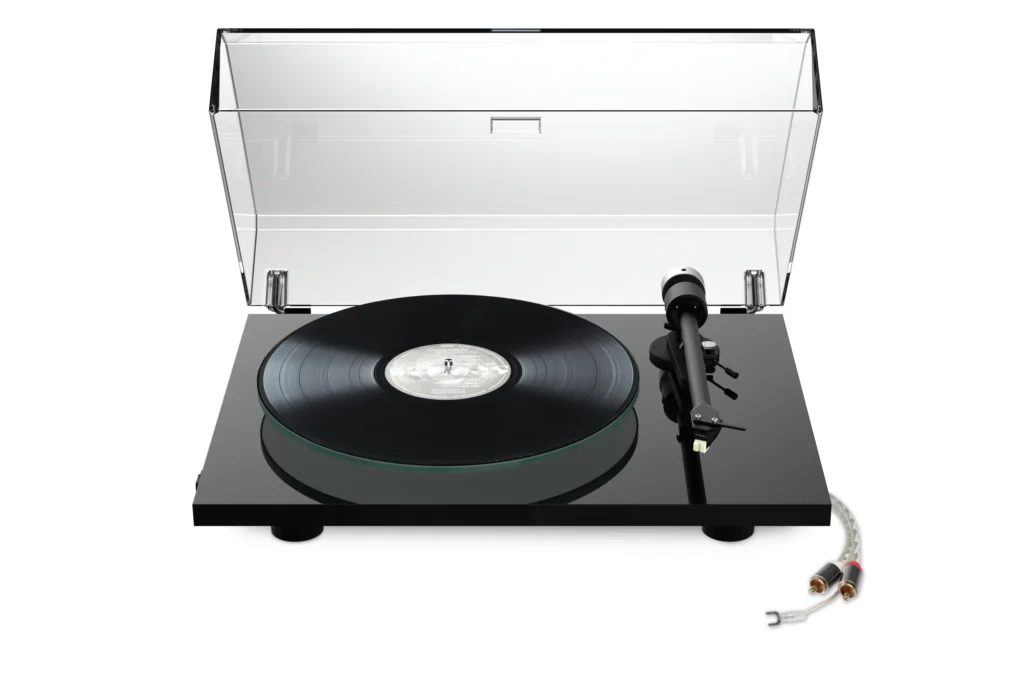
Pro-Ject T2 W addresses a specific modern vinyl problem: placing a turntable where records are convenient without requiring an ordinary analogue cable all the way to the listening system. Its network streaming is more ambitious than a simple Bluetooth transmitter, but compatibility remains central to the buying decision. It is also a conventional manual record player with a line output, so the recommendation must consider both routes. The most convincing owner has a defined compatible destination, accepts the operation of a manual deck and checks the actual stream rather than relying on the Wi-Fi badge.
Research-based review. This assessment draws on manufacturer documentation and the original published evaluations linked below. Audio Review has not performed a hands-on test of this model.
Sound quality depends on the complete playback route
SoundStage’s original evaluation finds engaging playback through the network connection, with clearer separation and space from a direct analogue route in its comparisons. Its subsequent format investigation also establishes that a lossless setting does not prove every destination is receiving lossless audio. Those findings support a useful convenience product, with a reason to audition the actual connection.
For a buying comparison, use the same record and comparable playback levels. Start with a central voice and a few instruments, then move to a denser arrangement. Decide whether the streaming route preserves enough musical interest for the intended room. A small difference noticed when rapidly switching inputs may matter less than the ability to place the record player comfortably. Conversely, someone purchasing mainly for a fixed listening position should not pay for networking without considering an ordinary wired alternative. The important comparison is between complete working arrangements. An unfamiliar speaker, different phono stage or altered cartridge can overwhelm a conclusion attributed only to wireless transmission.
Lossless support needs an exact endpoint check
The manufacturer distinguishes a compressed stream from FLAC streaming to selected compatible equipment. Its FAQ also explains a secondary stream for systems outside the ordinary UPnP route. These are different arrangements rather than one universal wireless input.
Before ordering, identify the full model name of the intended receiving device and its current software. Ask the manufacturer to confirm the specific route if documentation does not settle the question. During the return period, inspect a format display where one exists and try reconnection after both products have been switched off. Do not assume that an enabled option on the turntable proves the receiver’s capability. An owner satisfied with the compressed route may find this straightforward, but that should be a deliberate purchase. Someone requiring a particular lossless format should establish it before building the system around this model. Treat brand-level compatibility lists as starting points for a precise check rather than a promise about every generation or product from that company.
Multiroom convenience is different from synchronised playback
Pro-Ject explicitly notes that receiving devices buffer network streams differently. SoundStage’s original trial encounters a substantial mismatch between two systems. That is a meaningful limitation when adjacent rooms can be heard at once.
Define the intended use before paying for distribution. Sending music to an isolated study is not the same task as playing through an open living area with several independent receivers. Test from the actual rooms and listen where their sound overlaps. Check the delay between lowering the stylus and hearing the start, too. A system can work reliably while still responding more slowly than an analogue cable. Avoid judging a brief pause as proof of a fault without considering buffering. At the same time, do not accept an audible timing mismatch if synchronised playback is essential. A compatible single destination is the clearer brief. Whole-home use should be evaluated as a complete network arrangement, with the desired behaviour demonstrated rather than inferred from the ability to discover several devices.
The built-in phono stage defines the wired connection
T2 W’s phono stage remains engaged; the original review confirms that its RCA output is line level. This is useful for a suitable powered system or amplifier input, but it is not a separate raw cartridge output for an external phono upgrade.
Use an appropriate line input and confirm the receiving equipment’s input selection before playback. Do not add another phono stage simply because the source is a turntable. If the existing amplifier has both types of input, the distinction is important. Someone who already owns an expensive phono preamplifier should consider whether this arrangement fits the intended system. The integrated route reduces the number of boxes for a new owner, while an enthusiast wanting to experiment with several phono stages may prefer a different deck. Assess convenience over the expected period of ownership. A feature that simplifies the initial connection can also define the limits of a future upgrade plan. Buying around the actual output is more useful than assuming every turntable offers the same switching options.
Manual operation remains part of the ownership experience
Electronic speed selection does not turn T2 W into an automatic record player. Its arm still requires the ordinary manual listening routine. The reviewed package also calls for a properly level support rather than relying on height-adjustable feet to correct the furniture.
Choose a position with enough space for the cover and comfortable access to the arm. Keep it away from an unstable surface or a loudspeaker that makes the furniture vibrate. Establish the correct assembly and cartridge settings from the supplied documentation, checking the actual local cartridge package rather than an unrelated retail photograph. Anyone sharing the system should be comfortable cueing and returning the arm. Network playback may make the destination feel remote, but the record still needs attention at the source. If the main goal is unattended end-of-side operation, compare an automatic alternative before spending on streaming. The right arrangement is one that the intended owner enjoys using repeatedly, including changing and storing records, rather than simply admiring the connection list.
Value comes from solving a real placement problem
The strongest reason to choose T2 W is a practical network requirement. Its integrated approach can be attractive when a direct analogue run is awkward and the receiving equipment has been checked. It is less obvious value when the ordinary wired route already works comfortably.
Price the whole arrangement, including any receiver or supporting equipment required to make it behave as intended. Avoid adding a streamer just to rescue an assumption made before checking compatibility. Ask whether the same budget would improve the cartridge, loudspeakers or placement more usefully in a simpler system. That is a buying question rather than a universal argument against networking. A neat solution used every day can be worth more than a theoretically purer arrangement that makes records inconvenient. The purchase becomes persuasive when format support, reconnection, delay and daily manual operation have all been tried. It becomes speculative when the owner is paying for a collection of possibilities without identifying the destination and routine that matter most.
Alternatives to consider
Technics SL-1500C: SL-1500C is a useful alternative when a more conventional direct-drive system and end-of-side convenience are priorities. Compare the complete cartridge and phono arrangement rather than the drive mechanism alone.
Rega Planar 3: Planar 3 provides a manual belt-drive comparison. Include the exact fitted cartridge, required phono equipment and the practical daily routine when judging the price difference.
Pro-Ject T2 W key specifications
- Drive
- Manual belt drive
- Speeds
- Electronic 33⅓ / 45 rpm
- Tonearm
- 9-inch aluminium
- Platter
- 10 mm glass, approximately 1.7 kg
- Cartridge package
- Sumiko Rainier in original evaluated package; verify local supply
- Phono stage
- Integrated MM, always engaged
- Analogue output
- RCA line level
- Network
- Wi-Fi 2.4/5 GHz and Ethernet
- Stream formats
- Compressed MP3 or 24-bit/48 kHz FLAC on selected compatible endpoints
- Bluetooth
- BLE setup; not a Bluetooth music transmitter
- Size / weight
- Approximately 465 × 135 × 347 mm / 5.5 kg
Verdict
T2 W is a thoughtful option for a vinyl system with a verified network destination. Its wired route remains useful, while endpoint-specific lossless support, buffering and the fixed phono stage shape the recommendation. Compare the complete working system, not merely its wireless label. Buy it when network placement solves a genuine problem and the manual record-playing routine is welcome.
Documentation and original reviews
Pro-Ject official T2 W specifications and compatibility FAQ · SoundStage Simplifi original T2 W evaluation and format investigation
Editorial record
Sources and updates
Product specifications and factual claims were checked against Official Pro-Ject T2 W product page ↗. Scores and buying advice follow our category-specific editorial methodology.
- Published
- November 17, 2026
- Last updated
- November 17, 2026