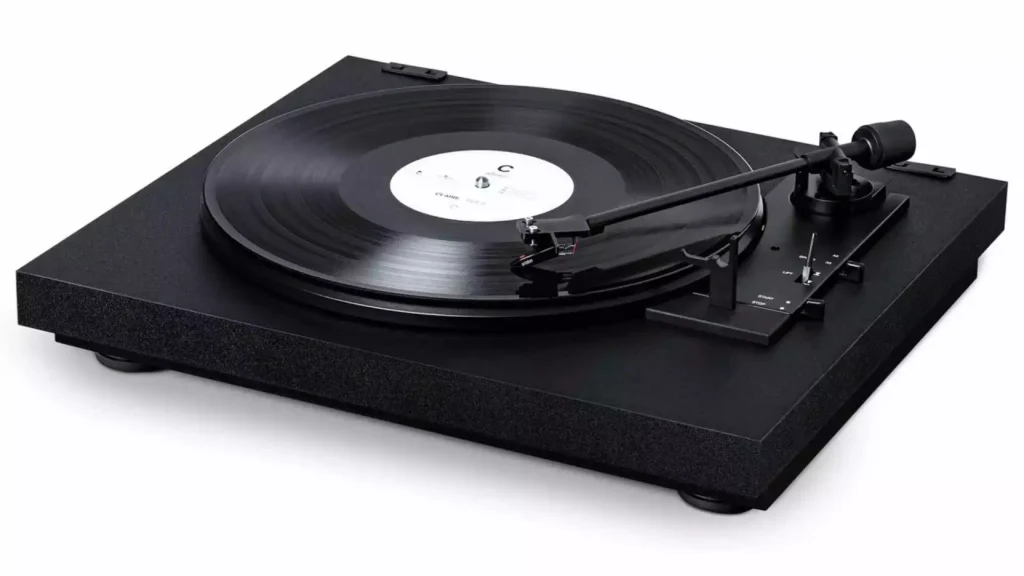
Pro-Ject Automat A1 puts daily convenience ahead of the usual assumption that a serious record player must do everything manually. The original model combines automatic playback with an already fitted OM10 cartridge and a switchable phono stage. Those choices can make an ordinary vinyl system easier to start and share. They do not eliminate every setup consideration, or mean the original A1 and newer A1.2 are identical products. This assessment concerns the original version and asks whether its practical benefits justify the compromises in finish, flexibility and ultimate musical scale.
Research-based review. This assessment draws on manufacturer documentation and the original published evaluations linked below. Audio Review has not performed a hands-on test of this model.
A coherent musical result is the starting attraction
Stuff’s original listening assessment favours the A1’s timing, vocal communication and bass punch, while finding limited dynamic reach and a restrained upper end. That evidence supports an enjoyable ordinary listening brief rather than a claim to reproduce every large-scale change with authority.
Audition a familiar rhythm-led record and then something with quieter detail and a stronger climax. Listen for whether the music stays interesting at the intended volume. A turntable that keeps the beat and communicates a voice can be satisfying without sounding spectacular in a short demonstration. At the same time, an owner who values orchestral scale or explosive contrasts should compare carefully before paying mainly for automation. Avoid making the comparison through different speakers or with a heavily upgraded cartridge on just one deck. The actual supplied package is the sensible starting point. Establish that it is enjoyable before planning changes, since a convenient product loses much of its value if the owner immediately wants to replace the parts that define its basic balance.
Automatic playback helps ordinary shared listening
The mechanism starts playback and returns the arm at the end of the side. Pro-Ject describes the automatic linkage as disengaged during playback. The useful ownership benefit is the routine itself rather than a promise that automation improves every aspect of sound.
Try the controls in a shop or during the return period. The person who will use the record player most should understand starting, stopping and safely handling a record. Keep a clear area around the arm and avoid interrupting its movement. Convenience is particularly valuable in a shared room where some listeners do not enjoy manual cueing. It can also encourage owners to play complete sides more often. However, it does not make a record player maintenance-free, nor remove the need to inspect a damaged stylus or dirty record. Think about how the unit will be used after the novelty has passed. Its appeal is a predictable everyday process, with less need to intervene at the end, rather than an elaborate set of controls to master.
Record size and speed are separate questions in a collection
AUDIO’s comparison explains that the original A1 associates automatic placement with the common 12-inch 33 and 7-inch 45 formats. A 12-inch record cut at 45 rpm needs the appropriate manual starting routine. Stuff also identifies this as a limitation worth checking.
Look through the records likely to be played before choosing an automatic deck. A collection of ordinary LPs and singles may fit the intended routine naturally. A collection containing unusual diameters, audiophile 45 rpm LPs or other exceptions deserves a demonstration with those actual formats. Do not force the arm to compensate for a misunderstood setting. Ask the dealer to show the approved operation and follow the supplied instructions. This is not a reason to reject automatic playback universally; it is a reason to distinguish this implementation from models with a separate size selector. The best choice is the one whose ordinary routine fits the collection. A small inconvenience repeated on many favourite records can matter more than an attractive feature list.
The switchable phono stage simplifies some systems
The original A1 includes a phono preamplifier that can be switched out. Stuff finds its switch inconveniently located beneath the platter. The feature therefore offers useful system choice, but frequent switching is not as easy as reaching a clearly exposed rear control.
Decide the normal connection during installation. A line input needs the internal stage engaged; a suitable external phono arrangement requires the appropriate bypass selection. Confirm the intended path before raising the volume. For a simple first system, the built-in stage can avoid an extra purchase. For an owner with existing phono equipment, bypassing it preserves a conventional route. Neither arrangement proves that one is automatically superior. Compare with level and supporting equipment controlled if an upgrade is being considered. Someone planning to alternate repeatedly between systems should also assess access to the switch. A feature that is easy to set once may be inconvenient to change every day. Evaluate that practical distinction alongside the number of inputs and boxes needed in the room.
The original fitted package deserves its own identity
Pro-Ject’s original information specifies the OM10, light aluminium arm and damped aluminium platter. This review does not transfer changes from the later A1.2 onto that package. A similar family name is insufficient evidence that an older listing contains newer hardware.
Check the actual model label, cartridge and condition before purchase, especially with remaining stock or used equipment. Ask whether the stylus is original, how long it has been used and whether the correct protective materials and packaging remain. A fitted cartridge reduces some initial work, but it is still sensible to verify the setup after transport. Follow the instructions for the supplied configuration rather than experimenting with unsupported adjustment. If replacement parts are likely to be needed, confirm availability and price first. An inexpensive older example is attractive only when it works correctly and does not immediately require costly remedial work. The model’s identity and condition are more useful buying information than a listing that combines photographs and specifications from several generations.
Convenience should be part of the value calculation
The original evaluation is less enthusiastic about the A1’s finish than its musical coherence. That makes it important to buy for function and listening satisfaction rather than expecting luxury construction at an approachable price.
Compare the current complete cost with alternatives that provide the required daily operation. Include any phono stage, cartridge work and delivery setup that must be bought separately. Then consider which tasks the owner actually wants to perform. A manual model may devote more of the budget to another priority, while the A1 can make more sense when automatic start and return encourage frequent listening. Neither result follows from the brand alone. Look at the controls from the usual seat and support position, check the space for the cover, and try several records before deciding. The strongest purchase is an intact original package that is pleasant to use as supplied. It is less convincing when immediate upgrades or awkward format exceptions erase the simplicity that motivated the choice.
Alternatives to consider
Technics SL-1500C: SL-1500C is a useful alternative when a more conventional direct-drive system and end-of-side convenience are priorities. Compare the complete cartridge and phono arrangement rather than the drive mechanism alone.
Rega Planar 3: Planar 3 provides a manual belt-drive comparison. Include the exact fitted cartridge, required phono equipment and the practical daily routine when judging the price difference.
Pro-Ject Automat A1 key specifications
- Version
- Original Automat A1, not A1.2
- Drive
- Fully automatic belt drive
- Speeds
- Electronic 33⅓ / 45 rpm
- Cartridge
- Factory-adjusted Ortofon OM10
- Arm
- 8.3-inch ultra-light aluminium
- Headshell
- Carbon-reinforced polymer
- Platter
- Damped aluminium
- Phono stage
- Integrated, switchable
- Connection
- Attached RCA lead in original evaluated unit
- Automatic drop
- Standard 12-inch 33 and 7-inch 45 arrangement; use appropriate manual routine for other combinations
- Size / weight
- Approximately 430 × 130 × 365 mm / 5.6 kg
Verdict
The original Automat A1 is a sensible shortlist option for straightforward automatic vinyl playback. Its OM10 package, internal phono choice and coherent musical evidence are appealing, with limits in finish and dynamics. Check record-format operation and distinguish it from A1.2 before ordering. It earns its place when everyday convenience matters more than extensive adjustment or a premium appearance.
Documentation and original reviews
Pro-Ject official original A1 product information · Stuff original Automat A1 evaluation · AUDIO original TD101A comparison explaining A1 record-size operation
Editorial record
Sources and updates
Product specifications and factual claims were checked against Official Pro-Ject Automat A1 product page ↗. Scores and buying advice follow our category-specific editorial methodology.
- Published
- November 17, 2026
- Last updated
- November 17, 2026