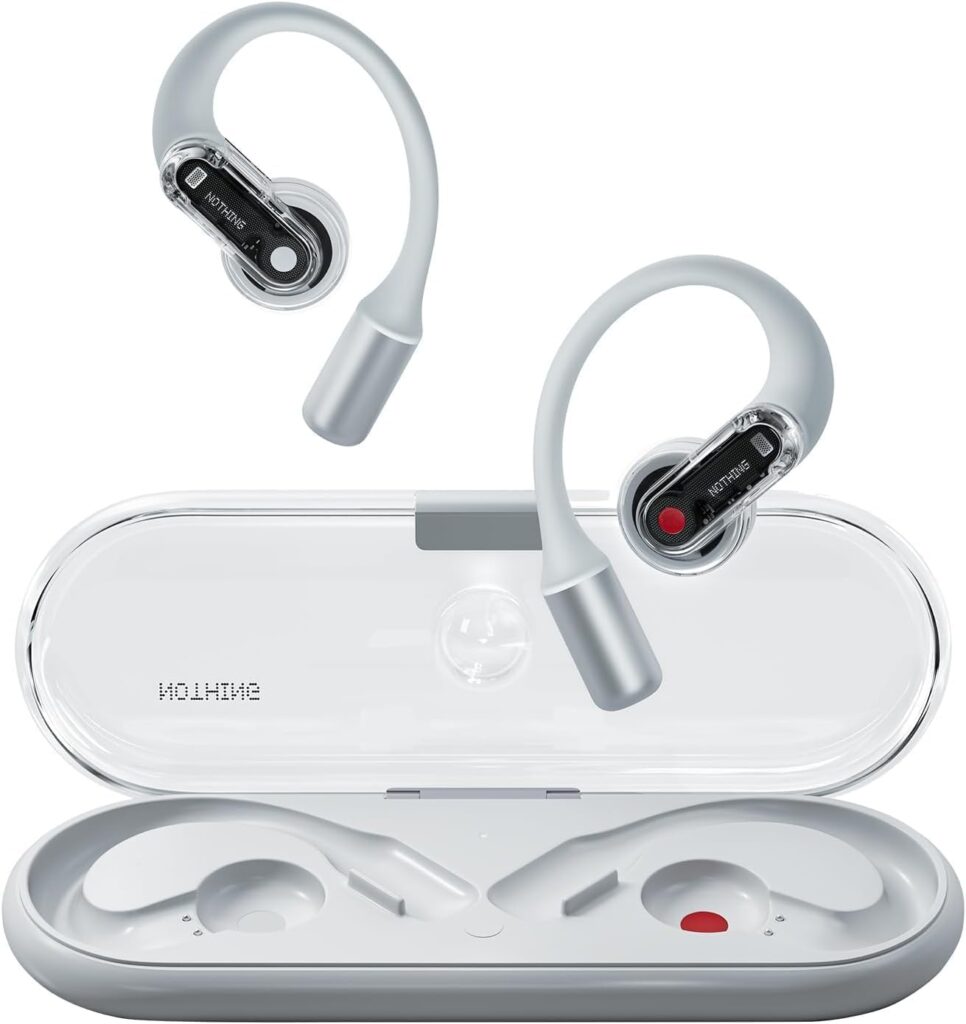
Nothing Ear (open) puts the speaker outside the ear canal and uses a flexible hook to keep it in place. Its purpose is to combine music with natural awareness of the room or route around you. It should therefore be judged against other open-ear products, not marked down merely for failing to behave like a sealed commuter earbud. The more useful questions are comfort, consistency of positioning and how well the sound remains enjoyable when the surroundings are audible.
Research-based review. This assessment draws on manufacturer documentation and the original independent evaluations linked below. Audio Review has not performed a hands-on test of this model.
An open speaker, not bone conduction
The official specification describes a 14.2 mm dynamic driver and an 8.1 g earbud. This is air-conduction playback near the ear opening, rather than a bone-conduction transducer or a sealed in-ear nozzle. Bluetooth 5.3, SBC and AAC are documented. The official FAQ separately confirms that LE Audio is not supported, despite Bluetooth LE terminology on the wider product page.
That distinction helps avoid a mistaken compatibility purchase. A Bluetooth version number does not guarantee every newer audio profile. If your source requires a specific hearing-assistance or broadcast-audio function, confirm it explicitly rather than inferring it from 5.3. For ordinary phone playback, the more immediate concern is whether the hook places the speaker consistently near your ear without competing with glasses or becoming uncomfortable.
Sound quality within the open-ear brief
SoundGuys’ original evaluation is notably positive about the Ear (open) relative to other open-ear models tested by that reviewer, particularly after modest EQ changes. It also reports stable wearing during exercise and useful comfort. Its call tests remain more qualified in wind. These are encouraging findings within a format that deliberately trades isolation for awareness.
Our assessment is that the product deserves consideration for podcasts, casual music and movement in reasonably manageable surroundings. It is less convincing as the only earbud for someone who spends hours beside loud traffic or on a train. A silent-room demonstration can make an open design sound more complete than it will in daily noise. Try the environment that matters before deciding how much bass and detail you can comfortably hear without raising the level excessively.
EQ and positioning should work together
Nothing X offers advanced equalisation and customisable controls. Use those tools after finding a repeatable physical position, not as a substitute for it. A small change in the distance and angle between speaker and ear can alter the perceived balance, especially when there is no seal fixing the acoustic relationship.
Begin with the default profile, then make a modest change and compare at similar volume. Avoid chasing the bass weight of a sealed earbud through large boosts. The open format has different limits, and a louder low end can reduce available headroom without overcoming the room noise. Save a useful everyday preset and return to it after experimentation. A good open-ear experience should remain simple enough to enjoy during a walk or routine task.
Awareness and privacy are separate issues
The official FAQ confirms there is no ANC. Ambient sound remains audible naturally rather than being recreated by a transparency microphone mode. That can be convenient when someone speaks to you, but awareness still depends on music level and attention. An open ear is not a guarantee that every important event will be noticed.
It also does not guarantee that nobody nearby can hear your playback. Nothing describes a system intended to reduce outward leakage, but perfect privacy should not be assumed in a quiet room. If spoken content is sensitive or someone beside you needs silence, check the actual level audible to them or use a different format. This is a practical choice about where you listen, not merely a specification to compare with a sealed model.
Fit with glasses and during movement
The hook needs to share space behind the ear with glasses, hair and possibly a hat. Try the combination you use every day. A product that sits securely without glasses can behave differently once the arm of a frame changes its position. Check both ears, because anatomy and preferred placement may not be symmetrical.
For exercise, confirm that the speaker does not move far enough to change the sound as you look down or turn your head. Do not infer universal stability from the original review’s successful fit. If the hook presses on a sensitive area, a clip-style alternative may suit you better. The useful advantage of this design is comfortable repeatability, so a persistent pressure point is a reason to compare another product rather than forcing a supposedly correct position.
Dual Connection, controls and calls
Dual Connection is available through the relevant phone settings or Nothing X. It supports a two-source routine, but should be tested with the applications you actually use. A laptop can keep an audio session open after playback stops, delaying the expected switch back to the phone. Multipoint does not mean two independent streams are mixed together.
Pinch controls can be convenient during movement, provided the gesture does not disturb the fit. Assign the controls around your routine and practise with the screen out of sight. For calls, test the actual microphone result in wind and your normal work environment. Noise reduction for the microphone is a different function from ANC for the listener; a claim about clearer speech does not mean surrounding noise will disappear from your own ears.
Battery, charging and resistance
Nothing claims eight hours of music from the buds and thirty hours including the case under its stated AAC, half-volume test conditions. Its separate support page explains those conditions. SoundGuys’ cited article does not provide a completed independent battery result, so the claim should remain labelled as a manufacturer figure. Calls and different settings can change the practical runtime.
The case charges by USB-C and has no wireless charging. Both earbuds and case are rated IP54, which is useful against dust and splashes but not a swimming specification. Let wet components dry before charging and keep contacts clean. The relatively wide case should also be checked against your usual pocket. A thin profile can look compact in a photograph while its width remains inconvenient in a small pocket or running belt.
Alternatives to consider
Shokz OpenFit 2: OpenFit 2 is a relevant hook-style comparison. Try both with glasses and your usual movement, then compare sound at a similar level in a realistic environment rather than judging the open-ear category only in a silent shop.
Bose Ultra Open Earbuds: Bose uses a different attachment method that may suit ears or glasses differently. Compare long-session comfort and the current price premium; neither open format should be bought as a substitute for sealed ANC when isolation is the main requirement.
Nothing Ear (open) key specifications
- Design
- Open-ear air-conduction with flexible hooks
- Driver
- 14.2 mm dynamic
- Earbud weight
- 8.1 g each
- Bluetooth
- 5.3
- Codecs
- SBC and AAC
- Multipoint
- Dual Connection via settings or Nothing X
- Claimed music battery
- Up to 8 h; 30 h with case
- Ingress rating
- IP54 earbuds and case
- Charging
- USB-C; no wireless charging
- ANC
- None
- LE Audio
- Not supported, official FAQ
Verdict
Nothing Ear (open) is a well-supported open-ear shortlist option, with encouraging original-review findings and useful EQ, controls and two-device connectivity. It makes the most sense when hearing the surroundings is a positive requirement and the hook fits comfortably with your normal accessories.
Compare Shokz OpenFit 2 for another hook approach and Bose Ultra Open for a different attachment method. Choose the Nothing when its fit, current price and app features work together in your real environment. Keep a sealed alternative in mind for noisy travel, because no amount of feature comparison changes the central open-ear trade-off.
Primary documentation and independent reviews
Nothing official Ear open product information · Nothing official Ear open battery conditions · Nothing official ANC clarification · Nothing official LE Audio clarification · Nothing official wireless charging clarification · SoundGuys original Ear open evaluation
Editorial record
Sources and updates
Product specifications and factual claims were checked against Official Nothing Ear (open) product page ↗. Scores and buying advice follow our category-specific editorial methodology.
- Published
- November 17, 2026
- Last updated
- November 17, 2026