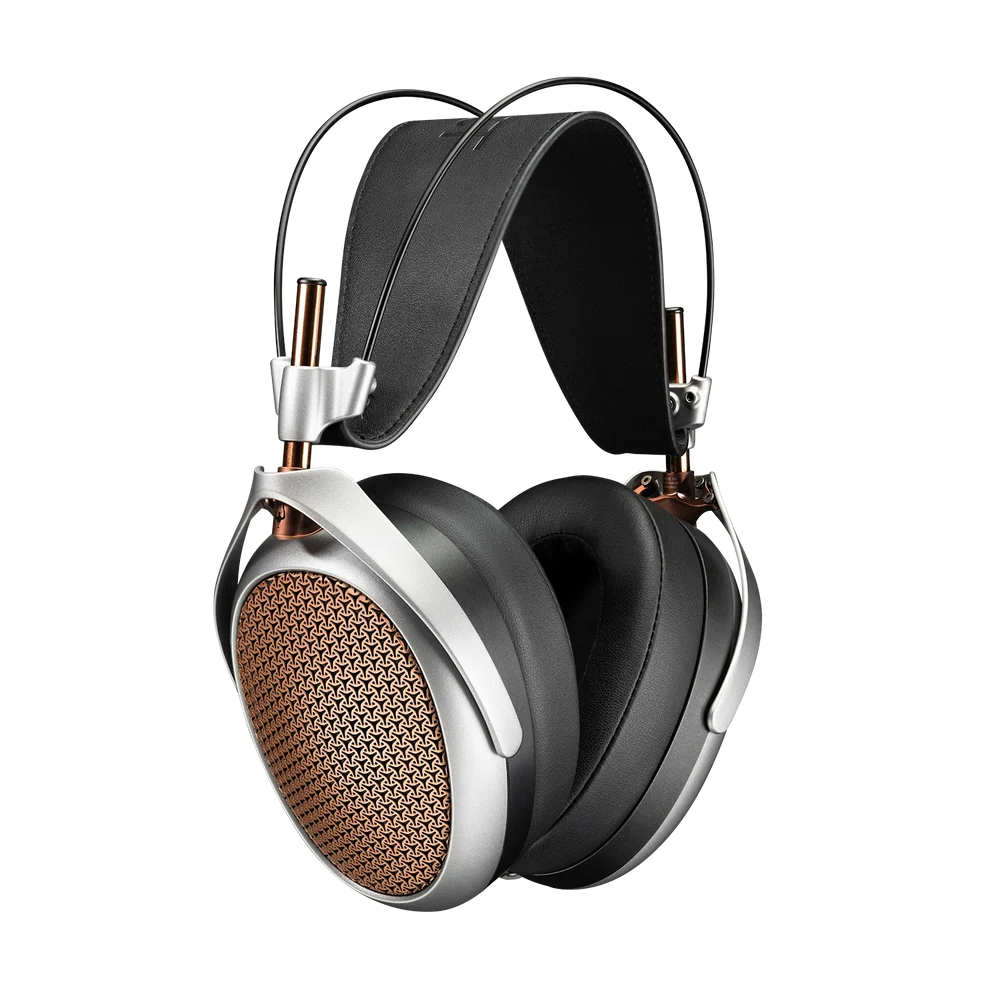
Meze POET is a premium open-back planar headphone for a dedicated home listening space. Its construction and presentation make it an object an enthusiast may want to keep for years, but its price also raises the standard of the buying decision. The published evidence is more qualified about the out-of-box sound than the luxurious positioning might suggest. A convincing purchase therefore starts with fit and tonal preference, rather than assuming that costly materials guarantee your ideal balance.
Research-based review. This assessment draws on manufacturer documentation and the original independent evaluations linked below. Audio Review has not performed a hands-on test of this model.
The MZ6 design and the complete package
Meze specifies a Rinaro MZ6 planar magnetic driver, a 55-ohm nominal impedance and 405 g weight. Dual 3.5 mm connectors take the supplied 2.5-metre lead, which ends in a 6.3 mm source plug. Magnetic ear pads, a cable pouch and a rigid case complete the package. These are practical details for a headphone intended to live near a listening chair or desk.
The planar label describes the driver approach, not an automatic hierarchy over every dynamic design. The finished acoustic balance, fit and source arrangement still determine whether the headphone works for you. Nor does an expansive published frequency range establish what you will hear in ordinary music. Treat engineering specifications as information for system planning, and reserve the musical judgment for a careful comparison at a comfortable level.
Comfort and the weight question
A suspended headband can distribute pressure, while deep pads can keep the ear away from the inner surface. Neither feature makes total mass disappear. With the POET, the stated 405 g weight is substantial enough that a brief fitting is not an adequate substitute for a realistic listening session.
SoundGuys finds the design comfortable in important respects but also notes the implications of its weight. Our advice is to sit as you normally listen, including looking down at a tablet or turning toward a screen. Check whether the position remains stable and whether the neck feels relaxed. If you only enjoy the fit while reclining in one exact posture, decide whether that is truly how the headphone will be used most evenings.
Sound quality and independent reservations
SoundGuys’ original evaluation considers the POET enjoyable in some respects but questions the out-of-box balance and value at this price. Its reviewer finds equalisation worthwhile and the power requirements relatively manageable. This is a more cautious assessment than the manufacturer’s musical description, and it should be visible in a buying recommendation.
Our editorial view is that the POET is best approached as a preference-led enthusiast purchase. An appealing design and a particular tonal character can be valid reasons to buy, provided the compromise is understood. They do not establish that the headphone is the most accurate or cost-effective choice. If a large part of the audition is spent wishing the sound were different, compare alternatives before treating a future EQ project as a reason to ignore that response.
EQ as an option rather than a rescue plan
Equalisation can adapt a headphone to a listener’s preference, and software makes that possible without replacing hardware. Start with broad, conservative changes and allow headroom so boosts do not clip the signal. Compare with the original setting at similar apparent volume, because an increase in level can masquerade as a tonal improvement.
For the POET, decide whether EQ fits the entire listening routine. A setting on a desktop player may not follow you to another source or streaming device. If the headphone will be shared, someone else may not want the same correction. Save presets clearly and keep a simple bypass available. Personalisation is useful when it remains convenient; it becomes less useful when the preferred presentation exists only in a complicated configuration you rarely activate.
Choosing an appropriate source
A premium headphone does not necessarily require a premium-priced amplifier. Begin with a clean low-output-impedance headphone stage that reaches your preferred listening level with room to adjust. SoundGuys specifically cautions about high-output-impedance sources with this model. Check the electrical match before assuming every older amplifier is an equally suitable partner.
The supplied larger jack suits many home components, but compact devices may need an appropriate adapter or alternative cable. Match connector wiring correctly and avoid forcing a plug into a socket that merely looks similar. A balanced output is not mandatory for stereo listening. Buy another cable or amplifier for a connection, level-control or noise problem you can identify, rather than treating the total price of the system as proof of musical quality.
Living with an open luxury headphone
An open enclosure belongs in a room where outside sound and outward leakage are acceptable. The POET does not become a commuter ANC headphone through a different source setting. A separate portable pair can be the simpler solution when the rest of the day involves travel or shared offices.
Think about storage and handling as part of the home setup. A stable stand should support the headphone without stretching the suspension unnecessarily, while a case keeps dust away when it will not be used for a while. Keep magnetic pads and their mating surfaces clean, and follow the manufacturer’s handling guidance. Replacement parts and local service arrangements deserve attention before purchase, particularly when importing a costly product from another market.
Value within Meze and beyond it
The less expensive 109 Pro is a meaningful comparison because it challenges how much of the POET appeal comes from the complete ownership experience. The higher-tier Empyrean II addresses a different spending level, but should not distract from the basic question of whether the POET already sounds and fits right. Comparing only increasingly expensive products can obscure a better-value match below them.
Use the same tracks and similar level when auditioning, then revisit a familiar pair before deciding. Consider how many hours the new headphone will actually be worn and whether its weight or need for personalisation limits that use. Resale assumptions are uncertain, so the strongest justification is daily satisfaction with the product itself. A beautifully built headphone that stays in its case is poor value for its owner regardless of its reputation.
Alternatives to consider
Meze Empyrean II: The Empyrean II is the relevant higher-tier family comparison. Audition it for fit and tonal preference, but do not assume moving farther up the range is the answer if the POET already needs substantial adjustment to suit your taste.
Meze 109 Pro: The 109 Pro offers a less costly Meze home-listening route using a different driver approach. It is an important check on whether the planar construction and ownership appeal of the POET provide enough additional benefit for your particular listening routine.
Meze POET key specifications
- Design
- Open-back, circumaural planar magnetic
- Driver
- Rinaro Isodynamic Hybrid Array MZ6
- Nominal impedance
- 55 ohms
- Sensitivity
- 101 dB SPL/mW at 1 kHz, manufacturer claim
- Weight
- 405 g
- Headphone connectors
- Dual 3.5 mm TS jacks
- Supplied lead
- 2.5 m copper cable with 6.3 mm source plug
- Pads
- Magnetically detachable
- Included storage
- ABS case and cable pouch
- Wireless and microphone
- None
- Frequency response
- 4 Hz–96 kHz (manufacturer specification)
Verdict
The Meze POET has a clear audience: an enthusiast who values its construction, enjoys its particular presentation and has a quiet place to listen. Magnetic pads, a useful case and a straightforward analogue connection support that ownership role. The independent reservations about tuning and value prevent an unconditional recommendation on sound alone.
Audition it over time, compare the 109 Pro and Empyrean II, and establish whether your preferred setup includes EQ. Choose it when the complete combination is satisfying at the price you will pay. If the appeal is mostly visual while the sound or weight remains troublesome, another model is the better purchase. Premium positioning should sharpen that decision, not make the compromises less visible.
Primary documentation and independent reviews
Meze official POET specifications and package · SoundGuys original POET evaluation and measurements · Meze official POET design information
Editorial record
Sources and updates
Product specifications and factual claims were checked against Official Meze POET product page ↗. Scores and buying advice follow our category-specific editorial methodology.
- Published
- November 17, 2026
- Last updated
- November 17, 2026