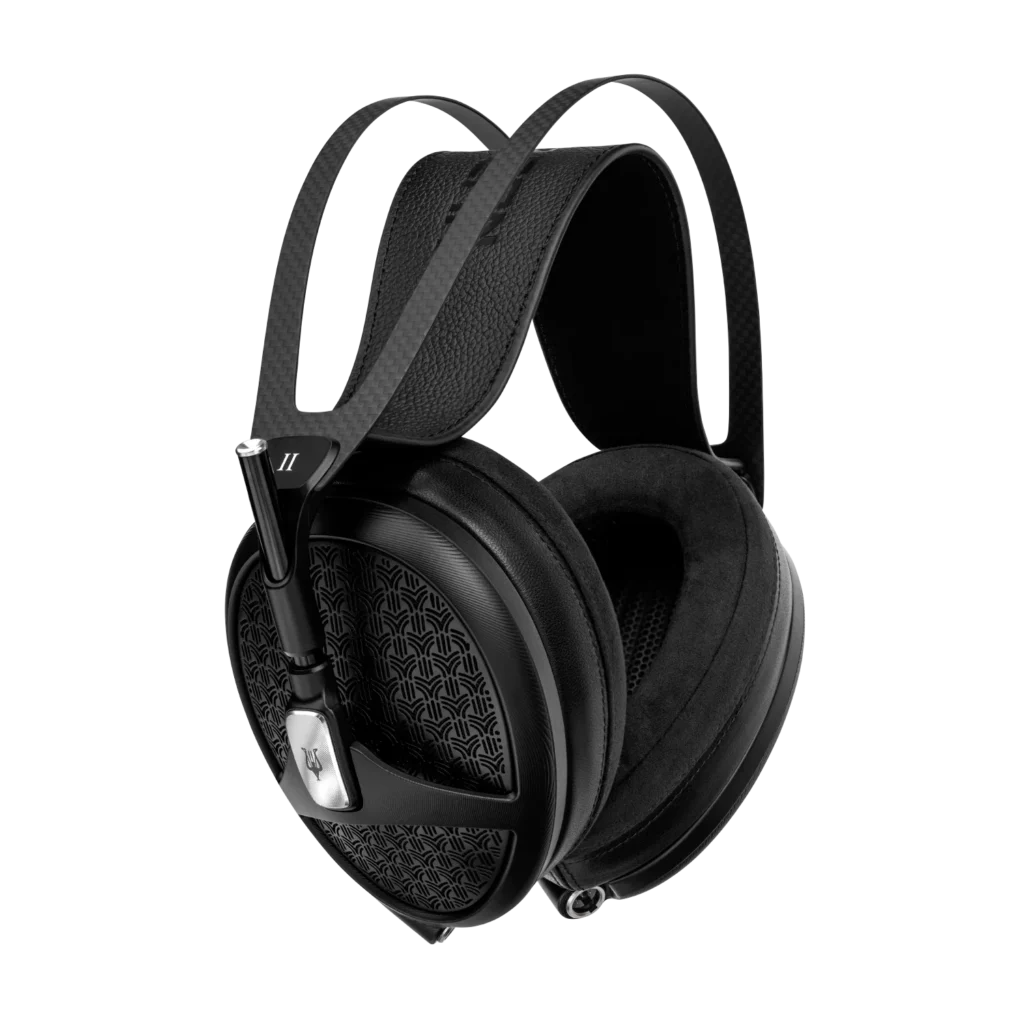
The Meze Empyrean II puts physical comfort and craftsmanship unusually close to the centre of the high-end headphone conversation. Its appeal is a complete listening experience: a sophisticated planar driver, a carefully supported fit and interchangeable pads that let the owner make a meaningful choice about presentation. The question is whether those benefits justify a substantial premium over more utilitarian headphones.
Meze Empyrean II — Design and construction
Meze uses Rinaro’s MZ3 Isodynamic Hybrid Array driver in an open enclosure. That architecture is distinctive, but the driver name alone cannot settle a buying decision. A headphone is the combined behaviour of its diaphragm, magnets, damping, pads and the listener’s ears. Comparing the complete product is more useful than ranking technologies on paper.
The materials and construction are a major part of the proposition. The Empyrean II belongs on a shortlist for someone who wants equipment that feels like a long-term possession rather than an interchangeable accessory. This is also a reason to examine it in person. A premium finish can be appreciated from photographs; the relationship between pad opening, jaw and headband has to be experienced.
There is a specification trap in weight comparisons. Meze’s current product table lists 449 g, whereas earlier reviews often quote 385 g without ear pads. Those figures use different conditions. They should not be treated as evidence of an unexplained production change or compared directly with a rival weighed complete. For ownership, supported weight and pressure distribution matter alongside the number.
Comfort and pad choices
Headfonics’ original evaluation praises the comfort and identifies a substantial change from the first Empyrean’s warmer character. Its listening account describes the second generation as clearer and more incisive, with the supplied pad options making a meaningful difference. That is a useful independent reference, rather than a claim that Audio Review has repeated the comparison.
Meze provides Duo and angled Alcantara pad options. The sensible first step is to learn the stock alternatives before considering other pads or electronic changes. Keep the same music, source level and listening position while comparing them. A slightly louder presentation can seem more detailed even when the underlying change is mainly tonal.
For long sessions, check where the headband bears weight and whether the lower pad edges maintain contact when you turn your head. Glasses, hair and small changes in seating position can alter the seal. An expensive headphone should earn its place through repeatable comfort at ordinary listening levels, not through an impressive five-minute demonstration.
Sound quality
The published evidence points towards a more explicit presentation than the original Empyrean, rather than a simple cosmetic refresh. Headfonics still does not regard the tuning as completely neutral. Its account makes this especially relevant to owners who loved the first model’s enveloping warmth: the new version should be auditioned on its own terms.
For a prospective buyer, that suggests two separate questions. First, does the balance make vocals and instruments convincing? Second, does the combination of openness and detail stay enjoyable across an entire album? A headphone can make cymbals and room ambience easy to notice while drawing too much attention to them on difficult recordings. Those outcomes are personal, and a premium price does not remove the need to check them.
Bass preference deserves the same care. Acoustic texture, the impact of a kick drum and the pressure of deep electronic bass are different things. Choose familiar examples of all three rather than judging the low end from one spectacular track. If the pad choice that gives the preferred bass also changes vocal presence, evaluate that trade-off before assuming an amplifier will solve it.
The open construction is suited to a quiet room. It allows sound to escape and lets the surroundings remain audible. That can be pleasant at home, but it does not make the Empyrean II a practical answer to commuting or a shared office. Paying for a higher acoustic tier cannot compensate for an environment in which important musical information is masked by noise.
Amplification and connections
The official specification gives 32 ohms and a sensitivity of 90 dB SPL per milliwatt at 1 kHz. Low impedance on its own does not mean that every small source will provide generous headroom. Look for a clean headphone output with appropriate current capability, useful gain choices and an absence of audible noise at the intended volume.
A dedicated desktop amplifier is a sensible partner for a purchase at this level, but expenditure should follow a specific need. If the existing amplifier already reaches comfortable levels cleanly with reserve for quiet recordings, a more expensive replacement may offer less benefit than finding the right pad configuration. Avoid using maximum volume as the test of quality.
The detachable earcup connections are dual four-pin mini-XLR. Confirm the amplifier-end termination when ordering, because cable options and retail packages can differ. A balanced cable is relevant when it accesses a suitable output on the chosen amplifier; the connector format is not a promise of better sound. Never use an adapter that incorrectly ties together the active outputs of a balanced headphone stage.
Ownership and value
The strongest reason to consider the Empyrean II is the combination of acoustic ambition with comfort, serviceable parts and a premium physical design. A buyer who spends several quiet hours listening each week may reasonably value these qualities more than the person who only wants occasional analytical comparisons.
The financial case is weaker if this is the first serious headphone in the system. Establishing the preferred tonal balance with less expensive equipment can prevent a very costly mismatch. A return window or an extended dealer audition has particular value here. Compare at matched levels and give yourself time to stop analysing equipment and listen to the music.
Ask the retailer about replacement pads, cable availability, warranty handling and the exact supplied accessories. These practical details influence the cost of keeping a headphone in service. Also consider the listening location: leaving an open headphone beside a noisy gaming computer or television undermines the reason for buying it.
For mixing or recording, the Empyrean II can be one reference among several, but its luxury status does not make it a universal studio standard. Open leakage limits microphone work, and unfamiliar headphones require time to learn. For leisure listening, the simpler test is whether its fit and balance make you want to finish more albums.
Alternatives to consider
Sennheiser HD 600: A much less expensive open dynamic reference that helps establish how much the Empyrean’s complete luxury package matters to you.
Audeze LCD-X: A contrasting planar option worth comparing for fit, tonal balance and the practical demands of extended sessions.
HiFiMAN Sundara: A useful reminder of what a more affordable open planar can offer before committing to a luxury model.
Meze Empyrean II key specifications
- Design
- Open-back planar magnetic
- Driver
- Rinaro MZ3 Isodynamic Hybrid Array
- Impedance
- 32 ohms
- Sensitivity
- 90 dB SPL/mW at 1 kHz
- Current listed weight
- 449 g; older 385 g figures exclude pads
- Earcup connectors
- Dual four-pin mini-XLR
- Driver dimensions
- 102 × 73 mm
- Frequency response
- 8 Hz–110 kHz (manufacturer specification)
Verdict
The Empyrean II is a compelling premium headphone for a quiet listening room when comfort, construction and an articulate planar presentation matter together. Its pad choices deserve an audition, and its price makes personal fit essential. Buy it for the complete experience rather than the expectation that price or driver technology guarantees a perfect tonal match.
Primary documentation and independent reviews
Meze Empyrean II official specifications · Headfonics original review · Headfonics sound and pad comparison · What Hi-Fi? original review
Editorial record
Sources and updates
Product specifications and factual claims were checked against Official Meze Empyrean II product page ↗. Scores and buying advice follow our category-specific editorial methodology.
- Published
- November 7, 2026
- Last updated
- November 17, 2026