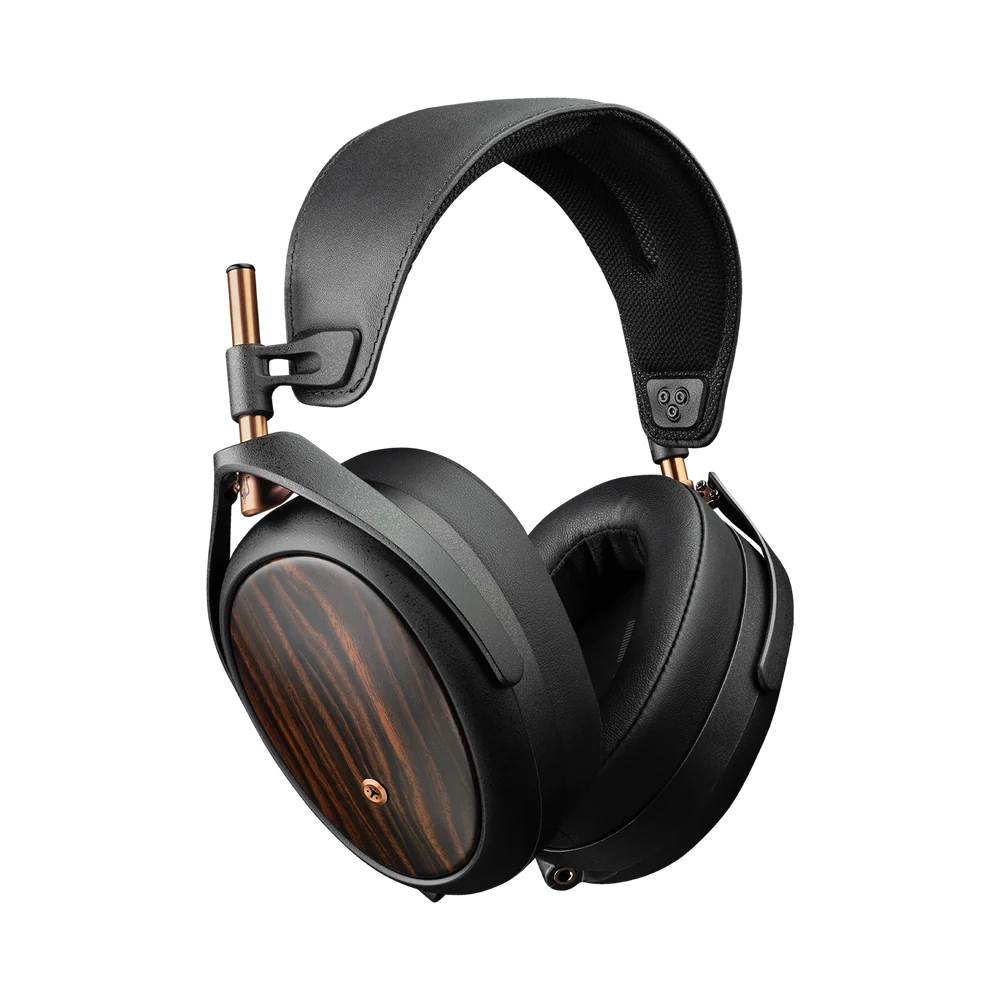
Meze LIRIC 2nd Generation is a passive closed headphone aimed at listeners who want a substantial home-quality system without the leakage of an open design. It changes more than the decoration of the original LIRIC. Revised tuning, magnetic pads and a different cable package make the generation important when comparing offers. The EU product page now marks it discontinued, so this review treats it as an established model rather than promising fresh stock or unrestricted availability.
Research-based review. This assessment draws on manufacturer documentation and the original published evaluations linked below. Audio Review has not performed a hands-on test of this model.
Identify the second generation first
The second-generation design uses Macassar ebony outer cups and Meze’s MZ4 planar driver arrangement. Its acoustic revisions include the QWRM component, which the manufacturer describes as addressing high-frequency peaks. These are useful identifiers, but they do not substitute for listening or make every recording automatically smoother.
Check the actual product, accessories and condition before comparing prices with the original LIRIC. A family name in an advertisement may conceal a different generation. On a used example, ask about pad history and whether any modifications have been made. The distinction matters because published listening observations about the second generation should not be transferred wholesale to an older pair. A good offer is one that matches the intended model and ownership expectations, not simply a low number beside a familiar brand name.
Warmth is a deliberate part of the appeal
Headfonics describes the revised presentation as fuller and more relaxed, with better coherence than the original. Its qualification is useful: energetic bass can overshadow some lighter vocals. SoundGuys also finds an appealing bassier balance while retaining a reservation about upper-range peaks.
Treat that evidence as a reason to audition familiar music. Include both sparse vocals and dense bass-heavy recordings, then check whether voices keep the prominence expected. A relaxed presentation can be very enjoyable without being a neutral monitoring reference. Someone who likes warmth may prefer it immediately, while another listener may want less low-frequency emphasis. Compare at similar loudness and leave time to judge an entire album. The important outcome is sustained enjoyment with the real library, rather than deciding from one flattering demonstration track or a suggestion that all planar headphones sound alike.
Closed does not mean active cancellation
The LIRIC is closed-backed and provides passive isolation. It has no active noise cancellation, Bluetooth link or stock calling microphone. Its enclosure therefore answers a different need from a battery-powered travel headset, even when both products cover the ears.
Consider the intended room and the people sharing it. A closed design can be helpful near a quiet office or another listener, but the actual seal and volume still determine what escapes. Check whether keyboard noise, nearby speech or a television remain distracting. For public transport and calls, an ANC wireless model may fit the routine better. Do not choose this expensive passive headphone on the assumption that its materials or driver technology will replace those missing functions. It makes most sense when the priority is wired music listening and a quieter room relationship than an open headphone can offer.
Magnetic pads help, but fit remains personal
Meze’s magnetic attachment makes the pads easier to remove than the original arrangement. The official weight is 427 grams. The original evaluations are encouraging about comfort and finishing, but SoundGuys also notes that the weight can matter during longer use.
Try normal eyewear and the actual listening posture. Check the crown, lower jaw area and whether both cushions seal evenly when looking down at a player. The premium finish does not ensure an identical fit on different heads. Before buying an established or discontinued model, check local access to correct pads and service. Replacement materials can affect sound as well as feel, so an inexpensive generic cushion is not necessarily equivalent. Maintenance should be considered part of the purchase rather than a problem deferred until a favourite pair has become uncomfortable or the original pads are no longer easy to obtain.
Two leads suit different source arrangements
The EU package specifies a short 4.4-millimetre cable and a three-metre conventional 3.5-millimetre lead, with adapters and a carrying case. That is a useful distinction between a portable source and a chair farther from a desktop system. Confirm the supplied package with the actual seller because regional or used bundles can differ.
Measure the cable route and identify the output socket before assuming that a balanced-looking connector is necessary. Use correctly wired cables rather than improvising an adapter between incompatible output arrangements. The official impedance and sensitivity do not by themselves demand an extreme amplifier. Check clean level on quieter tracks, background noise and a sensible volume range with the intended source. A practical connection that reaches comfortably and works quietly is more valuable than a speculative upgrade bought solely because the headphone is expensive.
Value depends on a complete offer
The published evaluations support a serious audition for someone seeking a warm premium closed planar. The current EU availability marker adds a practical qualification: remaining stock, an ex-demonstration pair and a used purchase can have different warranty and return arrangements.
Compare the complete cost, including any missing cable or replacement pads, and ask for a clear condition description. A large reduction from a historic price is not enough if the fit or presentation is wrong. Equally, discontinuation does not make a well-supported pair automatically obsolete; the passive analogue design does not rely on a battery or app subscription. The strongest case is a listener who has tried the headphone, likes its balance and can obtain suitable service. For someone primarily seeking calls, lighter weight or commuting convenience, the same budget can be spent more effectively elsewhere.
Alternatives to consider
Meze 109 Pro: A useful less expensive comparison for home listening if an open design suits the room. Judge comfort and the preferred tonal balance alongside the total system price.
Sennheiser HD 800 S: Consider this established open alternative when perceived space and long-session fit are central priorities. Compare at similar loudness rather than assuming that one driver technology must win.
Audeze LCD-X: Another serious planar option for home listening and production-oriented use. Check weight, the actual source and preferred presentation before deciding which approach suits the routine.
Meze LIRIC 2nd Generation key specifications
- Generation
- Second-generation LIRIC
- Design
- Closed-back circumaural planar
- Driver
- Rinaro MZ4 Isodynamic Hybrid Array
- Impedance
- 61 ohms
- Sensitivity
- 100 dB SPL/mW at 1 kHz
- Weight
- 427 g
- Headphone connection
- Dual 3.5 mm TS
- EU cable package
- 1.3 m 4.4 mm and 3 m 3.5 mm
- Pads
- Magnetically detachable
- Case
- Hard EVA pouch
- Bluetooth, ANC and microphone
- None
- Frequency response
- 4 Hz–92 kHz (manufacturer specification)
Verdict
LIRIC 2nd Generation has a credible published case as a refined, warmly balanced closed headphone with improved pad serviceability. It suits a listener who values wired listening and appreciates its particular presentation enough to accept the weight and investment.
Check the generation, package, comfort and current support before buying. The bass balance is an important preference decision, while the closed cups should be understood as passive isolation rather than ANC. A carefully chosen example can be rewarding without being the right answer for every premium-headphone buyer.
Documentation and original reviews
Meze official EU LIRIC second-generation specifications and package · Meze official LIRIC design and acoustic changes · Headfonics original LIRIC II design evaluation · Headfonics original LIRIC II sound and source evaluation · SoundGuys original LIRIC second-generation evaluation
Editorial record
Sources and updates
Product specifications and factual claims were checked against Official Meze LIRIC 2nd Generation product page ↗. Scores and buying advice follow our category-specific editorial methodology.
- Published
- November 17, 2026
- Last updated
- November 17, 2026