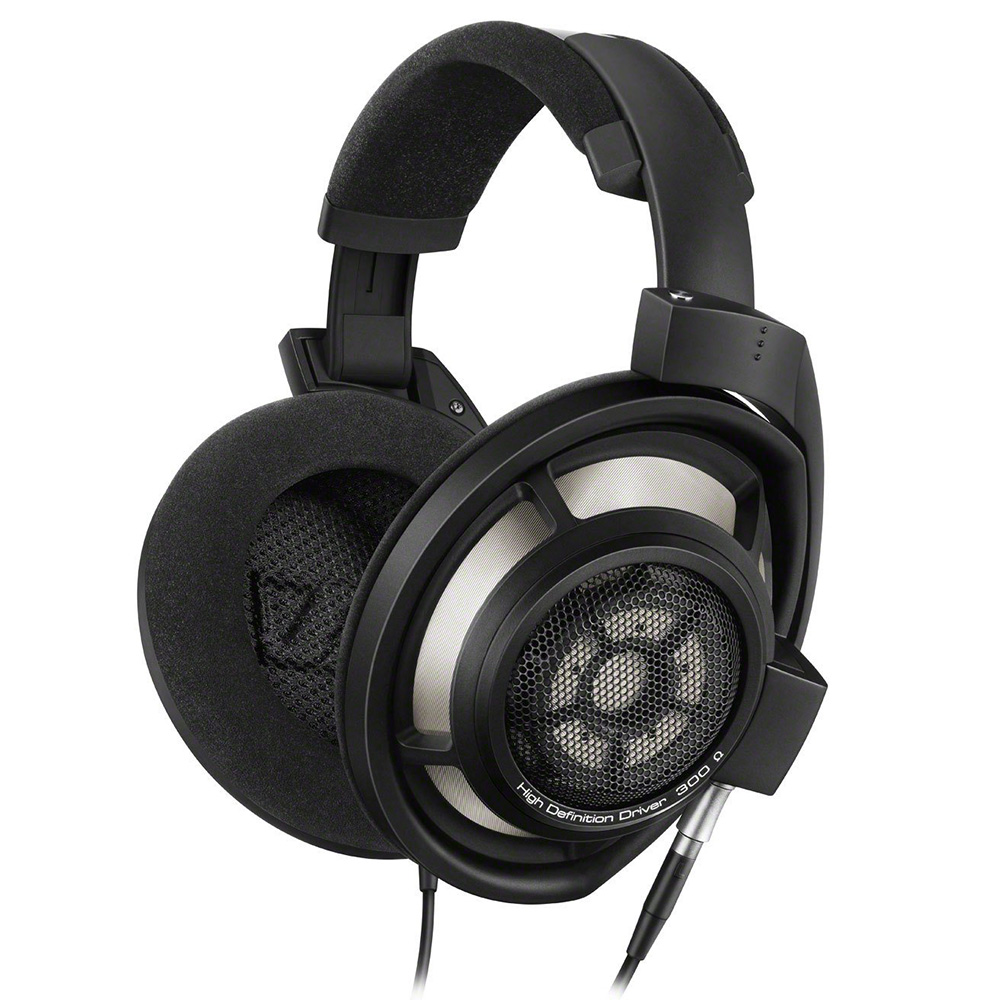
The Sennheiser HD 800 S is a specialist purchase for someone who already knows where and how they want to listen. Its large open earcups, distinctive driver arrangement and premium positioning make sense at a dedicated listening station. They make much less sense as an expensive way to solve ordinary commuting or headset requirements. The decision rests on whether its particular presentation and long-session fit justify the cost of the complete system.
Sennheiser HD 800 S — What the reference design actually offers
The HD 800 S uses a 56 mm ring-radiator dynamic driver in an open over-ear enclosure. The unusual size and arrangement are important aspects of its design, but they should not be treated as independent proof that every recording will sound more convincing. The useful question is how the complete acoustic system interacts with your ears and with the recordings you regularly play.
RTINGS identifies the headphone’s overall reproduction and consistency as strengths, while drawing attention to its limited emphasis in the deepest bass. Its review also describes the way the construction interacts with the listener’s outer ears. That evidence supports investigating the HD 800 S for a spacious, carefully organised presentation. It does not justify promising a loudspeaker-like image to every listener.
The difference matters because headphone spatial impressions are individual. A recording that produces an impressive sense of separation can still position a centrally mixed voice inside the head. Listen to a mixture of naturally recorded acoustic material and the more closely produced music you actually enjoy. Do not judge the purchase solely from a spectacular demonstration track selected to highlight one characteristic.
A clear sound case, with tonal preferences still relevant
SoundGuys gives a positive assessment of sound, comfort and maintainability, while also stressing the specialist nature of the product. Its discussion makes a useful distinction between an enthusiast listening station and a general consumer headphone. We agree with treating the HD 800 S as something to audition for its own balance and presentation, rather than assuming that a premium price makes every preference issue disappear.
An emphasis on openness and separation is not the same thing as a promise of generous low-frequency weight. If a strong sub-bass foundation is central to your listening, make that part of the audition explicitly. Test a familiar bass line at a comparable listening level and decide whether you are happy with the relationship between fundamental notes, voices and percussion. A more obvious upper range must not be mistaken automatically for more complete information.
Our assessment is especially favourable for listeners who want to examine recordings and can take time to establish a suitable setup. It is more conditional for a buyer hoping that an expensive headphone will instantly make every album sound warmer, fuller or more exciting. Those are different objectives, and another tuning can be the better purchase even when the HD 800 S is technically accomplished.
Amplification: plan the output, not the mythology
The documented nominal impedance is 300 ohms, with sensitivity quoted at 102 dB for 1 V. A source therefore needs enough clean voltage for the recordings, listening level and any processing you intend to use. Checking the output specification is more sensible than assigning a particular amplifier price to the headphone or assuming that every small source will be inadequate.
A suitable desktop headphone output provides a convenient way to obtain usable volume adjustment and headroom. If equalisation reduces the digital signal level to make room for a bass increase, additional voltage capability can become relevant. That is an identifiable system requirement. It should be separated from unsupported claims that a particular topology is necessary to unlock the headphone.
The conversion stage also deserves a practical assessment. Noise, insufficient level and unsuitable connections are reasons to investigate the source. A list of very high sample rates is not evidence that an existing converter needs replacing. Establish a reliable baseline first, then compare changes with levels matched. Otherwise the total system bill can grow without a clear account of what problem each extra component solves.
Cable connections need to match the amplifier
Sennheiser offers the HD 800 S with analogue cable facilities intended for dedicated listening equipment. SoundGuys discusses the full-size single-ended and balanced Pentaconn connection options in its review. Confirm the cables supplied with the exact regional package before ordering, especially when comparing new, older-stock and second-hand listings. A connector shown in a retailer’s photograph may not establish the contents of every bundle.
Balanced and single-ended outputs should not be connected casually through an arbitrary adapter. Use the cable intended for the amplifier’s output and the headphone’s earcup sockets, following the equipment manufacturer’s guidance. A balanced plug is not in itself a guarantee of audibly better reproduction. The immediate requirement is a correctly wired, compatible connection with sensible output capability.
For a permanent desk, think about where the cable will run and how the headphone will be stored. Large earcups and a long lead need space around a keyboard, chair or equipment rack. A tidy route reduces accidental pulling and keeps the connectors from taking unnecessary strain. Such practical details matter with a headphone intended for years of regular use.
Comfort is a reason to audition, not just a specification
The large cups are a central part of the HD 800 S experience. SoundGuys praises its long-session comfort, while noting that the pad material may not suit every glasses wearer. That combination is a useful reminder that a broadly comfortable design is not a universal fit guarantee. Check contact around the frames of your glasses and the headband pressure over a realistic session.
The physical size also means that the headphone is primarily for seated use. It is not designed as a compact accessory to throw into a shoulder bag or wear while exercising. If you need one pair to cover a listening chair, work calls, travel and outdoor activity, it is sensible to divide those tasks rather than expecting the HD 800 S to become suitable for all of them.
Cables and pads should be treated as part of the long-term ownership budget. Obtain replacement parts intended for the model, and consider the effect of pad wear when comparing a used example with a new demonstration unit. A second-hand saving needs to be judged alongside condition, accessories and the likely cost of restoring a consistent fit.
Room suitability and the cost of diminishing returns
The open enclosure offers very little isolation and leaks audio into the room. A quiet private space is therefore not merely a desirable extra: it is a practical condition for enjoying the headphone without raising the level to compete with background noise. An external microphone is also required if the system is meant to handle voice chat.
Those limitations should not be scored as surprises, but they are still reasons for some buyers to look elsewhere. A much less expensive closed or wireless headphone can do a better job on a train or beside another person trying to work. The correct comparison starts with the job, then asks how well the HD 800 S performs it.
At this level, value is about a particular preference rather than a proportional increase in enjoyment for every extra euro. Compare current European prices, the warranty route and the cost of the complete source chain. An audition against a well-chosen less expensive alternative is important: if the difference is not useful to you, the established reputation does not create a reason to spend more.
Alternatives to consider
Sennheiser HD 600: A lower-cost point of comparison for a dedicated home system; evaluate vocal balance and fit before deciding that the larger reference design is essential.
Sennheiser HD 650: Compare a different tonal presentation if the purchase is primarily about relaxed music listening rather than the HD 800 S approach to space.
Audeze LCD-X: A different planar design to audition for tonal preference, physical comfort and the complete ownership package.
Sennheiser HD 800 S key specifications
- Acoustic design
- Open-back dynamic over-ear
- Driver
- 56 mm ring radiator
- Nominal impedance
- 300 ohms
- Sensitivity
- 102 dB / 1 V at 1 kHz
- Wireless and microphone
- Not included
Verdict
The HD 800 S deserves its place on a serious home-listening shortlist. Published tests support the strengths of its open reference design, and its physical format can suit extended seated sessions well. The reservations are substantial price, room dependence, source planning and personal tonal preference. Buy it after a meaningful audition, with the required setup already understood. Its excellence is most persuasive when its specialist role matches your actual listening habits.
Primary documentation and independent reviews
Sennheiser official EU HD 800 S information · Sennheiser HD 800 S official product information · RTINGS original HD 800 S measurements and review · SoundGuys original HD 800 S review
Editorial record
Sources and updates
Product specifications and factual claims were checked against Official Sennheiser HD 800 S product page ↗. Scores and buying advice follow our category-specific editorial methodology.
- Published
- November 7, 2026
- Last updated
- November 8, 2026