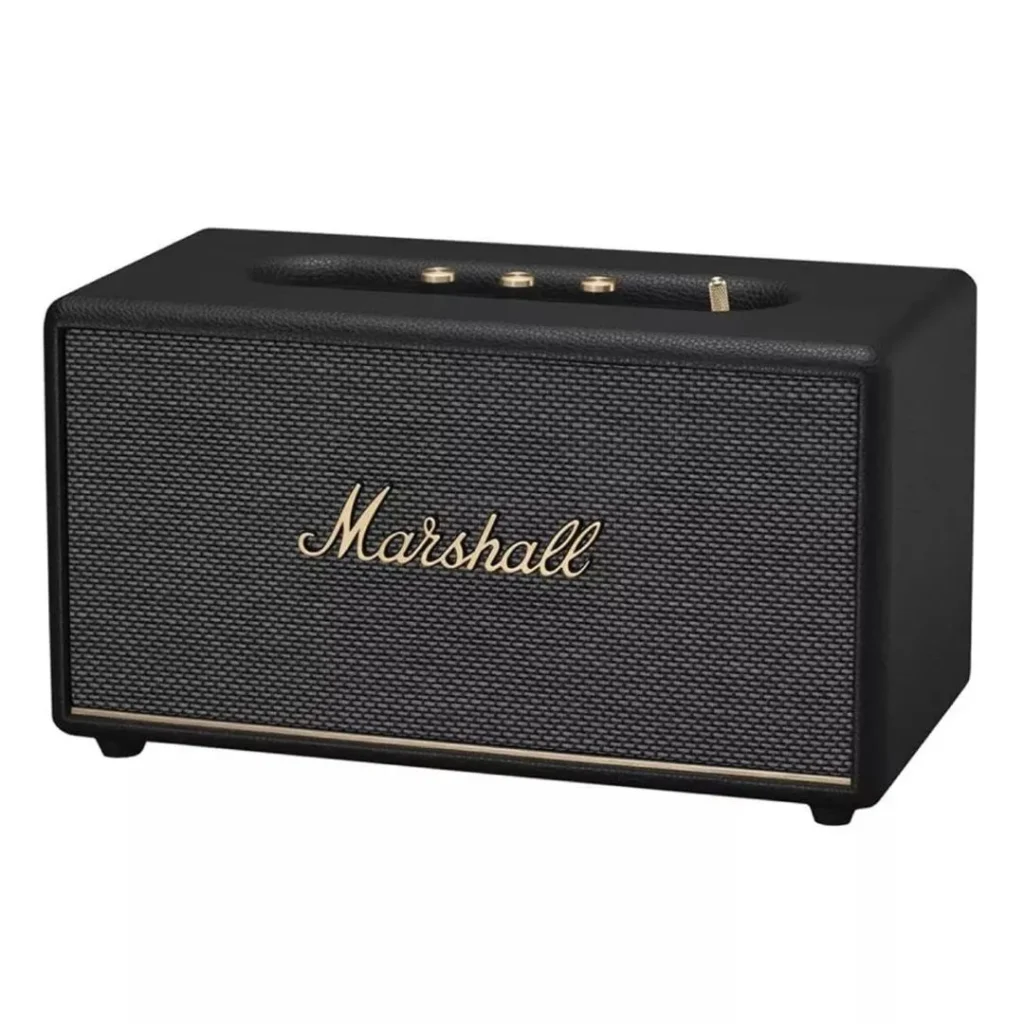
The Marshall Stanmore III is a home Bluetooth speaker with visible physical controls and a distinctive enclosure. Its appeal is local, uncomplicated playback rather than voice-assistant or multiroom integration. Buyers should choose it because that approach suits the room, not assume that every current wireless speaker includes Wi-Fi, a battery or television HDMI control.
Marshall Stanmore III — Physical controls are part of the appeal
Marshall documents volume, bass and treble knobs, source selection and playback controls on the top panel. Those can make daily operation straightforward without reaching for a phone every time. Check whether the speaker will sit somewhere the controls remain accessible.
The cabinet is 350 mm wide, 203 mm high and 188 mm deep, with a listed weight of 4.25 kg. This is a shelf or sideboard product rather than a travel speaker. Leave appropriate space around the enclosure and avoid choosing a location solely because the styling matches the furniture.
A single box with a specific driver layout
The specification lists a 50 W Class-D amplifier for the woofer and two 15 W amplifiers for the tweeters. That is a description of the architecture, not a measured total-output comparison against another brand. A single enclosure also cannot be assumed to produce the same stereo separation as a widely spaced pair of speakers.
Marshall quotes a 45 Hz to 20 kHz frequency range, but the span alone does not establish tonal accuracy or bass quality. We have not measured the response or tested output limiting. Placement near a wall or on a resonant surface can change the perceived balance, so begin there before making large tone-control adjustments.
Bluetooth and analogue are the documented routes
Bluetooth 5.2, RCA and 3.5 mm inputs are listed. These provide a straightforward path from a phone or suitable analogue source. There is no Wi-Fi in the official specification, so network streaming and home-system grouping should not be inferred from the word wireless.
The page says the hardware is ready for Bluetooth LE Audio. Read that wording carefully and verify current firmware and source support for any required future-facing feature. Readiness is not permission to assume every LE Audio function is already available with every source.
No battery, phono stage or smart-assistant promise
The Stanmore III is mains-powered, with no water-resistance claim in its specification. It is not an outdoor battery speaker simply because Marshall also sells portable products. Keep the intended environment and power connection part of the buying decision.
A turntable must provide a suitable line-level signal before using RCA input. If the deck lacks a phono stage, add one separately. The input socket shape does not supply cartridge gain and equalisation. For TV use, an analogue source route may be possible, but there is no documented HDMI ARC convenience to assume.
The Marshall Bluetooth app adds adjustment and update functions, while the physical knobs preserve a direct control option. Compare the complete system with a network speaker only if those extra network functions will be used. This review does not claim an auditioned Marshall sound signature or a measured advantage in bass and detail.
What to expect in a real setup
Can it work as a portable battery speaker? No. The Stanmore III is a mains-powered home speaker. Do not transfer portability features from other Marshall models.
Does the RCA input accept a raw turntable cartridge signal? It expects a suitable analogue line signal. Use a turntable’s active phono stage or a separate compatible phono preamplifier first.
Stanmore III is a mains-powered home speaker
The handle-free home format and required mains supply should be part of the placement plan. Do not treat the Marshall styling as evidence of the same battery or weather-protection role as a portable model. Choose a stable accessible surface with suitable power and clear driver paths. A speaker used in one living-room position has different requirements from one carried outdoors every day.
The physical tone and volume controls are a concrete reason to shortlist it. Try them in the intended location and check whether another household member can use the normal source routine easily. A direct-control approach can be valuable without a large app feature set. Conversely, someone who wants network services or assistant functions should compare those requirements explicitly, because they are not supplied by a Bluetooth logo.
Analogue inputs do not include a phono stage
The RCA and 3.5 mm routes accept appropriate line-level sources. A turntable without a suitable phono stage needs one elsewhere, even if an adapter fits. Include that component and cable in the total price. A microphone or guitar also should not be assumed to work as though the speaker has a dedicated performance input. Signal roles matter more than the visible connector count.
For Bluetooth, test the actual phone, normal volume and reconnection routine. If comparing wired and wireless playback, use familiar material at similar levels and keep tone controls fixed. A louder route can seem more substantial without proving a converter or codec advantage. This research has not performed a controlled listening or latency test.
Buying design with a complete use case
Try placement before strong bass adjustment, because a wall or shelf can affect the balance. Compare the entire installed arrangement with alternatives, including any separate network streamer or phono stage needed. A single enclosure is not the same spatial arrangement as two separately positioned speakers.
For used stock, identify the III generation, test inputs and controls and confirm applicable local support. Stanmore III is most convincing when the owner wants its actual home Bluetooth and analogue routine and values the physical controls. It is a weaker purchase if additional boxes are immediately needed to imitate a network or portable system that another product already provides.
Alternatives to consider
Naim Mu-so 2nd Generation: Compare a different integrated home-speaker approach if network music functions and a larger total budget are relevant.
Sonos Five: A network-focused alternative to consider when grouping and home-system control matter more than physical tone knobs.
Marshall Stanmore III key specifications
- Role
- Mains-powered home Bluetooth speaker
- Bluetooth
- 5.2
- Analogue inputs
- RCA and 3.5 mm
- Wi-Fi
- No
- Microphone / voice commands
- No
- Amplification
- 50 W woofer; 2 × 15 W tweeters, manufacturer specification
- Dimensions W × H × D
- 350 × 203 × 188 mm
- Weight
- 4.25 kg
- Water resistance
- None specified
- App
- Marshall Bluetooth
Verdict
The Stanmore III is easiest to justify when its straightforward controls and local connections are exactly what is wanted. Its lack of network and battery functions is a meaningful buying boundary. Evaluate placement, convenience and sound preference in person rather than choosing it on styling or amplifier figures alone.
Primary documentation
Specifications and feature descriptions were checked against the following official documents on 6 November 2026. Compatibility advice is our interpretation of those documented capabilities; it does not establish measured sound quality. Regional bundles, software features and service availability can change, so verify the exact European model and current support information before purchase.
Editorial record
Sources and updates
Product specifications and factual claims were checked against Official Marshall Stanmore III product page ↗. Scores and buying advice follow our category-specific editorial methodology.
- Published
- November 7, 2026
- Last updated
- November 8, 2026