Research note: This is an independent, research-based assessment built from official specifications and product documentation. We have not claimed a hands-on laboratory test.
Marshall Middleton key specifications
- Model
- Marshall Middleton
- Drivers
- 2 × 3 in 15 W woofers; 2 × 0.6 in 10 W tweeters; 2 passive radiators
- Amplification
- 2 × 20 W Class D woofer amps; 2 × 10 W Class D tweeter amps
- Frequency response
- 50 Hz–20 kHz
- Maximum SPL
- 87 dB SPL at 1 m
- Bluetooth
- Version 5.1; 10 m range
- Wired input
- 3.5 mm aux
- Battery life
- 20+ hours
- Charging time
- 4.5 hours; 20 minutes gives 2 hours playback
- Water and dust resistance
- IP67
- Dimensions
- 230 × 109 × 95 mm
- Weight
- 1.8 kg
Sound architecture and intended scale
Drivers fire in multiple directions to support Marshall’s True Stereophonic presentation, which is intended to sound consistent around the enclosure. This improves social listening coverage, although it is not the same as a separated stereo pair. This hardware should be judged against the cabinet size and intended listening distance, not against a separated stereo system. A single portable enclosure can create a broad presentation, but true left-right imaging still requires a second compatible speaker or a conventional pair. Placement, nearby walls and playback level will change bass balance more than small codec differences.
Portability and physical design
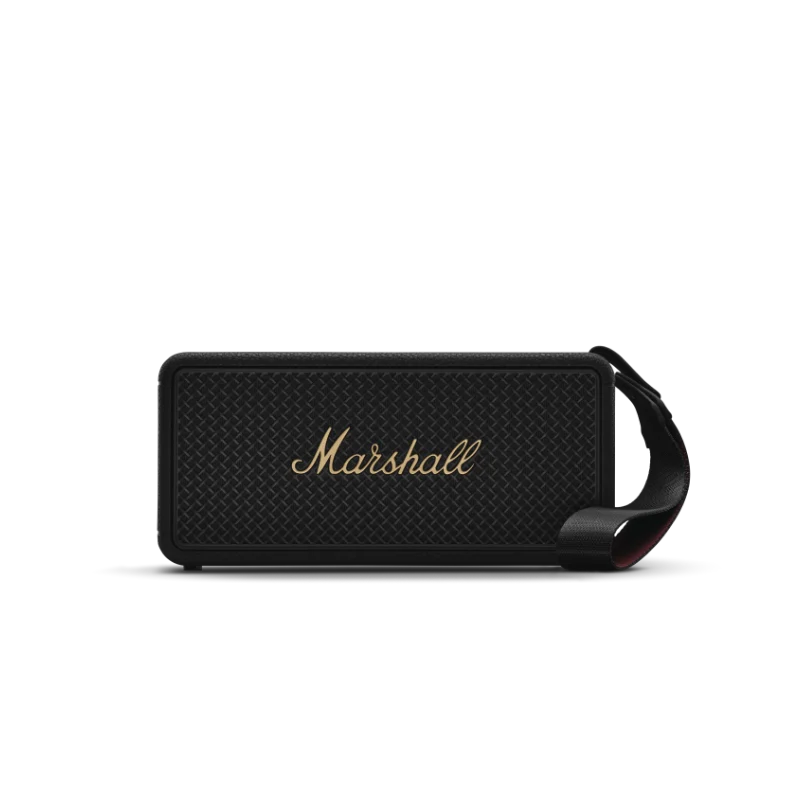
At 1.8 kg, Middleton is carryable with its strap but not a pocket or ultralight model. The textured rectangular enclosure suits short outdoor trips, patios and moving between rooms. The practical question is not whether the product is technically portable, but how often its weight and shape will suit the journey. A larger cabinet buys acoustic headroom and bass; a smaller one is more likely to leave the house. Buyers should match the format to real use rather than choosing the biggest specification sheet.
Battery and charging
Marshall claims more than 20 hours and provides quick charging, while the USB-C port can supply power to a phone. Using that function and playing loudly will shorten the available music time. Manufacturer battery figures are measured under controlled conditions and fall with high volume, heavy bass, calls or device charging. They are best treated as a ceiling rather than a guarantee. Charging accessories also vary by region, so the box contents and required power adapter should be confirmed before purchase.
Weather protection and care
IP67 makes the speaker dust-tight and resistant to controlled freshwater immersion. The tough exterior fits outdoor use, but USB-C must remain dry before charging and saltwater exposure needs prompt cleaning. An IP rating describes specific laboratory exposure, not unlimited use in every environment. Ports should be dry before charging, and salt, chlorine or sand should be cleaned according to the maker’s guidance. These safeguards make outdoor ownership easier, but they do not remove the need for ordinary care.
Connectivity, app and ecosystem
Bluetooth 5.1 covers normal streaming, the Marshall app provides EQ, and Stack Mode links compatible Middleton speakers for larger coverage. It lacks the Wi-Fi and AirPlay functions of a Sonos portable. App support can add EQ, updates and grouping, while ecosystem features may depend on compatible phones, Wi-Fi networks or another speaker of the same generation. Buyers replacing an older model should verify grouping standards instead of assuming cross-generation compatibility. A stable basic Bluetooth connection remains the most universally useful feature.
Value and trade-offs
The premium pays for a distinctive industrial design, multidirectional output and solid protection. Buyers focused purely on specifications can find more battery or app features for less, while Marshall fans may value the coherent package. The strongest purchase is the one whose compromises align with the intended setting. Paying for output that never gets used wastes money and luggage space; choosing too small a model can lead to distortion and short runtime at constant maximum volume. Alternatives below frame those trade-offs rather than treating every portable speaker as interchangeable.
Who should buy it?
Choose Middleton for patios, parks and medium rooms when you want broad dispersion, strong battery life and a recognizable design. It suits short carries rather than long hikes. Buyers needing Wi-Fi, voice assistants or very low weight should choose another format.
Alternatives to consider
JBL Xtreme 4 offers more output, Auracast and a replaceable battery; Bose SoundLink Max adds aptX Adaptive and AUX. Ultimate Ears MEGABOOM 4 is lighter with 360-degree sound, while Sonos Move 2 is stronger for home networking.
Verdict
Marshall Middleton is a stylish but genuinely functional outdoor speaker, not merely a logo exercise. Its multidirectional design, IP67 protection, power bank and 20-plus-hour endurance justify attention, although value-minded buyers should compare JBL, Bose and Soundcore carefully.
Primary source
Marshall Middleton official product page
Editorial record
Sources and updates
Product specifications and factual claims were checked against Official Marshall Middleton product page ↗. Scores and buying advice follow our category-specific editorial methodology.
- Published
- July 1, 2026
- Last updated
- July 25, 2026
Compare before choosing
Two strong alternatives from the same portable speakers category.