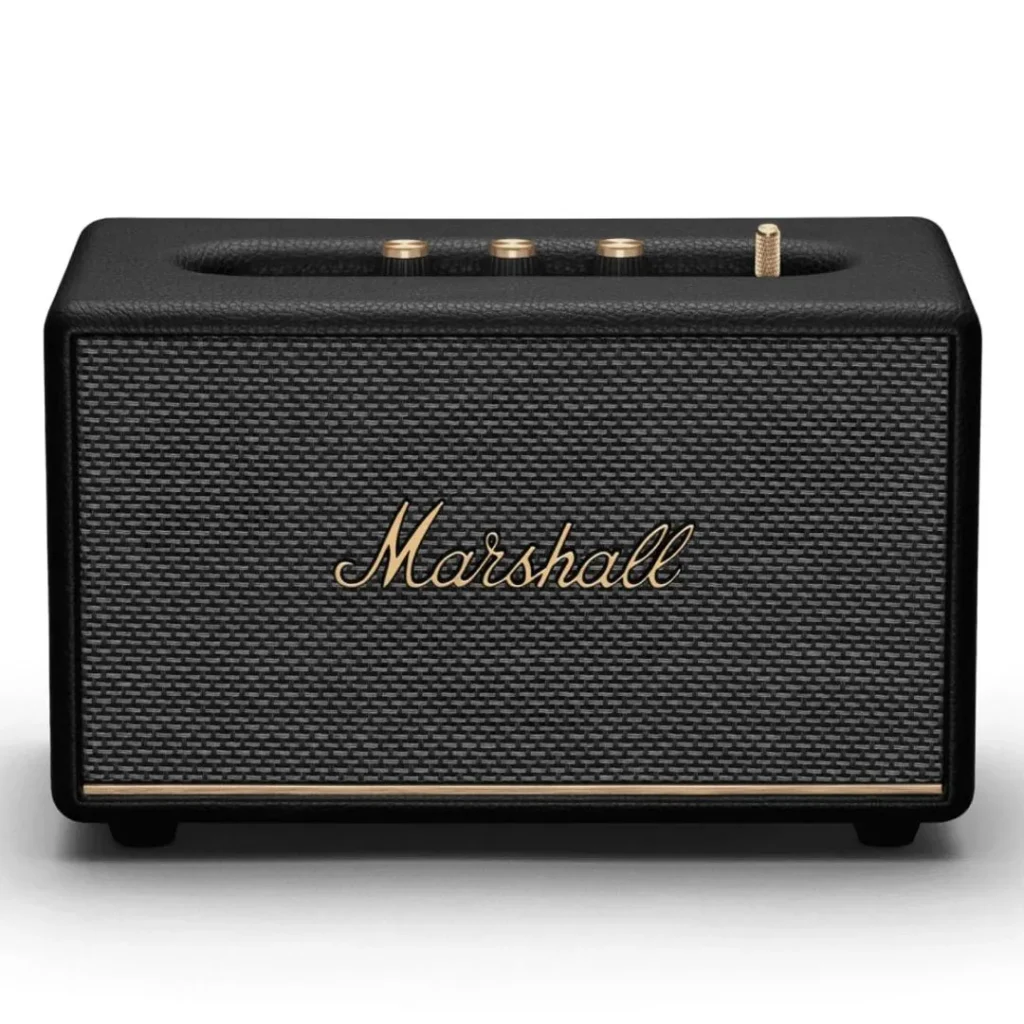
Marshall Acton III is a compact Bluetooth speaker intended to remain plugged in at home. Its familiar amplifier-inspired styling and physical tone controls are central to the appeal, alongside a simple choice of Bluetooth or a 3.5 mm source. It does not contain a Wi-Fi platform, microphone system or battery. Original review evidence supports a punchy and enjoyable presentation, but the limited feature set makes its value particularly dependent on the current price and intended job. This assessment concerns the third generation specifically, without borrowing features from similarly named later models.
Research-based review. This assessment draws on manufacturer documentation and the original published evaluations linked below. Audio Review has not performed a hands-on test of this model.
A compact speaker with a deliberately lively character
T3’s original review finds surprising output and an energetic presentation, with vocals remaining clear through busy rock music. It also describes a bass-heavy default character that will not suit every listener, while noting the useful scope for adjustment. That is a stronger reason to audition than to assume the brand name dictates suitability for one genre.
Try the recordings normally played at home, including quieter music or spoken material alongside anything energetic. Listen at an ordinary level and check whether the balance stays comfortable over a longer session. A compact single enclosure can provide a satisfying everyday result without reproducing the separation of two speakers placed apart. The correct comparison depends on the room: a side-table system, desk speaker and dedicated stereo seat are different jobs. Avoid evaluating only the loudest passage a dealer can demonstrate. The most useful result is music that remains enjoyable at the level and position actually available. The original evidence supports Acton III as a serious simple home option, with enough tonal character to make personal preference important.
Physical controls reward an accessible location
Volume, bass, treble and playback controls sit on the unit. These make ordinary operation possible without constantly opening an application. The Marshall Bluetooth app adds settings and firmware support, but the basic speaker does not require every interaction to pass through a phone screen.
Place it where the top panel is easy to reach and the enclosure is stable. Avoid a shelf so tight that adjusting a knob risks pulling a source lead or knocking the speaker. Start with a restrained tone setting and listen before changing anything. If bass dominates, a small reduction may be more useful than simply raising treble to compensate. Keep a sensible baseline for shared household use. The tactile design is an advantage when someone wants to walk past, adjust the level and continue with a task. It offers less benefit if the speaker will live out of reach. Choose the location around sound and daily access as well as appearance, since the controls are part of the practical reason to buy this model.
Placement compensation is guided adjustment, not a room measurement
The app provides placement compensation based on the speaker’s situation. This is useful supporting control, but it should not be confused with an automatic microphone measurement or assumed to make every corner sound identical. Furniture and boundaries still affect the result.
Begin with a reasonable physical location and use the documented setting for that arrangement. Compare familiar music before and after the change, without changing volume or another tone control at the same time. If the enclosure is pressed into a narrow recess, moving it may be a more effective first step. On a desk, check whether the supporting surface vibrates or puts the speaker at an awkward height. Keep the mains and source cables clear of anything likely to pull them. A compact home speaker is appealing partly because there is only one cabinet to accommodate. That advantage should make a good location easier to find, rather than encourage acceptance of the first empty gap. Simple setup controls work best when they support an already sensible placement.
Bluetooth and the analogue input define the source plan
Acton III uses Bluetooth 5.2 and a 3.5 mm line-level input. It has no RCA sockets, USB audio, optical input or HDMI television connection. A Bluetooth version number should not be read as proof that every newer broadcast or grouping feature is active.
Test ordinary pairing, reconnection and source switching with the actual phone. If the speaker is intended for a computer, assess the video synchronisation and volume routine rather than assuming it behaves like a dedicated USB desktop system. For a wired source, identify a suitable analogue output and start at a conservative level. A turntable without an internal phono stage needs the appropriate external stage before feeding line level. The fact that a cable can be adapted to a 3.5 mm plug does not establish that the signal is correct. A simple source plan is the strongest case for the Marshall. If the purchase requires several converters to connect a television and other equipment, a more directly equipped product may be both easier and better value.
This is a home speaker, not a battery or native multiroom product
Marshall documents mains operation and no water resistance. It also states that this model is standalone and cannot be used in native pairs or multiple groups. Its wireless source connection therefore does not make it a portable outdoor speaker or a networked whole-home system.
Confirm a safe mains location and keep the speaker away from likely spills. Its modest size makes it easy to reposition, but that is different from listening away from a socket. Do not buy a second unit expecting a native left/right arrangement unless an explicitly supported external system meets that need. Likewise, an app associated with a Bluetooth speaker is not necessarily a network-streaming platform. A buyer who wants independent service playback, household grouping or voice control should compare those facilities before choosing this simpler design. The absence of extras can be a positive when the actual job is direct music from one source. It becomes a limitation when a future expansion plan was silently assumed rather than checked.
Current price and exact generation decide the value
Acton III is an established generation, so it should be assessed at the price and support terms currently offered. Features from a newer Acton or a larger Marshall model should not be transferred to it merely because the enclosures share the same style.
Ask the seller to identify the exact model and regional package, including mains accessories and warranty. Compare a complete alternative with the same listening requirements rather than a portable speaker that solves a different job. Consider how often the physical controls and appearance will matter after the initial purchase. They can be legitimate reasons to prefer it, but should sit beside sound and source compatibility. A lower price can make a deliberately simple model attractive; a price close to more capable alternatives deserves a careful comparison. The strongest purchase is one in which Bluetooth and the analogue input already meet the long-term plan. That allows the compact format and enjoyable music evidence to carry the recommendation without relying on promised future features.
Alternatives to consider
Sonos Era 100: Compare a network-based home speaker if app-led service access and household integration matter more than direct analogue controls. Check the price of any required source adapter.
Marshall Kilburn III: Consider the portable model when battery use and movement between locations are central. Compare the exact source and protection requirements rather than assuming every Marshall enclosure has the same facilities.
Marshall Acton III key specifications
- Generation
- Acton III, not Acton IV
- Format
- Single-enclosure home speaker
- Amplification
- 30 W woofer channel plus two 15 W tweeter channels, manufacturer ratings
- Wireless
- Bluetooth 5.2
- Wired input
- 3.5 mm line-level analogue
- App
- Marshall Bluetooth app
- Tone control
- Physical bass and treble; app settings
- Placement compensation
- Available through app
- Wi-Fi / voice
- Not provided
- Native pairing / multiroom
- Not supported
- Power
- Mains only; no battery
- Water resistance
- None specified
- Dimensions
- 260 × 170 × 150 mm overall
- Weight
- Approximately 2.85 kg
Verdict
Acton III is an attractive compact choice for direct home music with tactile controls. Original review evidence favours its lively presentation, while the source and expansion limits are clear. It needs mains power and offers neither native multiroom nor stereo pairing. Choose the third generation at a sensible current price when that simple role is exactly what is required.
Documentation and original reviews
Marshall official Acton III specifications and pairing limitations · T3 original Acton III sound and operation review
Editorial record
Sources and updates
Product specifications and factual claims were checked against Official Marshall Acton III product page ↗. Scores and buying advice follow our category-specific editorial methodology.
- Published
- November 17, 2026
- Last updated
- November 17, 2026