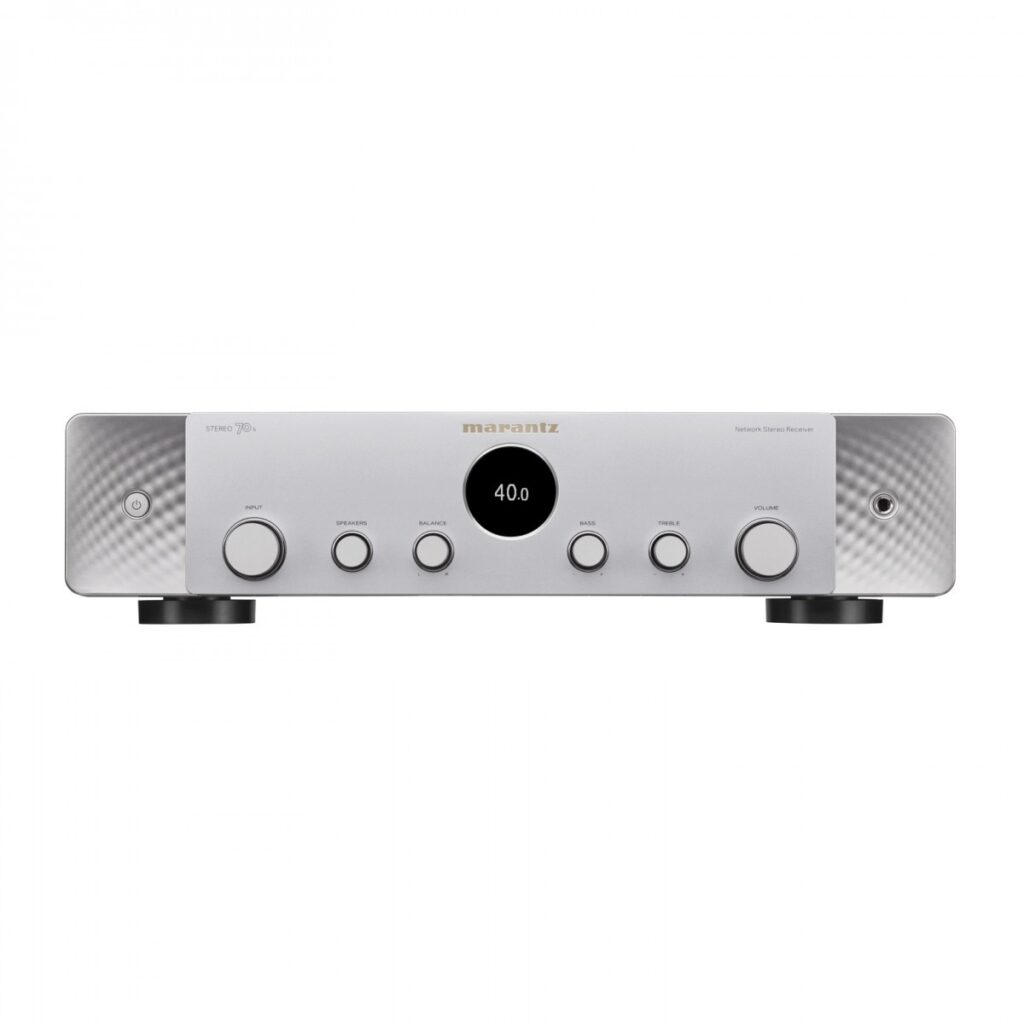
The Marantz STEREO 70s is designed for people who want several television sources and a proper pair of stereo speakers without installing a surround system. Its slim receiver layout combines HDMI switching, streaming and conventional music inputs. The important distinction is that it remains a two-channel amplifier, even when the back panel resembles an AV receiver.
Marantz STEREO 70s — Slim design and system role
The shallow-height enclosure makes the STEREO 70s easier to accommodate than many full-height receivers. It still needs ventilation and room behind the sockets, particularly once several HDMI leads and speaker cables are connected. Measure the usable shelf space rather than assuming that a low front panel guarantees a compact installation in every direction.
This model is not the CINEMA 70s with fewer speakers connected. The STEREO 70s is a dedicated stereo product with two amplified channels and a different intended system. That distinction matters when reading specifications or searching for accessories. It is a strong candidate for a television room that will stay stereo, but it does not provide a simple software path to adding a centre speaker and surround channels later.
HDMI switching and television setup
Six HDMI inputs allow several video sources to share the receiver, with one output to the television. Three inputs support the highest advertised 8K capability, so do not assume every rear input has identical high-bandwidth behaviour. Place a demanding console or player on the appropriate input and select the required signal mode in the receiver and television menus.
The European web manual documents ARC return audio. Product descriptions and reviews can use broader HDMI language, so the safe purchase assumption is the documented ARC path rather than a promise of every enhanced return-audio format. In either case, the output from this system is stereo: support for modern video does not create height or surround loudspeakers.
Check picture mode, audio delay and power control using the actual TV and sources. A stable movie demonstration does not establish that a console’s preferred refresh rate and variable-refresh mode are configured correctly. Likewise, successful source playback does not guarantee that the television’s own apps return audio until ARC and control settings are enabled. Test those separate use cases before hiding the cables.
Power and the two-channel limitation
Marantz rates the receiver at 75 watts per channel into eight ohms across 20 Hz to 20 kHz, with both channels driven at 0.08 percent distortion. Higher figures quoted under different load, frequency or distortion conditions should not replace that conventional full-bandwidth rating. The practical question is whether it comfortably drives the intended pair of speakers in the room.
Speaker A/B terminals add flexibility, but they do not supply four independently amplified channels. Running two pairs simultaneously changes the load seen by the amplifier, so follow the manual’s limits rather than connecting extra speakers simply because sockets are available. A second pair can be useful for occasional listening elsewhere, but it is not equivalent to an independently powered surround system.
For television, a well-positioned stereo pair can produce clear dialogue and a broad presentation. It will not offer the same dialogue anchoring across multiple seats as a physical centre speaker. If a future centre and rear channels are likely requirements, a suitable multichannel receiver is a more direct purchase than hoping this stereo model can be expanded through a menu.
Music sources and European features
HEOS network playback, AirPlay 2 and the current manual’s Roon Ready functions give the receiver a useful music role beyond television. Ethernet and Wi-Fi support different installation needs. Service support depends on region, accounts and firmware, so verify the library or subscription that matters instead of relying on an old review’s software snapshot.
The European manual includes DAB and FM reception. That regional detail should not be replaced by the AM/FM description found on some other-market pages. Check the exact local version and reception conditions if broadcast radio is a significant reason for purchase. Internet radio and terrestrial broadcasting are different routes, with different network and aerial requirements.
An MM phono input, analogue sources and digital audio connections support a conventional music system. USB-A handles supported storage media rather than serving as a general computer DAC socket. A turntable with its own enabled phono stage should feed a line input, while a bare moving-magnet cartridge uses the phono input. These ordinary connection choices matter more to a successful installation than chasing the maximum supported file resolution.
Subwoofers, headphones and additional rooms
Two subwoofer sockets make connection convenient, but the manual describes a 2.1-channel speaker arrangement. Do not infer two independently measured and corrected bass channels from the socket count. Subwoofer placement, level and crossover still need attention, especially if two units are used to improve coverage rather than merely increase output.
Main preamp outputs and a Zone 2 line output provide system options. The second zone needs appropriate additional amplification where passive speakers are involved; the main stereo amplifier does not gain another independent pair of power channels. Check which sources can feed the second zone before planning a multiroom installation around a particular HDMI device.
The headphone socket is useful for late listening, and Bluetooth headphone operation offers another documented route. Neither feature makes the system a multichannel processor for private cinema listening by default. Assess audio delay with television and the actual headphones, since comfortable synchronisation and reliable reconnection are more useful everyday criteria than a generic wireless logo.
Sound evidence and overall value
The Absolute Sound’s original evaluation described a warm, forgiving presentation and examined the product as a stereo listening component. Its video-source testing was limited, so it should not be presented as proof that every HDMI switching scenario was independently verified. The useful evidence is a positive listening assessment alongside a feature set whose exact operation is established by the manufacturer manual.
For an audition, compare familiar music and ordinary spoken television at matched levels. Include a busy soundtrack passage to check that dialogue stays understandable without forcing excessive volume. The absence of a centre channel makes speaker placement and seating position especially relevant. A good stereo result can be very satisfying, provided the goal is understood before purchase.
The STEREO 70s offers unusual convenience when several HDMI sources must share a two-speaker system. A compact streaming amplifier may be sufficient if the television already switches every source, while a full AV receiver is more appropriate for future surround expansion. Compare current European prices around that real requirement. The Marantz is strongest when slim proportions, HDMI inputs and a permanent stereo layout are all deliberate choices.
Alternatives to consider
Marantz MODEL M1: A smaller streaming amplifier when the television handles source switching and only a return-audio connection is needed.
WiiM Amp Ultra: Compare an app-focused compact stereo system if six HDMI inputs are unnecessary.
Marantz STEREO 70s key specifications
- Type
- Network stereo AV receiver
- Rated output
- 75 W/channel at 8 ohms, 20 Hz–20 kHz, 0.08% THD, two channels
- HDMI
- Six inputs, three 8K-capable; one output
- TV return audio
- ARC documented in European manual
- Speaker layout
- Stereo / 2.1; speaker A/B
- Network
- HEOS, AirPlay 2 and current Roon Ready
- European tuner
- DAB/FM
- Other connections
- MM phono, headphones, main preamp, two subwoofer sockets and Zone 2 line out
Verdict
A useful slim stereo hub for a television and several HDMI sources, with broad music access and positive listening evidence. Buy it for a permanent two-channel system, and distinguish its documented ARC and shared bass arrangement from multichannel receiver expectations.
Primary documentation and independent reviews
Marantz official European STEREO 70s manual · Marantz official European HDMI documentation · Marantz official STEREO 70s power specification · The Absolute Sound original STEREO 70s review
Editorial record
Sources and updates
Product specifications and factual claims were checked against Official Marantz STEREO 70s product page ↗. Scores and buying advice follow our category-specific editorial methodology.
- Published
- November 8, 2026
- Last updated
- November 8, 2026