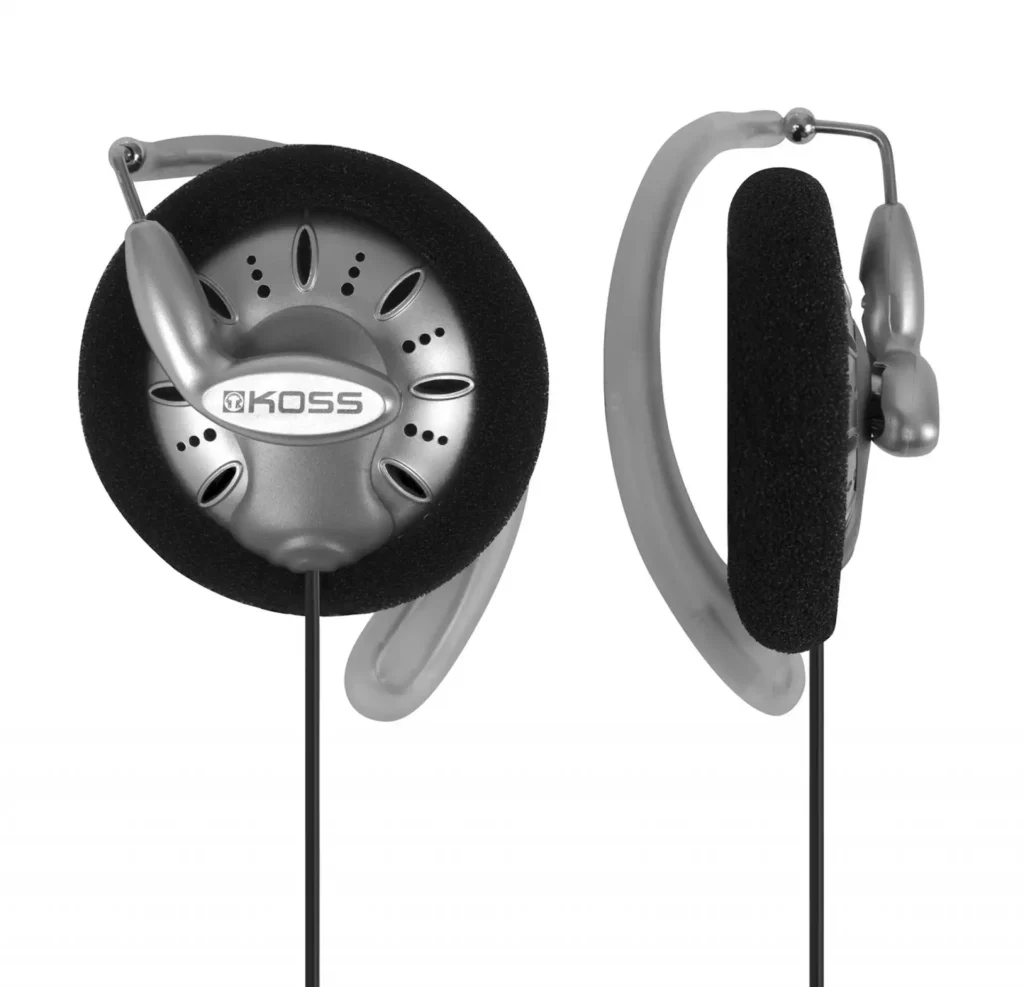
Koss KSC75 takes an unusual route to inexpensive personal listening: two small open earcups held by clips instead of a headband. It is a long-established wired model, not a true wireless earbud or a modern open-ear calling product. The appeal is a very simple, low-cost way to hear music without a band across the head. The trade-offs are equally clear once isolation, bass and cable handling enter the discussion.
Research-based review. This assessment draws on manufacturer documentation and the original published evaluations linked below. Audio Review has not performed a hands-on test of this model.
The clip fit is the first thing to try
Koss describes pivoting clips and foam cushions in an open-air construction. The cups sit on the ears, with the clip securing each side independently. RTINGS finds the design portable and reasonably stable, while also noting that comfort is not universal.
Try each clip without forcing it and check how it interacts with the arms of glasses. A product that avoids pressure on the top of the head can still create a pressure point behind an ear. Turn the head and look down as in normal use. The two sides should remain positioned without repeated adjustment or cable tension. If one side feels different, inspect the seating before judging stereo balance. A low price makes experimentation tempting, but fit is still the condition that determines whether the headphone can be used comfortably for more than a brief demonstration.
Clear middle frequencies with real bass limits
RTINGS’ original evaluation finds a reasonably balanced middle range and a useful sense of space for the small format. It also identifies reduced bass and an uneven upper range that can sound sharp on some recordings. Those limitations matter more than a broad claim that the KSC75 performs like every larger headphone.
Try spoken material, a familiar vocal and a recording with sustained low notes. Check whether the musical foundation remains satisfying at a comfortable level. If deep bass impact leads the preference, the open clip-on may be the wrong starting point. For editing, do not increase a recording’s bass simply because this headphone presents it lightly. Use another dependable reference to check important decisions. Enjoyable sound at a low price is a valid attraction, but it should not become a promise of accurate sub-bass monitoring or a fixed tonal result for every ear position.
Open listening is not sound isolation
The official open-air description and RTINGS’ evaluation agree that environmental sound remains audible and playback leaks out. There is no active cancellation or transparency setting. The acoustic design simply leaves the listener much less isolated than a sealed earphone.
That can suit a quiet personal space where a headband is unwelcome. It is less suitable beside conversation, on loud transport or near a live recording microphone. Consider other people in the room as well as what reaches the listener. If the surroundings conceal quiet musical information, turning the level up does not solve the design mismatch. Choose a more isolating product when that is the actual requirement. Hearing some external sound should also not be treated as a guarantee that every important event will be noticed. The KSC75 is an audio product with an open construction, not a universal solution for attention or awareness.
A fixed lead still defines portable use
Koss lists a four-foot straight dual-entry cable and a conventional 3.5-millimetre connection. The lead is not a standard detachable accessory and there are no onboard controls or microphone in the ordinary KSC75 package.
Think through the cable route before selecting it for movement. A wire snag can pull directly on the clips, so keep enough slack and avoid routing it around equipment. A phone without a headphone socket needs an appropriate adapter. Meeting applications need a separate microphone, and a computer may continue using its own built-in input. Those are simple arrangements when planned, but frustrating if the buyer expects a complete headset. The small cups are easy to store, yet the cable should not be crushed in a pocket or wound tightly around a sharp edge. Portability is a handling advantage rather than proof of rugged construction.
A simple source is a sensible starting point
Koss specifies 60 ohms and 101 dB SPL per milliwatt. The KSC75 is passive and has no internal battery or digital processing. Its actual level depends on the headphone output connected to it.
Start with a clean source and check quieter recordings as well as highly compressed music. Confirm that the volume control is usable and that there is no obvious noise in pauses. Do not assume that a costly amplifier is needed simply because the headphone is well liked by enthusiasts. Equally, a damaged adapter or poor connection should not be mistaken for a tonal defect. Check left and right channels and normal clip seating first. If applying EQ, leave sufficient headroom and make modest changes. The attraction here is an inexpensive complete listening routine, so extra equipment should solve an identified problem rather than overwhelm the original value proposition.
Durability and local value need realism
RTINGS describes the lightweight build as relatively fragile. Koss provides warranty information, but a limited-lifetime phrase is not the same as cost-free replacement in every country. Repair routes and shipping arrangements should be checked for the actual European seller.
Handle the clips and cable gently, inspect foam wear and store the pair where the cups are not bent beneath heavier objects. On a used unit, check channel operation and the cable near its entry points before considering a small saving worthwhile. Include shipping and adapters when comparing the total price with alternatives. The KSC75 is compelling when it remains inexpensive and the particular wearing style suits the owner. It is less compelling if the owner immediately needs isolation, deep bass, a microphone and a replaceable cable. The right response to those requirements is often a different design, rather than a chain of modifications that no longer resembles the product originally reviewed.
Alternatives to consider
Sennheiser HD 560S: HD 560S is relevant when the goal is a full-size open reference for a quiet desk. Its larger format and price need to be justified by the task rather than compared as though it were another pocket clip-on.
Audio-Technica ATH-M50x: ATH-M50x provides a different closed wired route with replaceable cables. Compare the space occupied, fit and intended monitoring role before assuming that a higher budget should preserve the KSC75’s particular wearing style.
Sony WH-1000XM4: WH-1000XM4 is a separate option if the true requirement is noise reduction and wireless convenience. It costs more and needs charging, but addresses needs the open KSC75 cannot be expected to meet.
Koss KSC75 key specifications
- Design
- Open on-ear with pivoting ear clips
- Diaphragm
- Titanium coating, 2 µm thick
- Impedance
- 60 ohms
- Sensitivity
- 101 dB SPL/mW
- Cable
- Fixed straight, dual entry
- Cable length
- Approximately 1.2 m / 4 ft
- Source plug
- 3.5 mm
- Headband
- None
- Battery
- None
- Bluetooth
- No
- ANC
- No
- Microphone and controls
- None
Verdict
Koss KSC75 is a worthwhile low-cost option for a listener who likes ear clips and wants uncomplicated open playback. The original test supports its clear middle range and useful presentation while making the limited bass and light construction important qualifications.
Try the clip fit, use it in a suitable environment and keep the complete source setup simple. It does not replace a sealed commuter headphone, a modern calling headset or a dependable sub-bass reference. Within its specific role, it can still offer a satisfying amount of music for a modest outlay.
Documentation and original reviews
Koss official KSC75 design and specifications · Koss official warranty and repair conditions · RTINGS original KSC75 sound, clip fit and durability evaluation
Editorial record
Sources and updates
Product specifications and factual claims were checked against Official Koss KSC75 product page ↗. Scores and buying advice follow our category-specific editorial methodology.
- Published
- November 17, 2026
- Last updated
- November 17, 2026