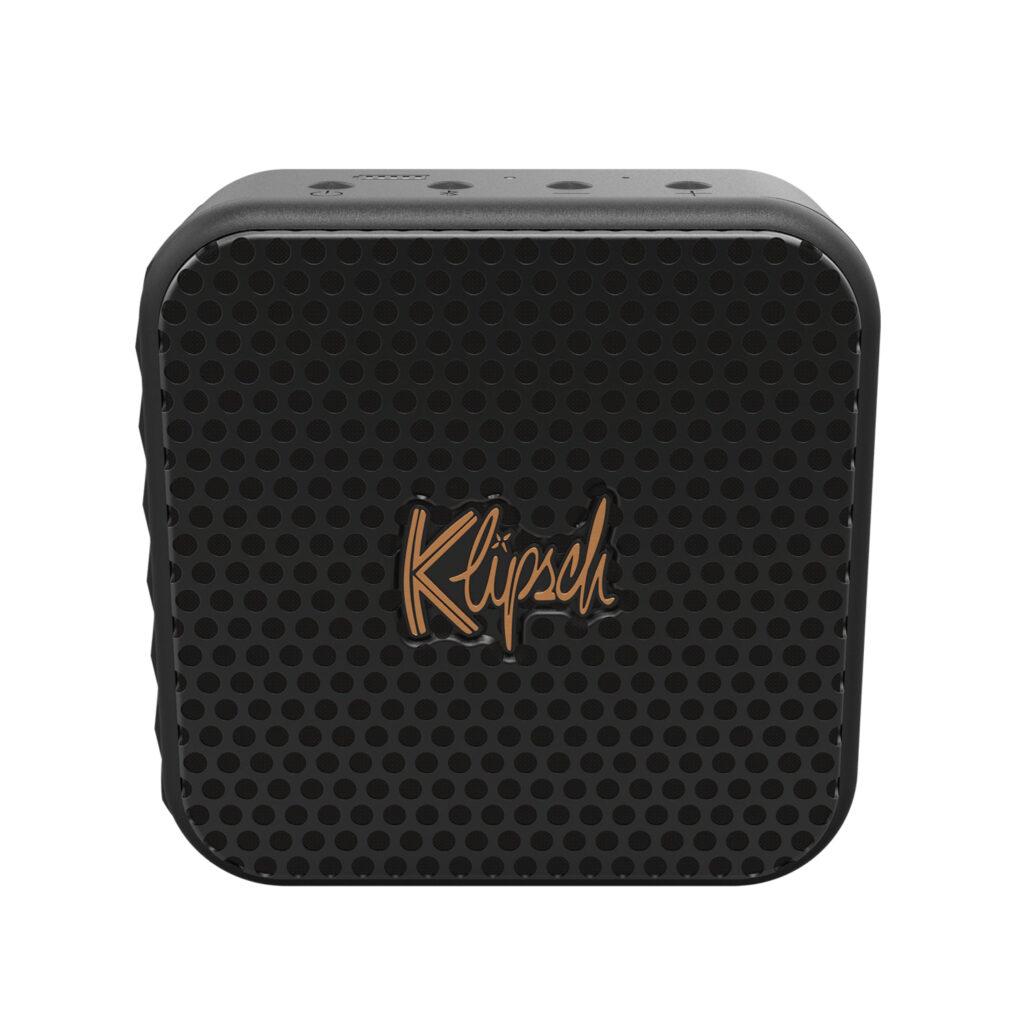
Klipsch Austin is the small, strap-equipped option in the Music City portable range. It is intended to put music close to the listener without demanding much bag space, and its dust and water protection makes that role more convincing. The key is to keep expectations proportional to the cabinet. Austin can be an appealing companion for speech, acoustic music and casual listening, but a tiny speaker is not a substitute for a larger outdoor system when bass weight and audience coverage come first.
Research-based review. This assessment draws on manufacturer documentation and the original independent evaluations linked below. Audio Review has not performed a hands-on test of this model.
Small enough to bring, large enough to notice
The current official specification lists four hundred and eleven grams and a compact square cabinet. The built-in strap is useful for attaching it to a suitable bag or support. Check the attachment securely before moving, and make sure the chosen position leaves the grille and passive radiators unobstructed.
That positioning choice affects the experience. A speaker attached behind a bag or beneath clothing may be convenient to carry but less clear to hear. Put it near the listeners instead of increasing volume to compensate for an awkward location. For a short picnic or a desk beside an open door, a compact speaker that is always available can be more useful than a larger one that routinely stays at home.
Sound evidence and the limits of scale
Stereo Guide’s original evaluation finds a balanced, natural presentation with particularly agreeable voices and acoustic music. It also reports limited low-bass authority and limited output for larger gatherings. Those are sensible boundaries for the recommendation, rather than shortcomings that a firmware setting can be assumed to remove.
Listen to speech and a few familiar songs at the distance you expect to use. Then try a bass-heavy track without immediately turning the equaliser upward. The question is whether the musical balance remains satisfying, not whether the cabinet can suggest the very lowest notes in a larger recording. A speaker can be enjoyable while omitting the deepest bass, provided that this is understood before purchase and the rest of the presentation suits the listener.
EQ is useful, but placement comes first
The supported Klipsch app provides sound adjustment and firmware updates. A modest EQ change can help adapt the result to a tabletop or a more open position. Keep the starting setting available so that a quick experiment does not become a permanent correction you can no longer judge fairly.
Large bass boosts are less useful when a small speaker is already near its output limits. Reducing volume or moving the cabinet closer is often a better approach. Stereo Guide’s test notes that the speaker’s processing limits the effect of boosting at higher levels. For an outdoor group, that is a reason to compare a larger speaker rather than keep increasing an adjustment that cannot overcome the driver’s physical limits.
Controls and phone dependence
Austin has physical controls for power, Bluetooth and volume, but the original evaluation criticises its limited on-speaker playback control. Try the actions you use most often, such as pausing a podcast or changing a song, before deciding that the app is a sufficient substitute.
The built-in microphone gives it a call function, but a microphone specification alone does not establish excellent speech quality in wind or a busy outdoor setting. Test a call if that function matters, and keep the phone accessible as a fallback. This is primarily a compact music speaker. It should not be selected as a work conference device without checking the complete call experience in the room and with the software that will actually be used.
Stereo pairing is different from Broadcast Mode
The current official manual includes a true-wireless stereo pairing procedure as well as a separate Broadcast Mode procedure. That is more specific than assuming every linked-speaker mode behaves the same. The official specification describes the additional broadcast devices receiving mono signals.
An earlier independent review says stereo pairing was unavailable, so use the current manufacturer instructions when checking the feature and confirm it on the firmware and pair you intend to buy. Do not assume an explanation for the discrepancy that has not been documented. For two-channel listening, ask for an actual left-and-right demonstration. For wider background coverage, Broadcast Mode has a different purpose and should be judged by connection reliability and the arrangement of the listening area.
Battery, USB charging and protection
Klipsch advertises up to twelve hours of playback and USB-C charging. That figure is a manufacturer claim, not a new battery test by Audio Review. Volume, settings, temperature and battery age affect endurance. Plan a charging margin if the speaker will be used away from power for most of a day.
The IP67 rating provides a useful level of dust and water protection under specified conditions. It is not a reason to ignore the care instructions or connect power while the port is wet. Dry the speaker and charging area appropriately before replenishing it. The charging connector also should not be assumed to accept USB music merely because a cable fits; buy the Austin for its documented Bluetooth playback role.
Who should choose Austin rather than a larger speaker?
The best case is a listener who wants a small, protected speaker for nearby use and likes its balance with vocals and acoustic recordings. The strap and simple transport are part of the value. Someone expecting a small box to fill an open space with deep dance bass is solving a different problem.
Compare current prices with StormBox Micro 2 and with the larger Nashville. If the smaller alternatives already provide the sound and carrying convenience required, the brand alone is a weak reason to spend more. If the Austin presentation and app are preferable in a direct comparison, the choice can be straightforward. Its role is a compact personal or small-group companion, and the recommendation is strongest when that role is exactly what the buyer needs.
Alternatives to consider
Tribit StormBox Micro 2: Micro 2 is an important comparison for a small strap-equipped speaker. Compare current prices, actual carrying convenience and the sound at your normal level, rather than assuming the Klipsch name makes the smallest Music City model a miniature home hi-fi system.
Klipsch Nashville: Nashville is worth considering when the Austin compactness is less important than a larger listening presentation. Try the two at a realistic distance outdoors and include their different carrying sizes in the decision.
Klipsch Austin key specifications
- Design
- Compact portable Bluetooth speaker
- Wireless
- Bluetooth 5.3
- Driver
- One 1.5-inch full-range driver, official specification
- Passive radiators
- Two
- Battery claim
- Up to 12 hours; manufacturer figure
- Charging
- USB-C, up to 18 W input
- Protection
- IP67
- Weight
- 411 g, current official specification
- Control app
- Klipsch Connect / current supported app
- Linking
- Stereo pairing and Broadcast Mode are separate procedures
- Microphone
- Built in
- Dimensions
- 105 × 105 × 44 mm
Verdict
Austin offers a sensible combination of compact size, an attachment strap, protection and a natural balance supported by the original listening review. It is worth shortlisting for speech, acoustic music and nearby outdoor listening.
Keep bass and party-volume expectations realistic, and check the current app and linking procedures rather than relying on an old feature summary. Compare Micro 2 for value and Nashville for more scale. Austin succeeds when portability and an agreeable close-range presentation matter more than the output of a much larger speaker.
Primary documentation and independent reviews
Klipsch official Austin information · Klipsch Austin official specification sheet · Klipsch Austin official operating manual · Stereo Guide original Austin evaluation
Editorial record
Sources and updates
Product specifications and factual claims were checked against Official Klipsch Austin product page ↗. Scores and buying advice follow our category-specific editorial methodology.
- Published
- November 17, 2026
- Last updated
- November 17, 2026