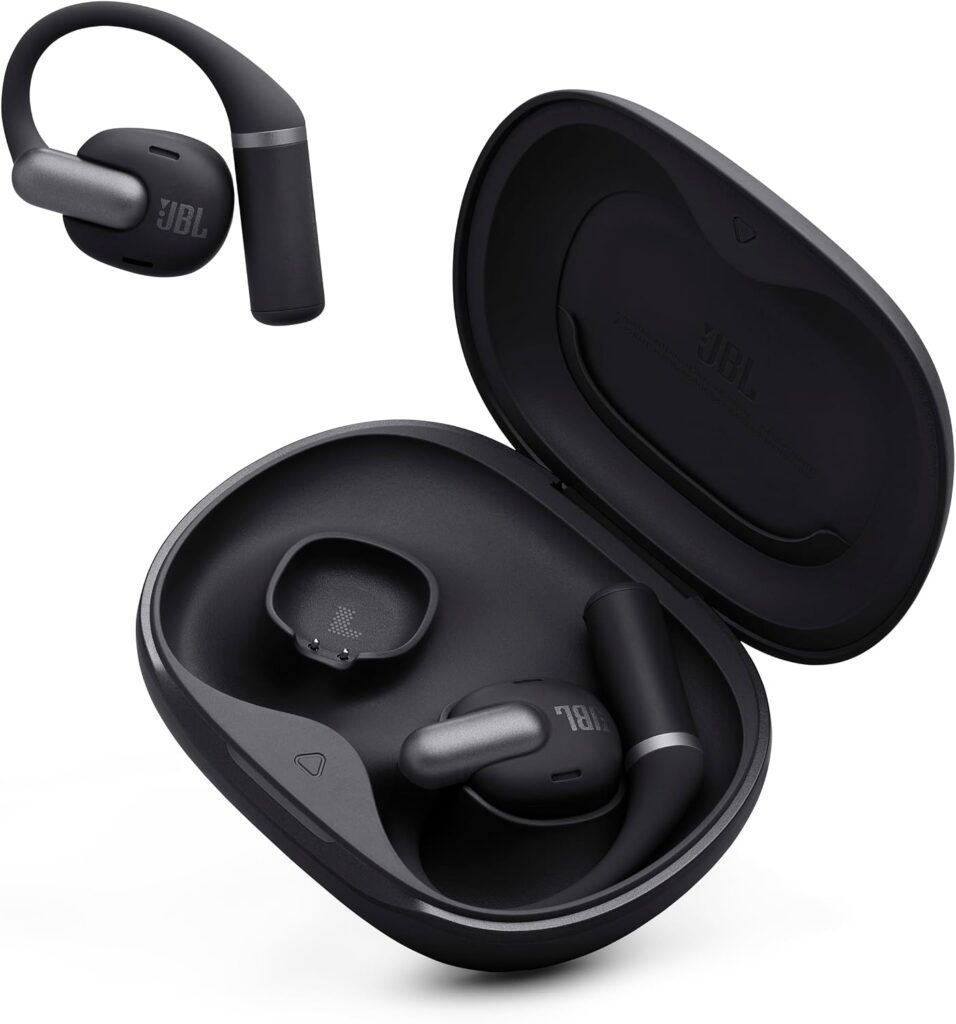
JBL Sense Pro combines an open-ear hook design with advanced wireless options, a voice pickup sensor and broad app personalisation. Original evaluation is positive about its full, natural listening character while identifying practical weaknesses in hook stability and touch sensitivity. It is an appealing feature-rich option for open listening, but those daily contact points matter more than the Pro name. The purchase should follow a successful trial with the actual phone and movement routine.
Research-based review. This assessment draws on manufacturer documentation and the original published evaluations linked below. Audio Review has not performed a hands-on test of this model.
The open listening role should come first
Sense Pro uses air-conduction speakers positioned near the canals rather than inserted sealing tips. Its voice pickup sensor uses vibration for microphone purposes; that does not turn the listening system into bone-conduction audio. These are different functions within the product.
Consider the environment where the earbuds will be worn. A quiet room, a walk with conversation and a noisy train can produce very different experiences. There is no sealed ANC mode to remove the surrounding world. Check leakage beside another person rather than relying on an absolute claim of inaudibility. Open listening can be attractive because it permits interaction, but awareness is not a guarantee that every event will be noticed. Someone whose main requirement is privacy or maximum isolation should start with another construction. Sense Pro makes more sense when an unsealed ear is an intentional preference and the rest of the features support that role.
Adjustability does not guarantee a stationary speaker
JBL provides an adjustable hook angle and soft contact materials. Headphonecheck’s original evaluation finds the supports flexible enough to allow some speaker movement, with touch inputs occasionally triggered while readjusting. That is a practical concern to check before treating the design as an automatic sports recommendation.
Try the actual movement, normal glasses and any headwear. Check whether both speakers maintain a consistent position without needing frequent correction. A soft support can feel comfortable while providing less stability than one particular ear needs. Do not compensate by forcing the hinge beyond its intended movement. A stationary listening trial and a running trial answer different questions, so use the relevant one. The strongest fit is comfortable and predictable through the actual routine. If the speaker repeatedly shifts or the controls fire during necessary adjustments, a different open design may be a better match even if its specification is less extensive.
Original sound evidence is encouraging in suitable conditions
Headphonecheck describes a lively, full presentation with useful bass, open mids and clear upper detail in quieter settings. It also recognises that low-frequency presence is harder to maintain when surrounding noise rises. That supports a positive conditional assessment rather than a promise of sealed-headphone sound everywhere.
Try familiar voices, a bass-led recording and an acoustic track. Keep the speaker position and loudness consistent when comparing. Listen to the standard profile before adding Spatial Sound or a personalised curve. An effect that increases apparent width may not be preferable for every recording. The best outcome is enjoyment of full albums and ordinary programmes in the real setting. A large driver and an adaptive bass label are useful design context, but they should not replace that preference check. Someone who wants a different vocal balance or more physical low-frequency weight should compare alternatives rather than assuming the feature list can make every taste converge.
Advanced wireless features need current compatibility
The current technical sheet lists Bluetooth 6.0, while the earlier announcement uses different version wording. Use the current unit’s documentation rather than combining launch and production details. LDAC is also source dependent and should not be described as mathematically lossless Bluetooth audio.
Check the actual phone after firmware setup. An iPhone does not gain LDAC through pairing, and a Bluetooth version number alone does not establish every optional broadcast function. Verify current Auracast roles and compatible equipment if that feature is important. Test multipoint with the phone and computer normally used, including an incoming call and return to music. Compare any higher-data-rate setting only after ordinary playback is stable, and check whether other preferred options remain available together. The useful configuration is dependable and convenient. It does not have to use every advertised mode simultaneously to provide an enjoyable listening experience.
Calls and touch controls need a complete trial
The official microphone design combines four microphones with a Voice Pickup Sensor. Headphonecheck finds calls clear on its test setup, while also criticising overly sensitive touch operation and grouped control assignments. A favourable calling report is encouraging without guaranteeing the same result on every street and application.
Ask someone to assess speech from the normal location and a representative noisy setting. Confirm the selected microphone and compare complete sentences. Then try essential controls without looking at the app. Check whether single touches, clothing or fit adjustments create unwanted commands. Configure the supported assignments around the functions used most often. A sophisticated sensor system has value when communication remains clear and predictable during ordinary use. It is less useful if interacting with the earbuds repeatedly interrupts playback or alters their position. Fit, controls and calls should therefore be tested together rather than accepted independently from a list of attractive technologies.
Read the total battery figure correctly
JBL claims up to eight hours from the earbuds plus up to 30 more from the case, for 38 hours in total. The larger figure should not be added again to the earbud runtime. USB-C and wireless charging are supported, with the official package noting that a charging cable is not supplied.
Plan around the longest uninterrupted interval required and allow for calls, volume, codec and battery age. Check that a suitable charging arrangement is already available. The case is substantial, so try carrying it where it will actually go rather than judging portability only from the earbuds. IP54 applies to the earbuds, and charging equipment should remain dry according to the instructions. Compare current European price, returns and support with other open options. Sense Pro is strongest when its sound, fit and app functions all work for the owner. It is weaker value when repeated adjustment or touch errors remain distracting, regardless of how advanced the wireless specification appears.
Alternatives to consider
Shokz OpenFit Air: A relevant open-hook comparison when comfortable movement matters. Try the exact fit with normal glasses and the intended activity before choosing from support style alone.
Bose Ultra Open Earbuds: A different open support arrangement to consider when hooks are inconvenient. Compare comfort, preferred sound and the current total price instead of assuming every open design offers the same experience.
JBL Sense Pro key specifications
- Design
- Open-ear air conduction
- Driver
- 16.2 mm dynamic
- Earbud weight
- 11.6 g each
- Bluetooth
- 6.0 in current technical sheet
- Codec option
- LDAC on compatible sources
- Support
- Adjustable ear hooks
- Noise cancellation
- None
- Microphone system
- Four mics plus Voice Pickup Sensor
- Connections
- Multipoint
- Battery claim
- Up to 8 h earbuds; 38 h total including case
- Charging
- USB-C and wireless; cable not included
- Resistance
- IP54 earbuds
- App
- EQ, Personi-Fi 3.0 and Spatial Sound
Verdict
Sense Pro has a persuasive published case for full, enjoyable open listening with broad adjustment and convenient charging. Hook movement and sensitive controls are the main practical reservations to resolve through a personal trial.
Choose it when those checks pass and the open format suits the environment. A different support style or sealed ANC earbud is more appropriate when stability, privacy or isolation is the overriding requirement.
Documentation and original reviews
JBL official Sense Pro technical and feature sheet · Harman official Sense Pro design and European announcement · Headphonecheck original Sense Pro listening, fit and control evaluation
Editorial record
Sources and updates
Product specifications and factual claims were checked against Official JBL Sense Pro product page ↗. Scores and buying advice follow our category-specific editorial methodology.
- Published
- November 17, 2026
- Last updated
- November 17, 2026