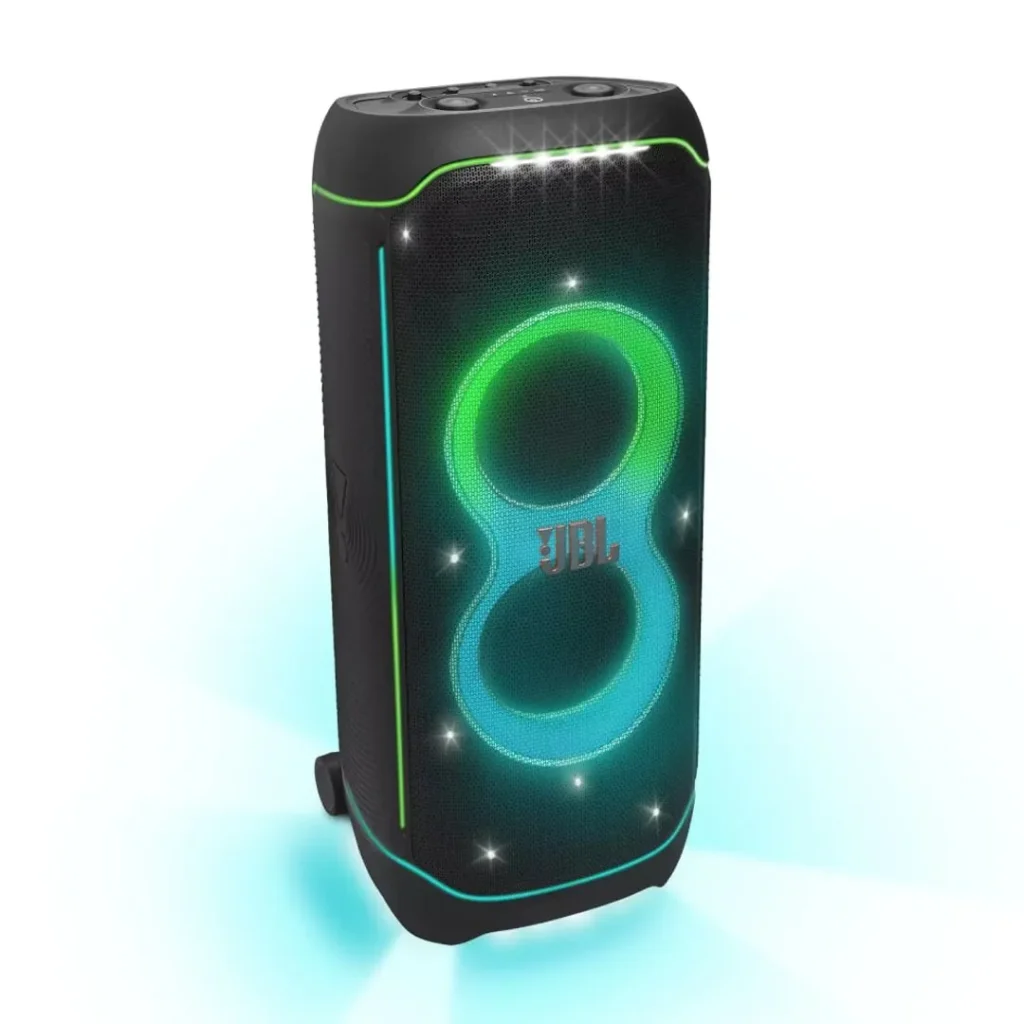
JBL PartyBox Ultimate is a large mains-powered event speaker with wireless source connections, not an off-grid battery portable. That distinction belongs at the beginning of any buying decision. Its original evaluation is enthusiastic about powerful, defined music and flexible control, while the enormous enclosure, price and more limited karaoke processing require perspective. It is best considered for repeated substantial gatherings with a workable storage, transport and power arrangement, rather than as the inevitable next step from a small Bluetooth speaker.
Research-based review. This assessment draws on manufacturer documentation and the original published evaluations linked below. Audio Review has not performed a hands-on test of this model.
The sound evidence goes beyond sheer output
Digital Trends finds the presentation clear and articulate as well as powerful, with controlled low-end impact across its original listening sessions. It does not independently test the advertised maximum venue coverage, and Audio Review has not performed its own acoustic measurements. The evidence supports a serious party brief without turning a marketing area claim into a universal guarantee.
Trial the system in a representative space with familiar voices and demanding rhythm-heavy material. Listen from the actual audience area and keep a sensible level while evaluating clarity. A reflective room, a crowded hall and an open garden impose different demands. The most useful result is consistent enjoyable music where people will gather, not a spectacular demonstration beside the grille. If a smaller system already covers that role comfortably, the extra physical scale may add little practical benefit. If regular events genuinely require more authority, the larger format can make sense as part of a planned setup.
Wireless playback does not remove the need for mains
The official product requires AC power and has no internal battery. Its wheels and wireless source options describe different parts of the system. They do not make it suitable for a remote location without an appropriate power arrangement.
Identify a suitable supply and cable route before comparing the speaker with battery-powered rivals. Consider where the enclosure will stand, how guests move around it and how power connections remain protected. Do not assume a small generic portable power bank can run a large mains appliance simply because it offers a familiar connector. If an off-grid supply is necessary, have the full electrical requirements assessed against suitable equipment rather than buying on an optimistic runtime estimate. For repeated indoor events, mains operation can be straightforward and avoids battery-session limits. For an occasional picnic, the same requirement can make a much smaller speaker more useful. The correct choice follows the event infrastructure as well as the desired sound.
Wi-Fi adds a different source routine
JBL includes Wi-Fi alongside Bluetooth and specifies supported network playback for Dolby Atmos music. Digital Trends values the network flexibility but finds the spatial effect modest and track-dependent. A compatible service, subscription and playback route are necessary; a Dolby logo does not turn every Bluetooth track into Atmos.
Check the current service support and account requirements in the region before treating a network feature as decisive. Try the intended phone, network and app during setup, then confirm playback remains convenient without repeated troubleshooting. A venue’s guest Wi-Fi may impose different restrictions from a home router. Keep a tested alternative source route available if the event depends on uninterrupted music. Compare spatial and ordinary tracks at a comfortable level, accounting for possible loudness differences before making a sound judgment. The useful network advantage is reliable access to the desired music and control routine. It should not be confused with the surrounding-speaker geometry of a complete home-cinema installation.
Live inputs are useful, while karaoke needs preparation
The original review likes the clear amplified voice and instrument facilities but finds the built-in karaoke processing less elaborate than expected. In particular, it does not find automatic vocal removal in the tested speaker. A microphone input and echo control are not the same feature as separating a singer from a finished recording.
Plan microphones, cables and accompaniment before the event. Check the exact offer rather than assuming handheld microphones are included with the enclosure. Use suitable backing tracks or a verified external playback function if lead-vocal reduction is required. Begin with moderate gain and keep microphones from facing the loudspeaker directly. Add echo cautiously so the words stay intelligible in a reflective room. If a second live input is needed, practise the control sequence and check where the relevant adjustment is located. An informal singalong and a professional event are different requirements. The available facilities are useful when tested against a defined arrangement, without expecting an entertainment-oriented speaker to replace every part of a dedicated mixer and PA system.
Its mass makes the carrying route a purchase criterion
The official weight is about thirty-nine and a half kilograms. Digital Trends emphasises the burden of lifting despite the useful wheels and handle. This is equipment that needs planned movement, rather than a speaker casually added to the day’s bag.
Measure the intended storage space and vehicle access. Check stairs, doorways, uneven ground and the point where rolling becomes lifting. Arrange suitable assistance and follow the handling instructions instead of judging the task from a single successful lift. Keep the enclosure stable at the listening position and allow access to controls and connections. IPX4 gives splash resistance, not an excuse to expose the mains connection to wet conditions. A product this large can be excellent value for frequent events and poor value for an owner who cannot move it comfortably. The practical question is whether the whole route works repeatedly, including packing away at the end when everyone is tired.
The complete system should justify the premium
JBL One provides adjustment and lighting control, while the physical interface can reduce the need to keep reaching for a phone. The original review is positive about those controls. Expansion facilities also deserve a specific trial rather than an assumption that every PartyBox generation shares identical linking behaviour.
If adding another enclosure, verify exact compatibility, reconnection and the handling of every source needed. Music linking alone does not establish the desired microphone routing. Include storage, transport and power for the second speaker in the budget. Consider how often the lights, live inputs and network features will actually be used. A less costly system that performs the ordinary event comfortably may be a better purchase than a premium design selected for rare extremes. Conversely, repeated larger gatherings can make a convenient integrated package attractive. The decision should compare the full present cost and operating plan, with sound serving a real audience rather than a desire to own the biggest product in the range.
Alternatives to consider
JBL PartyBox Stage 320: Compare this existing review when battery operation and a more manageable event system matter. Include the complete transport route, audience size and accessories, rather than choosing the largest model automatically or comparing watt figures as directly equivalent loudness measurements.
Tribit StormBox Blast: Consider this original-model review if the real requirement is portable music for a smaller gathering. A lighter battery-powered system may fit the routine better even when the Ultimate offers more scale; check the exact generation and current total price.
JBL PartyBox Ultimate key specifications
- Output rating
- 1,100 W
- Power
- AC mains required: 100–240 V AC, 50/60 Hz. No internal battery.
- Weight
- Approximately 39.5 kg
- Dimensions
- Approximately 455 × 1,050 × 440 mm
- Wireless sources
- Wi-Fi and Bluetooth 5.3
- Atmos
- Compatible music service and subscription over supported Wi-Fi path
- Analogue connections
- AUX, microphone and guitar facilities
- App
- JBL One
- Adjustment
- Self-tuning, EQ and bass options
- Expansion
- Matching stereo/group arrangements; verify exact compatibility
- Protection
- IPX4 splash resistance
- Handling
- Wheels and carry handle; lifting remains substantial
- USB charge output
- 5 V / 2.1 A maximum for an external device
Verdict
PartyBox Ultimate has strong original evidence for powerful, defined party sound and useful source flexibility. Its mains-only operation, size and lifting burden are equally central to the recommendation. Verify the venue, transport, sources and live-input plan, then compare complete-system costs. It is a credible choice for frequent substantial gatherings with the right infrastructure, rather than a universal portable upgrade.
Documentation and original reviews
JBL official UK PartyBox Ultimate specifications and power requirement · Digital Trends original PartyBox Ultimate evaluation
Editorial record
Sources and updates
Product specifications and factual claims were checked against Official JBL PartyBox Ultimate product page ↗. Scores and buying advice follow our category-specific editorial methodology.
- Published
- November 17, 2026
- Last updated
- November 17, 2026