Research note: This is an independent, research-based assessment built from official specifications and product documentation. We have not claimed a hands-on laboratory test.
JBL Bar 1300X key specifications
- Model
- JBL Bar 1300X
- System
- 11.1.4 channels with detachable wireless surround speakers and wireless subwoofer
- Total output
- 1170 W maximum at 1% THD
- Soundbar output
- 650 W maximum
- Surround output
- 2 × 110 W maximum
- Subwoofer output
- 300 W maximum
- Soundbar drivers
- 6 × 46 × 90 mm racetrack drivers, 5 × 20 mm tweeters and 4 × 70 mm upfiring full-range drivers
- Surround drivers
- Each speaker: 46 × 90 mm racetrack driver, 20 mm tweeter, 70 mm upfiring driver and 2 passive radiators
- Subwoofer driver
- 311 mm / 12 in
- Frequency response
- 33 Hz–20 kHz (−6 dB)
- Surround formats
- Dolby Atmos, DTS:X and MultiBeam Surround
- Connections
- 3 HDMI inputs, HDMI eARC output, optical, Bluetooth and USB-A
- Video passthrough
- HDR10 and Dolby Vision
- Wireless
- WiFi 802.11a/b/g/n/ac/ax; Bluetooth 5.0 main bar and 5.2 detachable speakers
- Soundbar dimensions
- 1000 × 60 × 139 mm; 1376 mm wide with surround speakers attached
- Subwoofer dimensions
- 366 × 481 × 366 mm
- Weight
- Soundbar 4.3 kg; each detachable speaker 1.25 kg; subwoofer 15.65 kg
Speaker architecture and surround approach
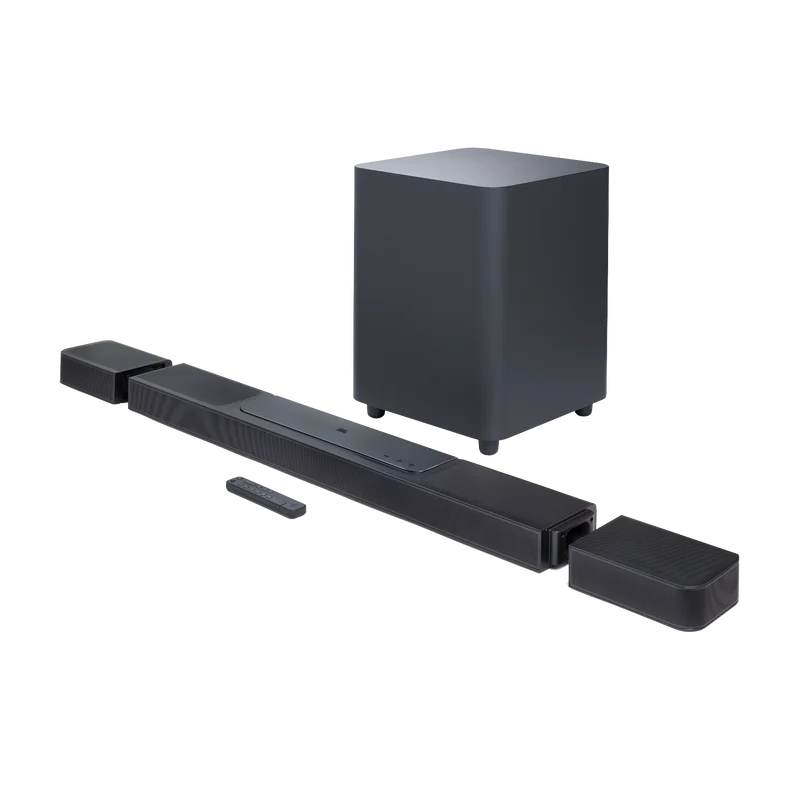
The main bar contains four up-firing drivers, while each detachable rear adds full-range, tweeter and upward-firing hardware. Together they create real 11.1.4 coverage rather than relying entirely on virtual rear channels. Channel labels describe processing and driver roles, not a guarantee that every room will produce discrete cinema-like positions. Ceiling height, side walls, seating distance and source mix strongly influence the result, especially for reflected height effects.
Subwoofer, rear channels and expansion
Battery-powered surrounds dock to the ends of the bar for charging and can be placed behind the listener without power cables. The included 12-inch subwoofer provides serious bass but occupies substantial floor space. Buyers should include the cost, power sockets and placement of every optional component when comparing systems. A complete package can deliver more convincing envelopment, while a single bar is simpler and visually cleaner.
Dialogue, calibration and everyday TV
PureVoice processing targets speech clarity and room calibration optimizes 3D effects. Rear battery state and placement influence consistency, so occasional setup attention is greater than with permanently powered satellites. These features matter as much as spectacular demo scenes because most viewing contains speech. Calibration improves consistency but cannot fully overcome a highly open room or poor source mix; manual level adjustment may still be useful.
HDMI, formats and gaming
Three HDMI inputs plus eARC offer excellent source flexibility. Dolby Atmos, DTS:X, HDR10 and Dolby Vision are supported, but the original 1300X is not the first choice for full 4K/120 console passthrough. eARC is the preferred connection for lossless Dolby Atmos from a compatible TV. Passthrough specifications matter only when sources connect through the bar; console owners should confirm 4K/120, VRR and HDR compatibility for their exact signal chain.
Music streaming and ecosystem
Wi-Fi 6, AirPlay 2, Chromecast, Alexa Multi-Room Music, Bluetooth and the JBL One app create broad music access. Detachable rears can also function as standalone Bluetooth speakers. Ecosystem advantages can be substantial, but several branded features require a compatible television or additional speakers. Core HDMI behavior and format support should remain the deciding factors for mixed-brand households.
Installation and long-term value
The package includes a massive sub and uniquely flexible rears, justifying much of its cost. Buyers must accept charging routines, a very wide docked bar and a 15.65 kg subwoofer. Soundbars are room systems rather than isolated gadgets: width, wall mounting, ventilation, cables and wireless-speaker positions deserve planning. A premium model earns its cost when it replaces a more complex receiver system without sacrificing the features the household actually uses.
Who should buy it?
Choose Bar 1300X if permanent rear-speaker power is impossible but you still want real surround for movie nights. It suits large rooms and multiple HDMI sources. Always-on users may dislike recharging satellites, and serious 4K/120 gamers should compare newer models.
Alternatives to consider
Samsung Q990D/Q990F use permanently powered rears and gaming-ready HDMI. JBL Bar 1300X MK2 is the newer successor, while Sony Bar 9 offers a cleaner standalone start. Nakamichi Dragon targets an even more extreme price and scale.
Verdict
JBL Bar 1300X solves rear-speaker wiring in an inventive way and combines it with excellent format, input and streaming support. The solution creates new chores—battery charging and docking—but for rooms where cables are the main obstacle, it delivers genuine surround that virtual bars cannot match.
Primary source
JBL Bar 1300X official specification sheet
Editorial record
Sources and updates
Product specifications and factual claims were checked against Official JBL Bar 1300X product page ↗. Scores and buying advice follow our category-specific editorial methodology.
- Published
- July 1, 2026
- Last updated
- July 25, 2026
Compare before choosing
Two strong alternatives from the same soundbars category.
Samsung HW-Q990F Review
Samsung HW-Q990F research-based review covering its 11.1.4 channels, 23 speakers, included rears and compact subwoofer, 4K/120 HDMI, calibration…
Samsung HW-Q990D Review
Samsung HW-Q990D research-based review covering its complete 11.1.4 package, included rears and subwoofer, two 4K/120 HDMI inputs, calibration…