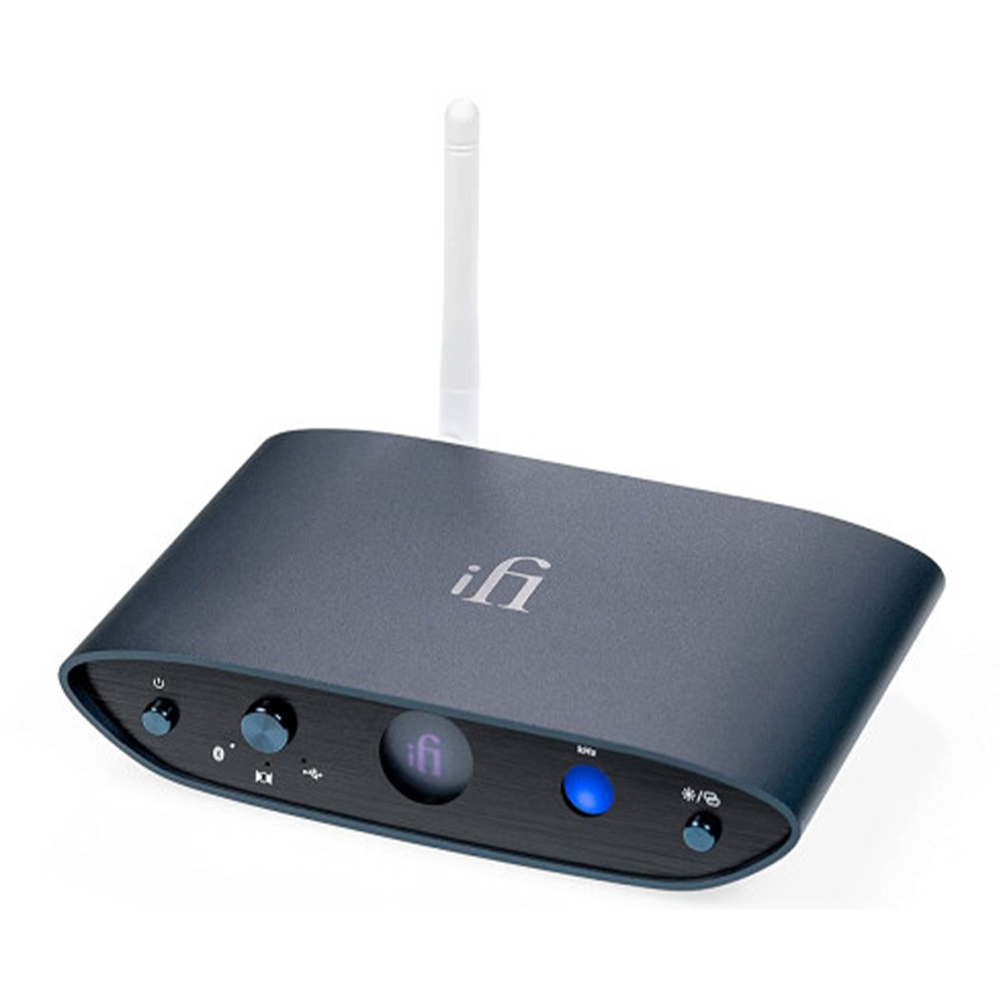
The iFi ZEN One Signature is a dedicated DAC and Bluetooth receiver for a system that already has amplification and volume control. It combines computer audio and other digital sources in a compact enclosure, but deliberately leaves out a headphone amplifier. Understanding that focus is essential before comparing it with the similarly styled ZEN DAC models.
iFi ZEN One Signature — Design and what the missing volume knob means
The ZEN One Signature follows the compact, curved ZEN enclosure style, making it easy to place beside a headphone amplifier or a small integrated stereo system. Its simplicity is central to the concept. There is no large volume control because level adjustment belongs to the next component in the chain. That can be an advantage when an existing amplifier already handles volume well: the DAC adds sources without duplicating a control you do not need.
It also means this is not an all-in-one listening station. Plugging headphones into a line connector is not an alternative to buying an amplifier. The resemblance to other ZEN products should not override the actual function labels. When planning the system, identify the source, converter, volume control and power amplification. The One Signature covers the conversion and receiving jobs; it expects other equipment to complete the chain. That clear division makes sense in separates, but less sense for a first-time buyer seeking a single box.
Digital sources and everyday convenience
Official documentation lists USB, coaxial and optical S/PDIF, plus Bluetooth receiving. That makes it useful for an amplifier which has only analogue inputs. A computer can use USB, while a compatible transport or television can have its own digital route. Select the source and let the existing amplifier remain the familiar listening interface. This is often a more useful improvement to an older system than replacing the whole amplifier solely to gain digital connectivity.
Television use needs a compatible stereo PCM output. The ZEN One Signature is not an HDMI ARC receiver and does not decode a surround soundtrack as a multichannel home cinema processor. Check the television’s output menu and available connection before buying. If convenient TV-remote volume control is the priority, an optical DAC feeding a separate amplifier may not provide the same routine as an HDMI-equipped product. The connection can work correctly while still being less convenient for that particular household.
Line outputs: 4.4 mm does not mean headphones
The analogue outputs are RCA and balanced 4.4 mm line connections, specified at 2 V and 4 V respectively. There is no variable volume control. The 4.4 mm output can feed a suitable balanced amplifier input using an appropriately wired interconnect, but it is not a headphone socket. The physical connector appears on many headphone products, which makes this distinction especially important for a mixed system.
An integrated amplifier, preamplifier or separate headphone amplifier provides the intended downstream level control. Active speakers need an appropriate way to manage volume too; connecting a fixed source does not by itself create a convenient speaker system. Start with the receiving component at a low setting and verify both channels. For a short domestic connection, RCA is a perfectly reasonable choice when that is what the amplifier accepts. A balanced connection can be useful in a compatible chain, but it is not a mandatory upgrade.
The fixed output also keeps the ownership arrangement straightforward. There is no question about which of two volume knobs was moved last, and the DAC does not need to become the centre of every action. Someone who specifically wants the converter to control active speakers should instead compare a model with variable line operation.
Sound quality and the original review evidence
AVForums’ original review was strongly positive about the ZEN One Signature’s performance, useful input selection and ease of use. That supports a favourable judgement of it as an affordable digital addition to an analogue system. It does not establish that every listener replacing a competent DAC will experience a dramatic improvement. The cited review concerns a particular system and evaluation, while our recommendation considers whether the functions solve the buyer’s actual needs.
The sensible starting question is what the existing system lacks. A noisy or inconvenient computer connection, missing optical input or the desire for occasional Bluetooth are concrete reasons to add a DAC. Expecting a small digital component to correct the tonal character of unsuitable speakers is much less reliable. Loudspeaker placement, room interaction and the headphones themselves can have a larger effect on listening satisfaction than exchanging one competent converter for another.
When comparing, keep playback levels consistent and avoid changing several components at once. A fixed line output can be louder than another source, creating a misleading impression of extra clarity. Familiar music and sustained listening are more helpful than brief jumps between unrelated recordings. The goal is a system that is enjoyable and easy to use, rather than a search for a particular chip brand’s supposed sound.
Bluetooth and file-format expectations
Bluetooth receiving is a major convenience feature, especially for a traditional amplifier without wireless access. The official codec list is broad, but the sending phone must support the chosen format as well. A receiver cannot add LDAC or an aptX variant to a source that lacks it. Check the negotiated codec if that matters to the purchase, and keep expectations separate from the general claim of high-resolution wireless support.
This is not a network streamer. A phone or other Bluetooth source still provides the music and control interface, and USB similarly depends on the connected host. For music playback without that dependency, add a suitable streamer or choose an integrated streaming product. The One Signature’s documented USB format support reaches PCM/DXD 384 kHz and DSD256. Those are compatibility limits; ordinary recordings can be played at their native rates without needing to pursue the largest figure.
Value in a separates system
The ZEN One Signature is particularly logical beside an existing analogue headphone amplifier or integrated stereo amplifier that the owner wants to keep. It adds several digital sources without buying another headphone stage or redundant volume control. That modular approach also lets the amplifier and source change independently later. A dedicated converter may therefore be a better fit than a combined unit, even if the combined unit appears to have more features for the money.
For someone starting with no other equipment, calculate the complete system cost before choosing. A DAC plus amplifier and cables can cost more and occupy more space than one well-chosen all-in-one. Current European pricing, VAT, returns and support also affect value, so an older launch-price comparison is not enough. The One Signature remains a strong shortlist product when its focused role is exactly what the system needs. It is a less suitable shortcut when the missing requirement is headphone amplification or direct speaker volume control.
Alternatives to consider
iFi ZEN DAC 3: Consider this when a USB headphone station and adjustable output are more important than the One Signature’s broader digital source selection.
S.M.S.L DO100 Pro: A published separate-DAC alternative. Compare the exact input and output-control requirements for your existing amplifier.
iFi ZEN One Signature key specifications
- Role
- Dedicated DAC and Bluetooth receiver
- Inputs
- USB, coaxial, optical, Bluetooth
- Analogue outputs
- Fixed RCA and balanced 4.4 mm line
- Output levels
- 2 V RCA; 4 V balanced
- Headphone amplifier
- Not included
- USB formats
- PCM/DXD up to 384 kHz; DSD256
- Power
- 5 V DC
Verdict
A focused and effective digital addition to an existing amplifier system, with useful wired inputs and Bluetooth. Its simplicity is a strength when volume control and amplification already exist; it is the wrong choice if you expect a headphone amp or variable line output inside the same box.
Primary documentation and independent reviews
iFi official ZEN One Signature specifications · AVForums original ZEN One Signature review
Editorial record
Sources and updates
Product specifications and factual claims were checked against Official iFi ZEN One Signature product page ↗. Scores and buying advice follow our category-specific editorial methodology.
- Published
- November 8, 2026
- Last updated
- November 8, 2026