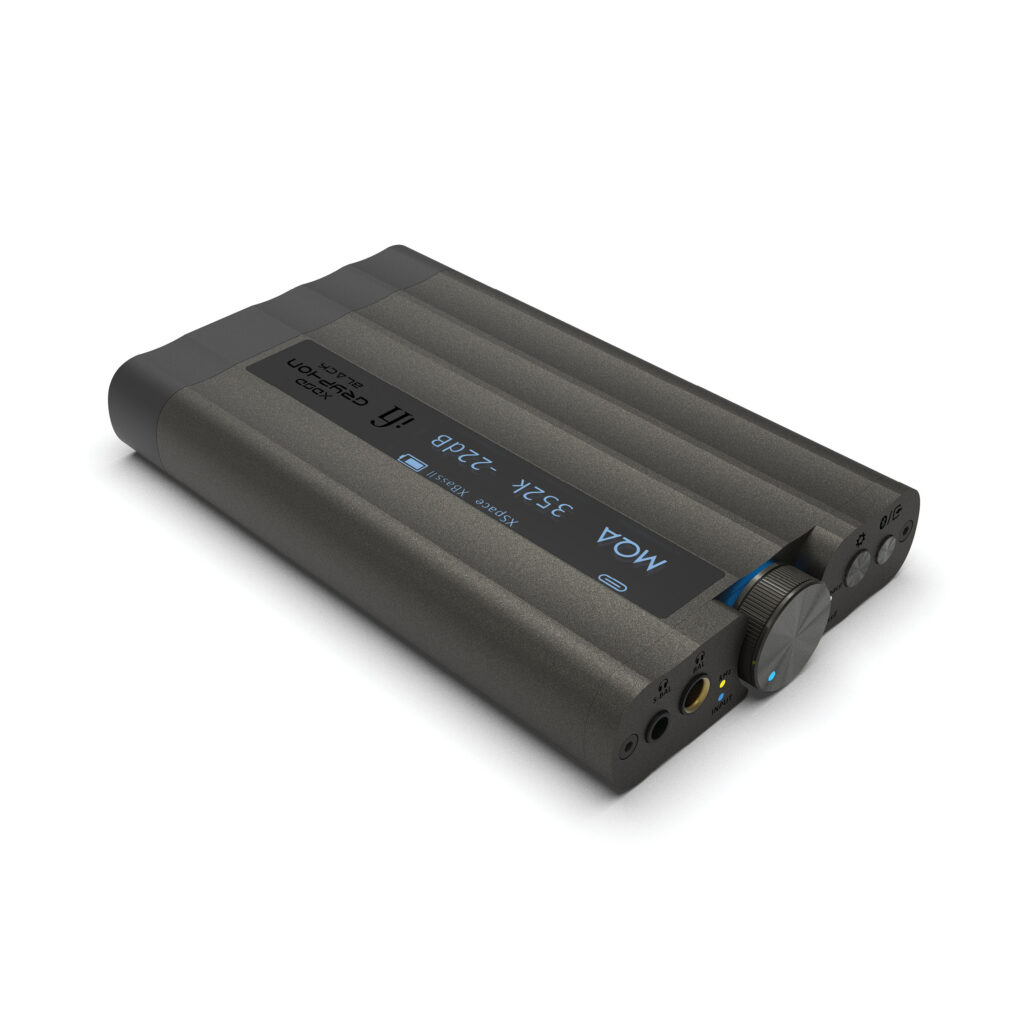
iFi xDSD Gryphon combines a portable DAC, headphone amplifier, Bluetooth receiver and analogue input stage. That range of roles is more ambitious than a basic dongle and can be genuinely useful when one device moves between a phone, computer and other sources. This research-based review considers the strong original listening evidence alongside volume, socket-role and charging details. Its premium appeal depends on using that flexibility, rather than paying for a complicated portable component when a simple wired output would be enough.
Research-based review. This assessment draws on manufacturer documentation and the original published evaluations linked below. Audio Review has not performed a hands-on test of this model.
Positive original evidence with a practical switching caveat
Headfonics’ original evaluation describes realistic voices, tight bass, good detail and lively dynamics. It also reports a thump when engaging the bass and spatial effects. Those observations and the source’s headphone pairings are third-party evidence, not Audio Review listening results.
Try the intended headphones at matched level and check quiet material as well as energetic tracks. A high output rating should not replace an assessment of noise, usable adjustment and headroom. The review’s positive account supports the Gryphon as a serious portable candidate without guaranteeing ideal results with every difficult load. Test the effects switch at a low level and decide whether those options are useful in the normal routine. A versatile component should be enjoyable with its basic functions, not dependent on constant menu changes. The strongest case is a complete arrangement that combines capable playback with source flexibility. If the extra roles never get used, a smaller or less expensive device may provide a better everyday result.
Digital and analogue sources make it more than a USB accessory
The supported source routes include USB, Bluetooth, a shared SPDIF coaxial/optical input and analogue line input. Optical connection requires the appropriate mini-Toslink arrangement rather than assuming that any 3.5 mm cable carries a digital optical signal.
Map the desired sources and select the matching operating mode. A suitable line source can use the analogue input, while a bare turntable output still requires an appropriate phono stage elsewhere. The SPDIF socket is an input, not a digital transport output for feeding another DAC. That distinction matters when comparing portable devices with similar-looking rear connections. USB also requires a source that actually supports the intended audio route; a connector by itself is not enough. Bluetooth is receiving convenience, not native Wi-Fi service playback. The Gryphon is particularly coherent when it moves between several real sources. Its input flexibility is less valuable if one phone and one headphone are the only planned use and no additional connection is likely to be needed.
Rear analogue sockets change function with source mode
The manual identifies the rear 3.5 mm and 4.4 mm connections as analogue inputs in Line mode and variable outputs when a digital source mode is selected. These are different roles from the front headphone connections.
Confirm the selected mode before attaching another component. A variable line output needs a sensible volume arrangement with an amplifier or active speakers. Begin low, identify which component controls listening level and check behaviour after changing modes or restarting. Do not interpret the same plug size as proof that sockets can be interchanged. Correctly wired balanced interconnects and headphone cables have specific destinations. If several outputs are connected, verify what remains active rather than assuming private headphone listening automatically silences every speaker path. This flexibility can replace separate boxes in a temporary or compact system, but it also demands a clear routine. The benefit comes from using the documented routes deliberately, not from treating every available socket as a universal input and output at the same time.
iEMatch and volume settings help a varied headphone collection
Front single-ended and balanced headphone outputs cover different cable arrangements, while iEMatch reduces output level for sensitive earphones. The menu also includes volume-related settings. These facilities support matching but do not remove the need to test the actual transducer.
Start low and check quiet adjustment, channel consistency and background noise. Follow the documented iEMatch position for the chosen socket. A headphone’s sensitivity matters alongside impedance, so neither a broad impedance range nor a headline watt figure establishes universal suitability. Use a correctly wired balanced headphone cable and avoid common-ground adapters that join independent negative channels. Set a sensible volume limit if useful, then verify behaviour after reconnecting the source or changing its volume synchronisation settings. Software and device controls can interact, so a repeatable baseline is more important than a familiar knob position. The Gryphon offers useful tools for a mixed collection, with the recommendation strongest when those tools produce comfortable operation for the headphones actually owned.
Charging and portable size deserve a realistic trial
Separate USB-C roles allow data and charging to be managed, with menu control over charging through the data connection. The internal battery makes the Gryphon transportable, but it remains a larger and heavier arrangement than a small dongle.
Use the documented cable and power setup for the actual phone or computer. Check whether the phone is supplying power unexpectedly and whether playback remains stable after sleep or reconnection. Do not assume that any high-rated charger creates fast charging outside the supported requirements. Plan endurance around a realistic session at the intended output and level, especially on a used unit with an older battery. Charging while listening can affect the practical routine and temperature, so allow sensible ventilation and avoid burying the device beneath insulating material. Try the full phone, receiver and headphone cable arrangement before buying a carrying accessory. The portability is most useful when it suits the way the owner moves between locations, rather than when a heavy stack spends every day in one place.
Wireless and sound options are useful when chosen deliberately
Bluetooth supports several codecs, while XBass II and XSpace provide optional listening adjustments. Actual wireless mode depends on the source, and the effects are preferences rather than automatic improvements for every headphone and recording.
Check connection stability with the phone in its normal location. A more ambitious codec mode is not useful if it causes interruptions in the intended environment. For video, test synchronisation in the actual application. Begin listening without processing and compare options individually, keeping level sensible. Extra bass or presence can help one pairing and be excessive with another. Follow matching official firmware instructions if an update is relevant, and verify exact Gryphon identity rather than borrowing features from a later iFi product. Compare current local offers with accessories, warranty support and battery condition included. The Gryphon has a strong value case when its several source and control roles genuinely replace extra equipment. Its premium becomes harder to justify when those facilities are only items on a checklist.
Alternatives to consider
iFi hip-dac 3: A simpler wired portable system can be better value if the Gryphon’s analogue input and wireless roles would remain unused. Compare the actual cable and headphone routine.
iFi iDSD Diablo 2: Consider a different portable power-and-control approach when the actual headphones justify it. Include physical bulk, charging and supported input functions in the comparison.
iFi xDSD Gryphon key specifications
- Role
- Portable DAC, headphone amplifier and variable line-output device
- DAC
- Burr-Brown platform
- Digital inputs
- USB-C; shared 3.5 mm coaxial/optical SPDIF input with appropriate cable
- Wireless
- Bluetooth 5.1 receiver with source-dependent codec selection
- Analogue input
- Rear 3.5 mm single-ended or 4.4 mm balanced in Line mode
- Headphone outputs
- Front 3.5 mm and balanced 4.4 mm
- Rear analogue outputs
- Variable line output when using digital source modes
- Manufacturer 32-ohm headphone rating
- Over 320 mW single-ended; over 1000 mW balanced
- USB formats
- Supported PCM up to 768 kHz and DSD512 in appropriate configuration
- Controls
- OLED display, iEMatch, XBass II, XSpace and volume settings
- Size / weight
- Approximately 123 × 75 × 19 mm; 215 g
- Battery capacity
- 3,600 mAh lithium-polymer
Verdict
xDSD Gryphon is a persuasive research-based transportable DAC/amp with strong original evidence and useful digital and analogue flexibility. Verify socket roles, volume behaviour, headphone matching and charging. Its best value lies in a real multi-source listening routine, with the extra complexity justified by functions the owner will actually use.
Documentation and original reviews
iFi official xDSD Gryphon product · iFi official Gryphon user guide and output-mode instructions · Headfonics original Gryphon design and connectivity evaluation · Headfonics original Gryphon listening and pairing evaluation
Editorial record
Sources and updates
Product specifications and factual claims were checked against Official iFi xDSD Gryphon product page ↗. Scores and buying advice follow our category-specific editorial methodology.
- Published
- November 17, 2026
- Last updated
- November 17, 2026