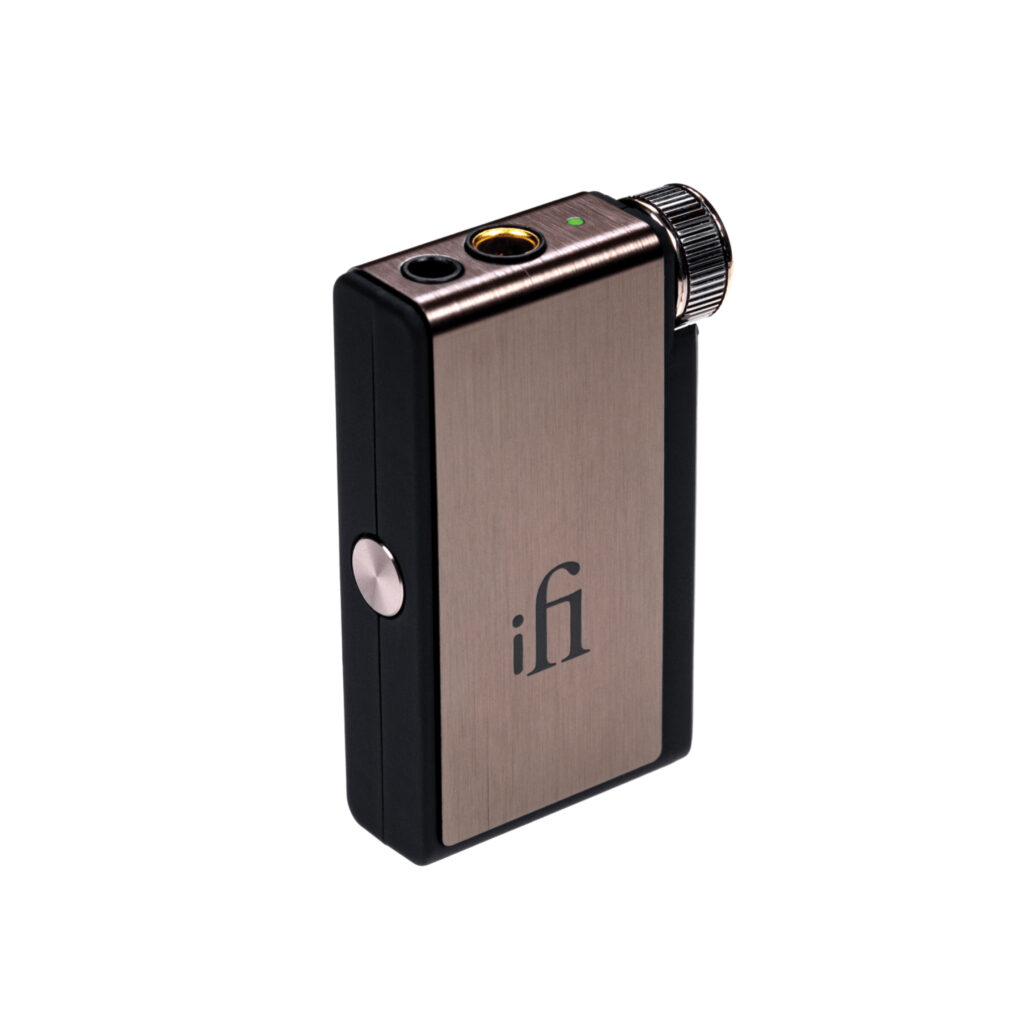
iFi GO blu is a tiny Bluetooth receiver and DAC/headphone amplifier for people who want to keep wired headphones without running their cable directly to the phone. Physical volume and optional sound controls make it more than a basic wireless adapter, while USB audio provides a second source route. This research-based review considers the positive original listening evidence alongside battery care, codec compatibility and headphone demands. Its appeal is the complete portable routine, not a claim that a very small box replaces every desktop amplifier.
Research-based review. This assessment draws on manufacturer documentation and the original published evaluations linked below. Audio Review has not performed a hands-on test of this model.
Detailed and engaging in an original review
What Hi-Fi’s original evaluation describes a clear, engaging presentation with good separation and sensitive handling of musical dynamics. Those impressions support the GO blu as more than a convenience accessory, but they belong to the original reviewer’s system. Audio Review has not performed a listening test of this model.
Try it with the actual earphones or headphones rather than assuming the result from another pairing. Match volume when comparing it with a wired source, because a louder presentation can seem more detailed or spacious. Assess quiet passages, vocal balance and the range of comfortable adjustment. A portable receiver earns its place when it makes listening easier while preserving a result the owner enjoys. It does not need to produce a dramatic change in every system to be useful. The positive evidence makes the GO blu a credible shortlist choice, with final suitability tied to the transducer, connection stability and convenience rather than to an unqualified promise of better sound from every phone.
Bluetooth frees the phone, not the headphones
The phone sends audio wirelessly to the receiver, while the headphone cable still connects to the GO blu. This changes where the cable runs and can make it easier to handle a phone without moving the headphones at the same time.
Try the physical routine before assuming it is ideal for exercise, commuting or desk use. A wired receiver is not a true-wireless earbud, and the remaining cable can still catch on clothing. Consider where the small box will sit and whether the controls remain accessible. Check playback while the phone is in its normal pocket or bag, not only when both devices are on a table. Wireless range and stability depend on the environment and source, so a maximum codec setting should not outrank a reliable connection. The GO blu is particularly useful when a favourite wired headphone is already comfortable and there is no desire to replace it. Its convenience is less persuasive if the cable and another battery create more friction than a direct dongle.
Codec support is shared between two devices
The receiver supports several Bluetooth codecs, but the sending device must support the selected route as well. A compatible receiver cannot force an unsupported codec onto a phone. Bluetooth capability is also distinct from the wired USB-audio connection.
Confirm what the actual source negotiates and assess practical playback rather than reading the full codec list as a universal promise. Do not assume a service’s lossless label describes the complete Bluetooth transmission path. If a particular supported wired format matters, use the appropriate USB connection and verify source settings. Different operating systems and applications can handle audio differently. For video and games, test synchronisation in the intended application rather than assuming that a low-latency codec is always available or active. A stable everyday link can be more useful than chasing the most ambitious mode. The right connection is the one that provides reliable listening and a result the owner prefers with the actual source, rather than the one with the most impressive name in a product description.
Small headphone outputs still require sensible matching
The GO blu provides 3.5 mm and balanced 4.4 mm headphone connections. The manufacturer lists different output ratings for those routes. Those figures are not a complete recommendation for every headphone or listening level.
Start low and check noise with sensitive earphones, useful volume adjustment and headroom with less efficient headphones. Impedance alone is not enough to predict the requirement. Use a correctly wired balanced cable if choosing 4.4 mm, and never join independent negative channels through an unsuitable common-ground adapter. A proper single-ended connection can remain entirely satisfactory. Match loudness before deciding whether one supported route sounds preferable. The small case is valuable for portability, but it should not encourage an assumption of unlimited drive or desktop-style input flexibility. If a difficult headphone is the main purpose, compare the complete result with a more suitable amplifier. An easy daily pairing is a stronger reason to buy than a maximum rating divorced from its load and connection conditions.
Sound controls are optional, and battery claims need context
XBass and XSpace offer quick listening adjustments. Their usefulness depends on the headphone and recording, rather than requiring both to remain engaged. The built-in battery also needs a realistic place in the charging routine.
Begin with processing off and compare one option at a time. Extra bass can help a lean presentation but may be unnecessary with an already warm headphone. Spatial adjustment is a preference, not a guarantee of more accurate reproduction. For battery planning, note that the current product page contains an approximate eight-hour specification and an up-to-ten-hour marketing claim. Neither is an Audio Review endurance result. Output level, headphone load, connection mode and battery age affect actual use. Test a typical session rather than planning a journey around the largest advertised number. A used unit should be checked for practical endurance and charging behaviour, not merely whether it powers on. The convenience of a tiny receiver depends on it being ready when the owner wants to listen.
USB audio and calls add useful secondary roles
USB-C can carry supported digital audio as well as serving the charging arrangement, and the built-in microphone supports compatible call use. Those functions can make the unit useful beyond music, although they do not create a full desktop interface.
Check the cable supplied by the seller and any additional connection needed for the intended phone or computer. Test recognition, playback and microphone selection in the actual call application. A microphone on a receiver does not guarantee identical behaviour from every connected headphone cable or operating system. Confirm where the receiver sits during a call so clothing and handling do not dominate the voice pickup. The original GO blu is distinct from similarly named later products, so verify exact identity and matching support instructions. Compare current local offers with warranty support and any accessories included. Its strongest value is a compact daily arrangement that combines enjoyable music with straightforward phone handling. Buyers who mainly listen at a desk may find a larger combined unit more convenient.
Alternatives to consider
FiiO BTR15: Compare the real phone connection, controls and headphone match. Include the charging routine and useful output rather than choosing a receiver only by its codec list.
iFi hip-dac 3: Consider a larger wired portable route when direct USB listening is the priority. The extra size may be worthwhile if the actual headphone needs and controls justify it.
iFi GO blu key specifications
- Role
- Battery-powered Bluetooth receiver and USB DAC/headphone amplifier
- DAC
- Cirrus Logic CS43131
- Digital sources
- Bluetooth 5.1 and USB-C audio up to 24-bit/96 kHz PCM
- Headphone outputs
- 3.5 mm single-ended and 4.4 mm balanced
- Manufacturer output at 32 ohms
- 165 mW single-ended; 245 mW balanced
- Sound options
- XBass and XSpace
- Calls
- Built-in microphone and supported call controls
- Battery
- Manufacturer specification approximately eight hours depending on use; marketing also quotes up to ten hours
- Size / weight
- Approximately 54 × 34 × 13 mm; about 27 g
- Not provided
- Wi-Fi playback, optical input or analogue line input
Verdict
GO blu is a convincing research-based portable receiver when keeping wired headphones and freeing the phone are clear priorities. Check the actual Bluetooth mode, headphone match and battery routine. Its small size and physical controls are useful, with positive original musical evidence and a clear distinction from a network player or all-purpose desktop amplifier.
Documentation and original reviews
iFi official GO blu product, specifications and connection guidance · What Hi-Fi original GO blu evaluation · Headphonesty original GO blu evaluation
Editorial record
Sources and updates
Product specifications and factual claims were checked against Official iFi GO blu product page ↗. Scores and buying advice follow our category-specific editorial methodology.
- Published
- November 17, 2026
- Last updated
- November 17, 2026