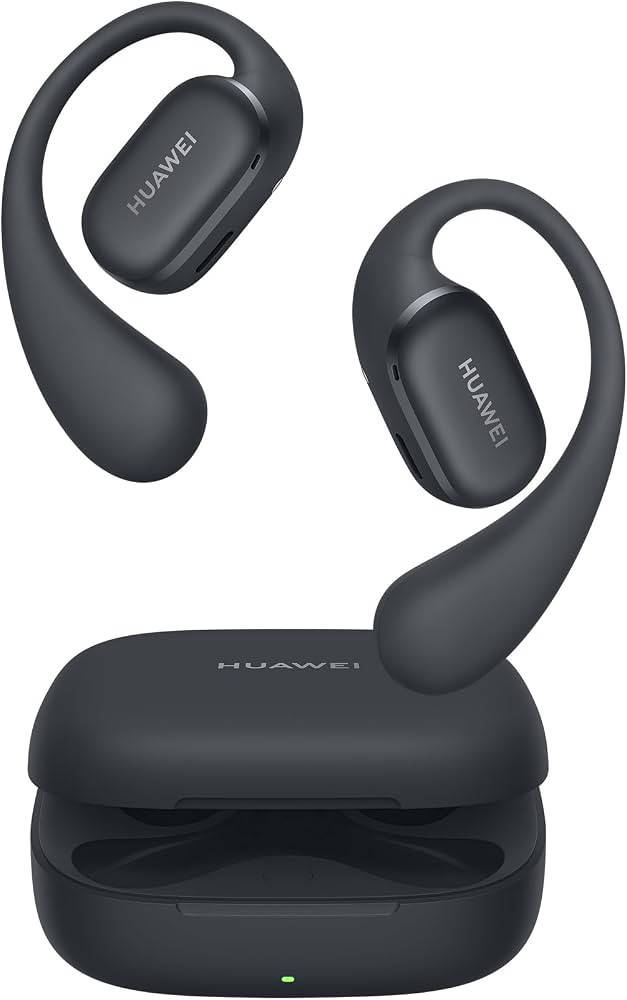
Huawei FreeArc takes an open-hook approach to everyday and activity listening, leaving the ear canal unsealed. Its original reviews are positive about comfort and music in suitable surroundings, with touch-control and noisy-environment limitations. It is an air-conduction design rather than bone conduction, and microphone noise processing should not be confused with ANC for the listener. The strongest case is a comfortable open pair bought at an appropriate current price for a clearly defined role.
Research-based review. This assessment draws on manufacturer documentation and the original published evaluations linked below. Audio Review has not performed a hands-on test of this model.
The hook fit is the practical starting point
Expert Reviews and TechRadar both find the FreeArc comfortable and stable in their own activity use. The manufacturer specifies approximately 8.9 grams per earbud, distributed around a flexible hook. Those accounts make it worth a trial, while leaving personal ear shape and wearing accessories important.
Try the hooks with the glasses, cap or other headwear normally used. Check both sides independently and include ordinary movement rather than deciding only while seated. A speaker that stays near the useful position can sound more consistent, but retention should not require distracting pressure. Wear the pair for the intended session length to check contact behind and above the ear. Also practise putting it on without pulling the support unnecessarily. The best fit should be easy to repeat, comfortable after the initial novelty and stable through the actual activity. A positive original review is useful guidance, but it cannot establish the same physical result for every listener.
Open listening works best in the right surroundings
The design leaves environmental sound audible and offers no listening ANC. Expert Reviews finds a useful balance during quieter activity but needs considerably more playback level in noisier places. That is a format limitation to consider before comparing smaller specification differences.
Try a familiar spoken recording in the normal room or route. Check whether words remain easy to follow without repeatedly raising level when noise increases. A pair that is pleasant for household tasks may be less useful on public transport. Likewise, a listener wanting casual conversation may prefer an unsealed arrangement that another buyer finds distracting. Check leakage beside a nearby person rather than treating directional processing as an absolute privacy guarantee. The product should be chosen for the interaction and wearing preference it serves. If concentration and isolation are the primary need, a different construction may provide a more suitable experience than attempting to overcome the surrounding environment through volume alone.
The music evidence is encouraging for this format
TechRadar is especially positive about the sense of space, detail and energy in quieter conditions. That favourable assessment should remain tied to its original test and the open-ear context, rather than becoming a universal claim of superiority over conventional in-ears.
Compare a vocal recording, acoustic instruments and a rhythmically dense track. Listen for whether individual parts remain easy to follow and whether the bass has enough body for the intended use. A listener may value clear accompanying music during activity without needing the same low-frequency pressure as a sealing earbud. Someone whose main pleasure comes from powerful bass should compare a sealed alternative directly. Keep loudness similar and check whether small movements change the result. The most useful outcome is enjoyment across the actual library in normal surroundings. An impressive driver dimension or enthusiastic headline should not replace that comparison, especially when the environment can obscure the very detail that makes the sound appealing at home.
Touch controls and calls need an activity trial
The official controls include tapping and swiping for volume. TechRadar finds swipes more temperamental than taps, while Expert Reviews highlights inconsistency when the controls are wet. Its calling account is broadly useful but notes that strong wind still intrudes.
Try the required gestures with the phone out of sight and check whether reaching the control area shifts the speaker. A system that works neatly while stationary may be less convenient during movement. Learn the current app assignments and avoid assuming every gesture can be mapped without restrictions. Conduct a complete call in the usual setting and ask the other person about words, interruptions and background noise. A microphone noise-processing description is not evidence that every outdoor conversation will be clear. If frequent control changes or difficult calls dominate the routine, compare those tasks directly with another design. Physical comfort and enjoyable music are strengths, but ordinary operation still needs to remain predictable.
App access and dual-device use should be checked early
Huawei provides app-based adjustment and dual-device connection, but setup routes can differ by phone. TechRadar finds the Android app installation more involved than a familiar single-store process. Huawei’s current guidance also identifies its relevant iOS management app.
Check the present official instructions for the exact handset and region before purchasing for a specific app function. Use the manufacturer’s distribution route rather than an unrelated download site. Test the real computer and phone together, including an incoming call and a return to the original music source. Standard Bluetooth listening and ecosystem-only conveniences are separate matters. A person who wants simple playback may need fewer adjustments than someone managing several devices and custom profiles. Consider that difference when assessing setup effort. The best configuration is the one that remains reliable through ordinary tasks, without treating the absence of a favourite advanced codec or an unused novelty feature as more important than comfort and a stable connection.
Durability and battery claims need their boundaries
Huawei rates the earbuds IP57 and explicitly excludes the case from water resistance. It claims seven hours of music playback and 28 hours including the case. USB-C is the charging route, without wireless charging. The cumulative total requires intervals in the case rather than one continuous session.
Follow the official cleaning, drying and charging instructions after activity. A protection label should not be converted into an unrestricted swimming or underwater Bluetooth recommendation. Plan the longest session with room for volume, calls and battery age. Check that the case is convenient in the pocket or bag used each day, and confirm the accessories in the particular regional offer. Compare the present delivered price with other open hooks and clips instead of relying on the original launch position. FreeArc is strongest when its comfortable fit and enjoyable open listening meet a real need. It is less attractive if noisy surroundings or awkward controls repeatedly undermine those advantages during the routine for which it was bought.
Alternatives to consider
Shokz OpenFit Air: Compare this existing open-hook review when fit and straightforward daily listening are the main priorities. Use the actual local price and try the hooks with normal glasses and headwear. An open design still needs a personal comfort check.
Bose Ultra Open Earbuds: A useful clip-style alternative if an over-ear hook creates awkward contact. Compare long-session comfort, controls and music before choosing the support system. The different construction may matter more to the routine than a small specification difference.
Huawei FreeArc key specifications
- Technology
- Open-ear air conduction
- Driver
- 17 × 12 mm per earbud
- Earbud weight
- Approximately 8.9 g each
- Case weight
- Approximately 67 g
- Bluetooth
- 5.2
- Codecs
- SBC and AAC
- Connections
- Two devices
- Noise cancellation for listening
- None
- Controls
- Touch gestures and volume swipe
- Battery claim
- Up to 7 h earbuds; 28 h including case
- Charging
- USB-C; no wireless charging
- Protection
- IP57 earbuds; case not water-resistant
Verdict
FreeArc is a strong established open-hook candidate for comfort, enjoyable music in quieter places and practical value. Its unsealed format, touch controls and app setup deserve a real trial. Buy it for the role it serves well, with realistic expectations about noise, charging and long-session endurance.
Documentation and original reviews
Huawei official FreeArc specifications · Huawei official FreeArc features and app guidance · Expert Reviews original FreeArc evaluation · TechRadar original FreeArc evaluation
Editorial record
Sources and updates
Product specifications and factual claims were checked against Official Huawei FreeArc product page ↗. Scores and buying advice follow our category-specific editorial methodology.
- Published
- November 17, 2026
- Last updated
- November 17, 2026