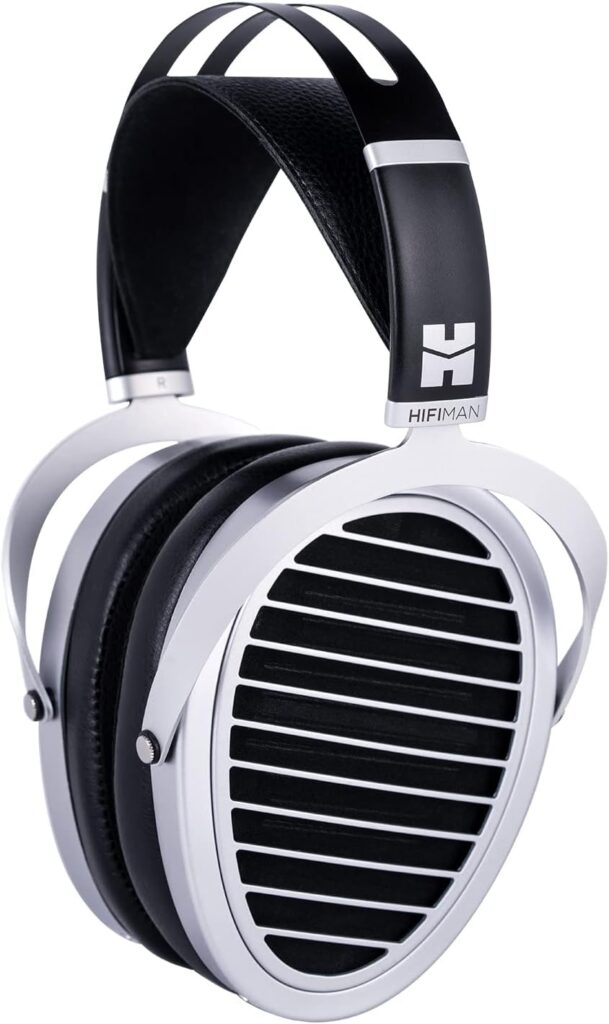
The HiFiMAN Ananda Nano takes the company’s large-cup open planar concept and places its thin-diaphragm technology in a comparatively accessible model. Its attraction is a clear, revealing presentation without flagship pricing. The trade-offs are familiar but important: a large physical fit, very little isolation and a treble balance that should be checked against the listener’s own tolerance.
HiFiMAN Ananda Nano — Design and model identity
The Nano is a particular version of the Ananda, not a generic name for every headphone in that family. HiFiMAN’s official guide identifies an open-backed design with its nanometre-thickness diaphragm and Stealth Magnets. Listings for earlier Ananda variants should not be used as a substitute for the Nano’s specifications or accessories.
The official technical table gives 14-ohm impedance and 419.6 g weight. It lists sensitivity as 94 dB without a reference unit in that table. Headfonics expresses the sensitivity per milliwatt in its review, but preserving the distinction is preferable to silently adding a measurement condition to the manufacturer’s document.
Large asymmetric earcups are central to the design. They provide a different fit from the round cups found on many conventional headphones. That can create welcome space around the ears, but the lower pad edge extends further down the face. Whether it works well depends on the listener’s head and jaw rather than the apparent size of the opening alone.
Sound quality and treble
Headfonics’ original review reports strong transient definition and a detail-forward presentation with more bass presence than the earlier Ananda. It also identifies a bright character and treble energy that can become prominent with cymbals. That combination supports a positive assessment for analytical listening, with a clear reservation for buyers sensitive to the upper range.
The practical test is whether detail remains useful across an entire album. A revealing balance can make background instruments and reverberation easy to notice. It can also place emphasis on recording flaws that another headphone softens. Neither outcome is universally preferable; the right choice depends on whether the owner wants close inspection or a more forgiving everyday presentation.
Listen to vocals separately from cymbals. A headphone may make percussion seem very explicit while also making consonants more insistent than expected. Include a bright recording that you know well in an audition rather than evaluating only polished demonstration material. Lower the level before deciding that more volume makes the sound more complete.
Equalisation can be useful if the source supports it, particularly for a listener who already knows a preferred tonal target. Small adjustments are a better starting point than applying a large preset without checking it. Measurements from a standardised fixture are valuable references, but personal ear geometry can move the apparent position of high-frequency features.
Bass, openness and musical use
The published account suggests that the Nano combines substantial low-frequency capability with an explicit upper range. For buyers, bass extension should be considered separately from bass emphasis. It is possible to hear low notes clearly without receiving the elevated bass weight associated with many portable headphones.
Compare a sustained synthesiser note, a recorded kick drum and an acoustic bass. These ask different questions about extension, impact and pitch definition. If the balance is too light for the preferred music, make that judgement directly. An expensive amplifier should not be expected to act as an undocumented bass control.
The open enclosure makes the room part of the listening experience. Quiet environmental sounds remain audible, while music can be heard by nearby people. The Nano is therefore best suited to a private space. It is poorly matched to commuting, tracking beside sensitive microphones or blocking conversation in a shared office.
For games and film, a wired connection is straightforward and avoids Bluetooth pairing. Spatial impressions still depend on the recording, game engine and listener; the headphone does not turn every source into a guaranteed surround presentation. A separate microphone is required for communications, with leakage checked at the actual listening level.
Comfort and long sessions
Headfonics notes relatively strong clamping pressure in its sample, alongside the benefits of the large pads. That is a more useful buying detail than a simple statement that the headphone is comfortable. Pressure distribution and adjustment range can determine whether a substantial headphone remains pleasant after an hour.
Try the Nano while looking down, turning your head and leaning against the chair normally used for music. Check that the headband adjustment has enough travel and that the pad does not bear unevenly against the jaw. Glasses should stay on during the test, since their arms can change both pressure and the acoustic seal.
Pads are replaceable, but their condition and type affect the response. A heavily worn demonstration sample may not represent a new retail pair, and an aftermarket pad may change the tuning substantially. Ask about original replacements and their cost before treating the purchase as a long-term listening investment.
Source matching and connections
The 14-ohm load deserves an amplifier capable of clean operation into low impedances. It is not enough to see a low impedance number and assume any phone output will be ideal. Output impedance, current capability and volume headroom should be considered together. A compact competent desktop DAC and amplifier is a practical partner.
Use the lowest gain setting that provides sufficient level. A comfortable volume range and low noise are more useful than the ability to reach unnecessarily loud levels. If quiet recordings require the control to be near its limit, assess available headroom before concluding that the headphone lacks dynamics.
The guide shows detachable 3.5 mm earcup connections and a source connection with a 6.35 mm adapter. Accessory details deserve a retailer check: the official guide lists a 1.5 m lead, while an original review describes a longer supplied cable. Avoid assuming every regional or later package matches one review sample.
A replacement cable can improve desk handling or match a different amplifier termination. It should be chosen for correct wiring and suitable physical fit. Balanced operation is useful when it accesses an appropriate amplifier output; it is not an independent measure of headphone quality.
Value and ownership
The Ananda Nano is attractive when its actual selling price, personal fit and treble balance align. Its appeal is strongest for a listener who values an explicit presentation and can provide a quiet place to use it. A warmer preference or an uncomfortable fit can easily outweigh technical interest in the diaphragm.
Check warranty handling and authorised supply in Europe, particularly when comparing heavily discounted offers. Confirm the exact model name, whether the unit is new or refurbished and what the return policy covers. Headphone pricing can change sharply, so a launch review’s cost comparison should be revisited against current alternatives.
The sensible system budget leaves room for a suitable source and future pads without assuming an expensive chain is compulsory. If an existing amplifier already provides clean reserve, the most valuable improvement may simply be a quieter listening position. The Nano should be bought for a presentation you enjoy, rather than as the next unavoidable step in an upgrade ladder.
Alternatives to consider
HiFiMAN Edition XS: Another large-cup planar to compare for headband fit, balance and the actual price available locally.
HiFiMAN Sundara: A different physical format that may suit a listener who finds the Nano’s elongated pads awkward.
Sennheiser HD 600: An established dynamic alternative when vocal balance and a more compact earcup arrangement are the main priorities.
HiFiMAN Ananda Nano key specifications
- Design
- Open-back planar magnetic
- Technology
- Nanometer Thickness Diaphragm and Stealth Magnets
- Impedance
- 14 ohms
- Sensitivity
- 94 dB listed in official guide; reference unit not stated there
- Weight
- 419.6 g
- Connections
- Detachable 3.5 mm earcup sockets
Verdict
The Ananda Nano offers a persuasive route to detailed open planar listening, provided its prominent treble and large fit suit the owner. It needs a quiet room and a suitable low-impedance headphone output. A careful audition and exact package check matter more than its technology labels or a historical launch-price comparison.
Primary documentation and independent reviews
HiFiMAN Ananda Nano official owner’s guide · HiFiMAN UK Ananda Nano product page · Headfonics original Ananda Nano review · Headfonia original Ananda Nano review
Editorial record
Sources and updates
Product specifications and factual claims were checked against Official HiFiMAN Ananda Nano product page ↗. Scores and buying advice follow our category-specific editorial methodology.
- Published
- November 7, 2026
- Last updated
- November 8, 2026