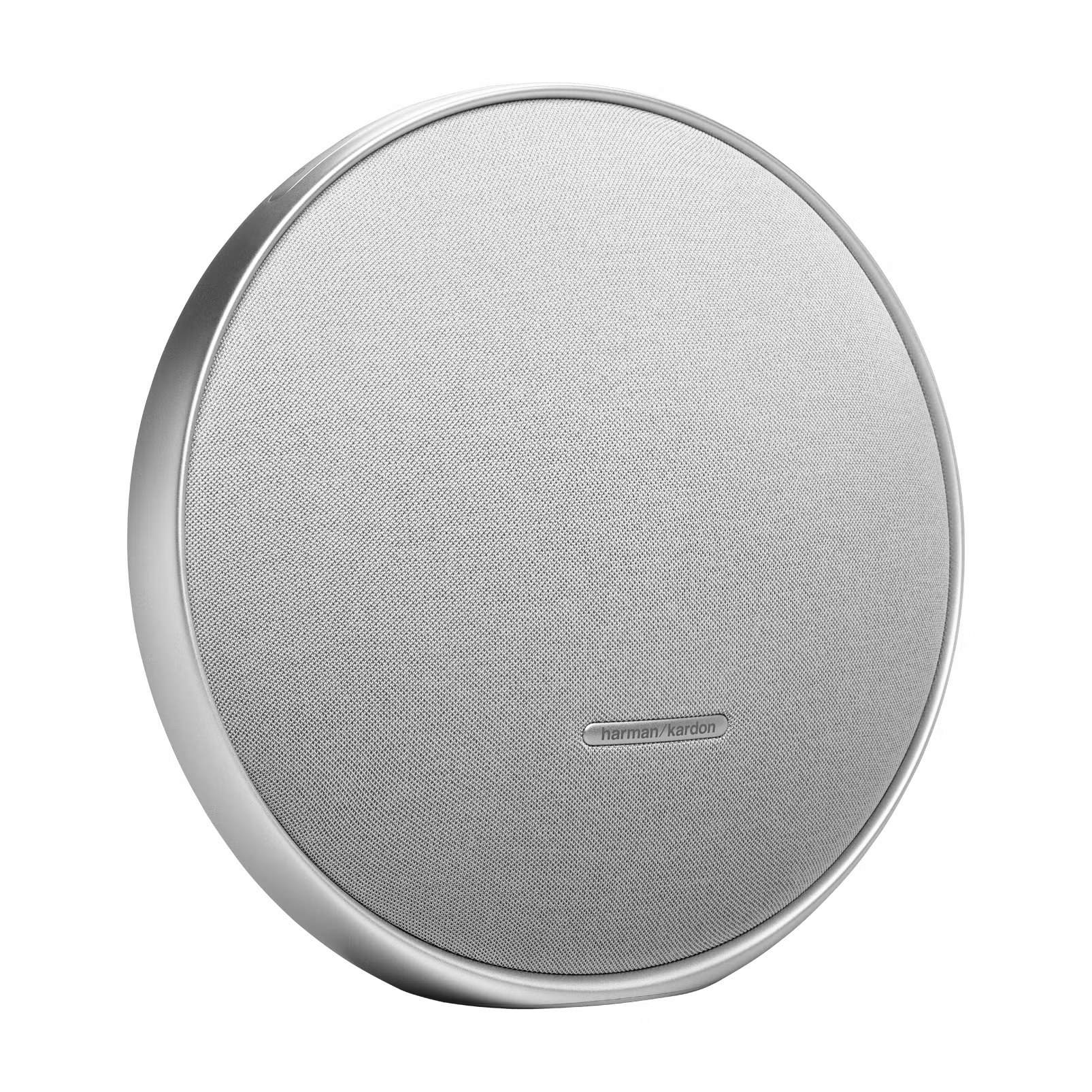
Harman Kardon Onyx Studio 9 is a movable home speaker, with a handle and battery that make indoor repositioning convenient. Its restrained design and app support are stronger reasons to investigate than the idea of a rugged all-day outdoor companion. The original test finds clear speech and useful room adjustment, alongside limited deepest bass, high-level compression and modest practical endurance. Regional USB differences also matter to European buyers, so connection expectations should be checked before purchase.
Research-based review. This assessment draws on manufacturer documentation and the original published evaluations linked below. Audio Review has not performed a hands-on test of this model.
A speech-friendly balance suits an indoor routine
RTINGS finds natural clear voices and a generally balanced upper presentation, with extra lower-midrange warmth rather than extensive deep bass. That supports spoken programmes and ordinary music around the house without promising the weight of a larger party speaker or separate subwoofer.
Try a familiar podcast, a singer with acoustic accompaniment and a bass-heavy recording. Decide whether the warmth makes listening comfortable or gives some material too much thickness. Check the normal listening distance and level, not only a brief demonstration close to the grille. Someone mainly using the speaker while working or cooking may prefer clear words and easy handling to very deep impact. A listener wanting large-scale electronic music at gatherings should compare a different class of product. The useful buying question is which system serves the normal room and library, rather than whether the brand’s sound terminology promises the most impressive experience in every setting.
Self-tuning helps placement, but does not make it irrelevant
The speaker automatically adapts when powered on, and the app provides further adjustment. RTINGS still identifies a front-facing character and changes at different listening angles. Automatic calibration is therefore useful context, not proof that every location or seat receives identical sound.
Place the front toward the main listening area and keep the grille unobstructed. Try moving it away from a corner before applying a large EQ correction for excess warmth. Walk to the normal seats and check voice clarity. If the household uses it in several rooms, assess each ordinary position instead of expecting one stored preference to solve every layout. Keep a familiar reference setting while experimenting so changes remain easy to judge. A product that moves conveniently can still benefit from a little care each time it is set down. The strongest use of self-tuning is helping a sensible placement work well, rather than asking processing to compensate for a blocked or poorly aimed enclosure.
The battery is for movement within a realistic schedule
Harman Kardon advertises up to eight hours, while RTINGS reports around six under its own conditions. The official support notes also explain that maximum loudness is higher on AC than battery. Power mode is part of the listening configuration, not merely a choice of how the same result is supplied.
Try the actual room-to-room routine at the preferred level. Check whether a normal evening fits comfortably without planning to the last advertised minute. A speaker used near mains for part of the day can be convenient even if it is less suited to an all-day park outing. Recharge before a longer battery session and allow time for the full process. If using the speaker’s device-charging output, account for the extra demand and the manufacturer’s conditional behaviour. A phone charging feature does not create additional energy. The useful outcome is a predictable schedule for both devices. Buyers who need sustained high output away from mains should compare products designed around that requirement before choosing chiefly for the styling.
European buyers should verify USB expectations
The official datasheet explicitly limits USB audio playback to the US version and describes other versions differently. That restriction must take precedence over assuming a USB-C connector supplies universal wired playback. The current UK page’s general file-format field does not remove the regional qualification.
Check the exact local model and manual before buying for a computer, storage device or other wired source. Do not assume a familiar plug makes the speaker a USB DAC or general-purpose audio interface. Ask for a demonstrated supported route if the purchase depends on a specific connection. A turntable buyer should establish the complete source chain, including any phono stage and compatible destination input, before treating a Bluetooth home speaker as a direct replacement for an integrated system. For ordinary phone streaming, these distinctions may be unimportant. For a source-specific purchase, they can determine suitability. The review recommendation therefore rests on documented regional capability rather than merging every market’s features into one apparently more versatile product.
Stereo and group linking are specific expansion choices
The official documentation supports a pair of Onyx Studio 9 speakers and compatible Auracast grouping. A single enclosure already contains several drivers, but a physically separated pair offers a different listening arrangement. Neither should be confused with unrestricted Wi-Fi multiroom service support.
Identify the desired layout and exact second device before buying. Stereo at a fixed seat asks for sensible spacing; background music across several areas asks for coverage and convenient control. Test pairing, reconnection and source changes during the return period. A shared manufacturer or wireless label does not guarantee every earlier model joins identically. Include a second charging or mains routine and the space needed for both enclosures in the cost comparison. If starting from scratch, compare the pair with another system designed for the same task. Expansion is most useful when it solves a defined problem, rather than becoming an automatic purchase intended to overcome a different limitation such as insufficient deepest bass.
Home styling is a strength with clear boundaries
The integrated frame serves as a handle and stand, and the soft exterior is intended to look comfortable in a room. The original test does not identify a dust or water rating and confirms no speakerphone facility. The battery and handle do not change those limits.
Try the carrying grip and intended shelf position. Keep the unit stable, leave the front clear and make sure the charging cable reaches without crossing a walking route. For a balcony or garden, protect it from weather instead of transferring assumptions from rugged outdoor speakers. A phone can provide music without the speaker becoming a hands-free call system. If the real brief requires voice-assistant control, regular wet exposure or long outdoor use, compare an appropriate alternative. The Onyx Studio 9 is strongest when the attractive object is also a practical part of a defined indoor routine. Buying it for that purpose is more persuasive than expecting its design to conceal missing capabilities.
Alternatives to consider
Sonos Move 2: Compare this existing review if the intended routine extends beyond simple indoor Bluetooth playback. Check the actual source, network and movement requirements, as well as present price, rather than assuming every handle-equipped speaker provides the same kind of home-system integration.
Bose SoundLink Max: Consider this existing alternative if the purchase centres on taking music out of the house. Judge the complete protection, handling and battery routine against the Onyx’s indoor brief, rather than deciding from a similar size or a single output figure.
Harman Kardon Onyx Studio 9 key specifications
- Output rating
- 50 W RMS
- Official transducers
- One 120 mm woofer and three 20 mm tweeters
- Bluetooth
- 5.3; two-device connection
- Weight reference
- Official datasheet: approximately 3.36 kg net
- Dimensions
- Approximately 289.2 × 287.5 × 130 mm
- Manufacturer runtime
- Up to 8 h; level and content dependent
- Charging
- AC power cable; approximately 4 h
- App
- Harman Kardon One with EQ
- Adjustment
- Automatic self-tuning
- Expansion
- Matching Onyx Studio 9 pair and compatible Auracast group
- USB regional note
- Official datasheet limits audio playback to US version
- Protection and voice
- No stated dust/water rating; no speakerphone in original evaluation
Verdict
Onyx Studio 9 is an appealing movable home choice for clear speech, ordinary music and a restrained physical presence. Its app and self-tuning are useful, while deep-bass scale, high-level behaviour, battery planning and regional USB limits need perspective. Verify the precise source and room routine, then compare the current offer. Choose it for a sensible indoor role rather than an assumed all-weather or universal wired function.
Documentation and original reviews
Harman Kardon official UK Onyx Studio 9 product and support notes · Harman Kardon official Onyx Studio 9 datasheet and regional USB note · RTINGS original Onyx Studio 9 evaluation
Editorial record
Sources and updates
Product specifications and factual claims were checked against Official Harman Kardon Onyx Studio 9 product page ↗. Scores and buying advice follow our category-specific editorial methodology.
- Published
- November 17, 2026
- Last updated
- November 17, 2026