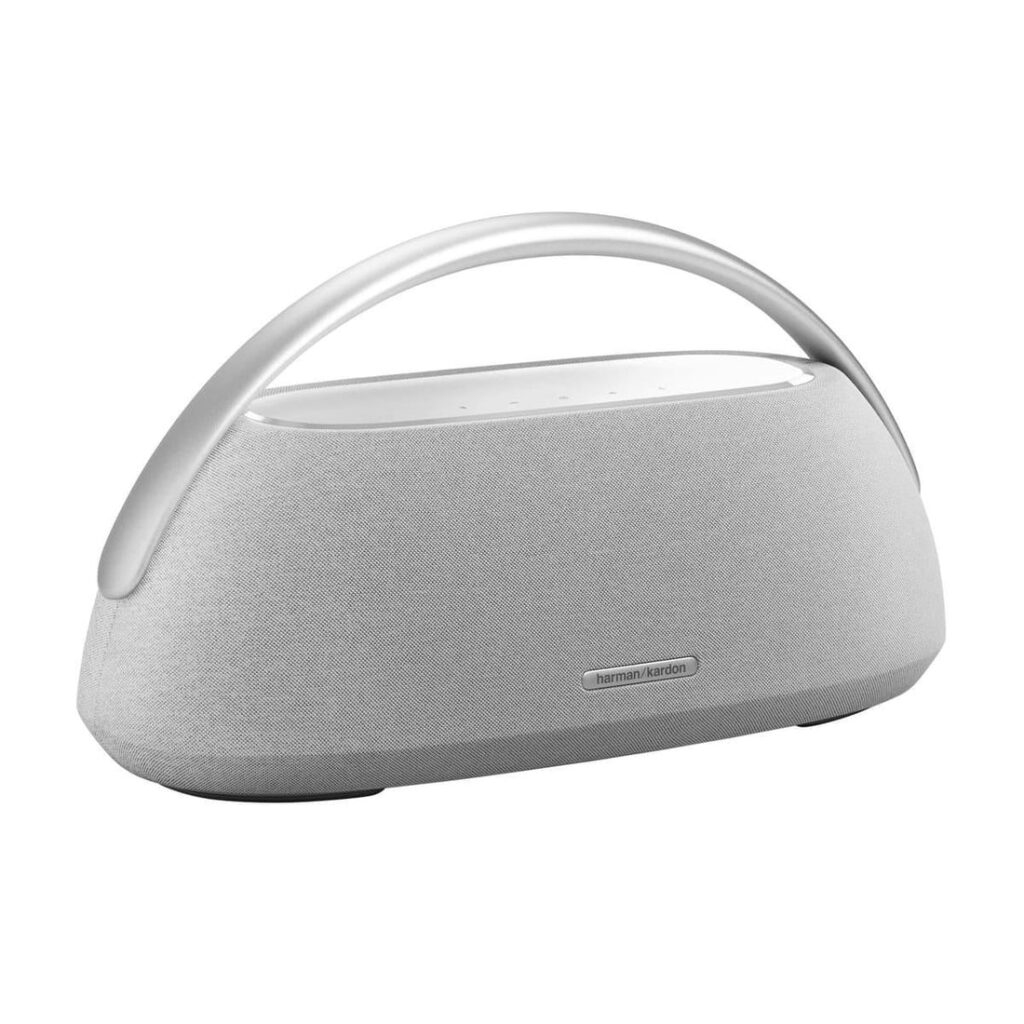
Harman Kardon Go + Play 3 is best understood as a transportable home speaker. It combines a large handle, built-in battery and a three-way driver arrangement in one substantial enclosure. Bluetooth and an analogue input keep the source brief straightforward. Its appeal is moving music around the home without a full separates system, rather than replacing a lightweight, weatherproof speaker for every outdoor journey.
Research-based review. This assessment draws on manufacturer documentation and the original published evaluations linked below. Audio Review has not performed a hands-on test of this model.
Indoor portability is a distinct category
The manufacturer gives a weight of 4.7 kilograms and a width of 439 millimetres. The handle makes room-to-room movement practical, but it does not make the speaker a small bag accessory. RTINGS identifies the lack of an IP rating, so weather resistance should not be assumed from the presence of a battery.
Decide where it will normally be placed and how far it will be carried. A short move between rooms can justify the design, while a long walk or uncertain weather calls for another comparison. Check that the chosen surfaces are stable and leave room for normal handling. A speaker can be portable in the sense of being easily relocated within a home without being the best choice for a beach, campsite or poolside setting. Matching the environment first avoids paying for a form of mobility that does not fit the actual routine.
Sound evidence supports a home-listening role
RTINGS finds a broadly balanced midrange, useful punch and clear voices, while identifying limited deepest-bass rumble and a change in treble when listening from behind the speaker. Its assessment supports music and speech in ordinary indoor rooms rather than unlimited output or identical sound in every direction.
Audition from the places people normally occupy. A forward-facing enclosure on a sideboard may work well for a sofa but less well when listeners gather all around it. Use familiar music with both vocals and bass movement, then compare quieter material at normal evening level. A larger cabinet should offer a benefit you can use, rather than merely a more dramatic demonstration. If the sound is satisfying only from a position the room cannot provide, another layout or speaker design may be more appropriate.
Self-tuning is helpful, but not a substitute for placement
Harman Kardon states that the speaker calibrates to its surroundings when powered on. There is no companion-app equaliser, so automatic tuning and the inherent sound replace the extensive user-adjustment route offered by some alternatives.
Try the product in its intended positions and compare the result with familiar material. Leave room around the enclosure and choose a stable surface rather than assuming self-tuning can undo every placement problem. If a large tonal change remains undesirable, do not plan the purchase around an EQ menu that does not exist. The simpler arrangement can be attractive when the sound already suits the listener. It is less useful when a highly specific preference requires manual adjustment that must instead be applied in each source application.
Battery endurance is for realistic sessions
The official guide claims up to eight hours, depending on level and content. RTINGS reports roughly seven hours in its testing. These figures support occasional battery use, but they are not a promise of a full day at party volume.
Estimate the time away from mains power and keep a margin for variation and battery ageing. If the speaker usually remains near an outlet, endurance may matter less than sound and handling. If long outdoor sessions are central to the plan, compare a model designed around that use before accepting a shorter runtime as a minor detail. Phone charging can also be useful, but the speaker and phone do not gain an unlimited energy supply simply because one can power the other. Plan the whole session rather than treating every headline feature as independent of the battery budget.
Wired playback and USB are different routes
The official product lists a 3.5 mm analogue input, and the quick-start guide instructs users to disconnect Bluetooth for audio-cable playback. It also distinguishes US USB music playback from other regional versions. European buyers should not assume the USB facility is a general music-player input.
For a wired source, confirm an appropriate line-level output and use a sensible initial volume. A turntable still needs the correct phono stage before a line input. For video, test the actual source and application: RTINGS found substantially different Bluetooth delay with its Android and iOS test routes, while applications can compensate differently. A cable option is useful, but it should be chosen for a defined connection need rather than as a blanket guarantee that every TV, console or computer arrangement will behave identically.
Calls, pairing and the complete purchase
The product includes dual microphones and supports two source devices. A second matching Go + Play 3 can also form a larger stereo arrangement. Source multipoint and two-speaker pairing are separate functions and should not be confused with unrestricted multiroom networking.
Try a real call in the intended room if conferencing matters, and verify source switching with the phone and laptop normally used. If a stereo pair is planned, include the cost, space and power arrangements for both enclosures. Compare that whole system with other stereo solutions rather than purchasing the second unit simply because pairing is possible. With one unit, judge whether its scale, sound and straightforward controls serve enough daily listening to justify the premium over a smaller Bluetooth speaker. A good purchase should fit the room and routine as clearly as it fits the specification list.
Alternatives to consider
Bose SoundLink Max: SoundLink Max is relevant when outdoor durability is central to the purchase. Compare sound and handling alongside protection and endurance, rather than assuming every battery speaker serves the same environment.
Sonos Move 2: Move 2 offers a different network-and-portable approach. Compare the value of integrated home streaming with the Harman Kardon wired input and straightforward Bluetooth role.
Harman Kardon Go + Play 3 key specifications
- Type
- Three-way transportable Bluetooth home speaker
- Drivers
- Two 70 mm midrange, two 20 mm tweeters, one 130 mm bass driver
- Manufacturer rated power
- 160 W RMS
- Bluetooth
- 5.2; two source devices supported
- Wired audio
- 3.5 mm analogue
- Tuning
- Automatic self-tuning at power-on
- Manufacturer battery claim
- Up to 8 hours, volume and content dependent
- Weight
- 4.7 kg
- Dimensions W x H x D
- 439 x 240 x 192 mm
- Other features
- Phone charging, dual microphones, matching-model stereo pairing
- App EQ / IP rating
- Neither
- EU USB music playback
- Not supported as a normal music-player input
Verdict
Go + Play 3 is a convincing candidate for substantial indoor Bluetooth music with occasional battery-powered movement. Its published sound assessment supports that role, and the analogue input adds useful flexibility when regional USB limitations are understood.
Choose it for a home layout that benefits from one transportable enclosure, with realistic expectations about weight, endurance and directional sound. Compare a protected outdoor speaker when weather exposure is part of the plan, or a network system when home streaming is the priority. The Harman Kardon is strongest when selected for its actual purpose rather than for an overly broad reading of the word portable.
Documentation and original reviews
Harman Kardon official Go + Play 3 product and connections · Harman Kardon official Go + Play 3 quick-start guide and regional USB note · RTINGS original Go + Play 3 sound, battery and latency assessment
Editorial record
Sources and updates
Product specifications and factual claims were checked against Official Harman Kardon Go + Play 3 product page ↗. Scores and buying advice follow our category-specific editorial methodology.
- Published
- November 17, 2026
- Last updated
- November 17, 2026