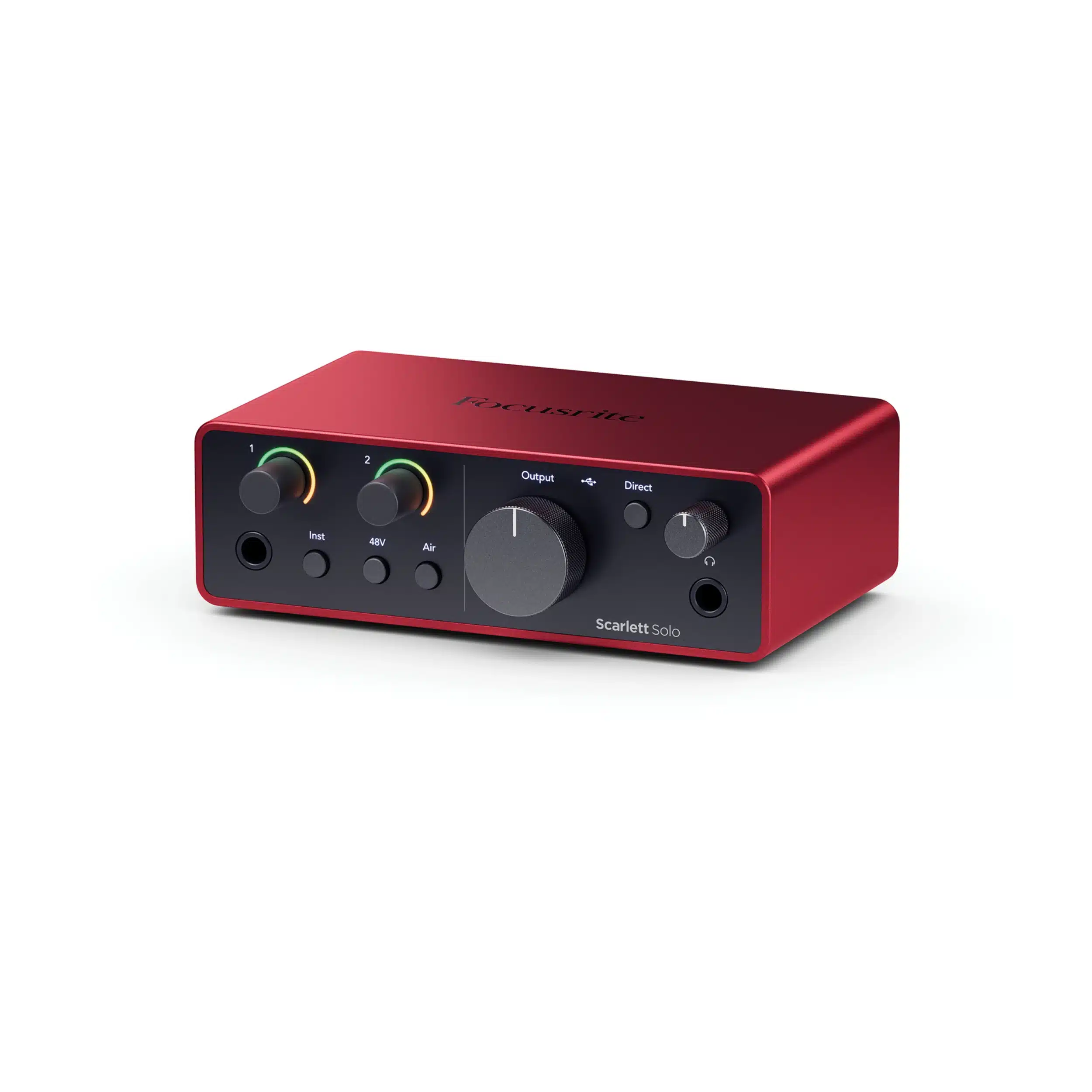
Focusrite Scarlett Solo 4th Gen overview
Focusrite Scarlett Solo 4th Gen is a compact USB audio interface for the solo musician, podcaster or voice creator who needs one microphone input, one instrument input and straightforward monitoring. Its appeal is that it provides a serious recording front end in a format small enough for a laptop desk. For official specifications, see the Focusrite Scarlett Solo page, without asking a beginner to manage a larger studio mixer. This is an editorial assessment built around the published specification, the product’s intended use and the surrounding market rather than a substitute for a long-term in-room or bench test. The important question is not simply whether the feature list is impressive; it is whether the design makes a convincing, usable system for the listener it targets.
Design and day-to-day use
On the Focusrite Scarlett Solo 4th Gen, a one-input-per-source layout can be ideal when recording happens one track at a time. The front-panel controls make gain and monitoring accessible, and the compact enclosure keeps the interface easy to carry or place beside a computer. Thoughtful cable placement is still important so a microphone lead, guitar cable and headphone lead do not turn a small desk into an obstacle course. The practical appeal is in the details: control placement, the quality of the physical interface, cable routing and the way the product fits into an existing setup can matter as much as any headline specification. Buyers should consider the space around the unit, the equipment it must connect to and whether its operating style suits the way they actually listen.
Features and connectivity
The Solo combines a microphone preamp, instrument input, headphone output, monitor outputs and USB computer connection. Current driver support, bundled software and operating-system compatibility should be checked before purchase, because the interface becomes part of a larger recording workflow. Direct monitoring and clear metering are valuable practical features when tracking vocals or instruments. Those options create a useful degree of flexibility, but they also reward careful system planning. A feature has genuine value when it removes friction from a regular listening habit, not when it merely looks good on a comparison chart. Before buying, verify the exact regional specification and make a short list of the sources, headphones, speakers or cartridges that will be used with it.
Sound and system matching
For the Focusrite Scarlett Solo 4th Gen, the goal is clean, reliable capture with sufficient gain and low noise. That gives a recording a usable starting point before editing or mixing, but microphone selection, room reflections and performance remain decisive. For many solo creators, stability and simple monitoring are more valuable than a long specification list. On paper, that direction should suit listeners who prefer an assured presentation over an artificially flashy one. Final results will still depend heavily on the partnering equipment and the room or listening position. Matching should therefore be treated as part of the purchase: a well-chosen source, cable or cartridge can make more difference than chasing a marginally higher specification elsewhere.
What to expect in a real setup
A sensible evaluation should begin with familiar recordings at normal listening levels, then move to more demanding material. Listen for tonal balance, control at the frequency extremes, image stability and whether the product remains satisfying over a complete album rather than a single impressive track. If it offers software, presets or calibration, start from the neutral setting and make one change at a time so that the result is meaningful.
Strengths
The stripped-back design removes distractions and fits the most common first recording scenario: one performer, one microphone or instrument, one pair of headphones. Focusrite’s broad software ecosystem and widespread support also make it easy to find tutorials and troubleshooting help. Just as importantly, the product avoids forcing the buyer into an unnecessarily narrow use case. Its strongest case is made when the complete system is considered: layout, source quality, available connections and the type of music or content that will be played. That makes it a more considered proposition than a purchase driven only by a single headline feature.
Limitations to consider
A single microphone input and limited expansion make it unsuitable for two-person interviews, stereo microphone techniques or live ensemble recording. Users who need MIDI, multiple headphones or separate cue mixes should choose a larger interface from the start. None of those points automatically rule it out, but they should shape expectations. This is not a category where the most expensive option is always the most appropriate one. Buyers who need a very different connection, a smaller footprint, more automation or a bundled accessory should compare those priorities directly before committing.
Who should buy it?
It is well suited to singer-songwriters, guitarists, narrators and streamers recording one source at a time. It can also serve as a portable backup interface for a more developed studio. It will make the most sense for a listener who understands the role it will play in a system and is prepared to set it up properly. It is less compelling when bought as a shortcut around a weak source, unsuitable headphones or poorly positioned speakers. In that situation, allocating part of the budget to the rest of the chain may produce a more balanced result.
Alternatives to consider
Focusrite’s two-input models remain alternatives to the Focusrite Scarlett Solo 4th Gen, Audient EVO, PreSonus, MOTU and SSL interfaces are relevant choices. The correct alternative depends on whether a second microphone input, extra gain, MIDI or bundled software has greater value. Alternatives should be judged by their complete ownership experience, not just a specification table: warranty, app support where relevant, availability of accessories and how easy the product is to place, upgrade or resell all deserve consideration. The best alternative is the one that solves the same listening need with fewer compromises for a particular setup.
Focusrite Scarlett Solo 4th Generation key specifications
- Model
- Focusrite Scarlett Solo 4th Generation
- Interface type
- USB-C desktop audio interface
- Analogue I/O
- 2-in / 2-out
- Microphone preamps
- 1
- Instrument inputs
- 1 dedicated Hi-Z input
- Line inputs
- 1
- Line outputs
- 2 balanced 6.35 mm TRS
- Headphone outputs
- 1 × 6.35 mm TRS
- Phantom power
- 48 V
- Air modes
- Presence and Harmonic Drive
- Resolution and sample rate
- 24-bit / 192 kHz
- Supported sample rates
- 44.1, 48, 88.2, 96, 176.4 and 192 kHz
- Microphone input
- 20 Hz–20 kHz ±0.06 dB; 113 dB dynamic range; -127 dBu EIN; 57 dB gain
- Instrument input
- 20 Hz–20 kHz ±0.15 dB; 112 dB dynamic range; +12 dBu maximum input; 1 MΩ impedance
- Line output
- 20 Hz–20 kHz ±0.02 dB; 120 dB dynamic range; +16 dBu maximum output
- Headphone output
- 112 dB dynamic range at 33 Ω / 115 dB at 300 Ω; 32 mW at 33 Ω
- USB protocol
- USB 2.0 Type-C; bus powered, 900 mA
- Loopback
- Yes; 4 × 2 simultaneous I/O including loopback
- Dimensions
- 143 × 46.5 × 96 mm
- Weight
- 0.382 kg
View the official Focusrite Scarlett Solo 4th Generation product page
Verdict
The Focusrite Scarlett Solo 4th Gen is a focused first interface: compact, purposeful and most convincing when its simple one-creator workflow matches the job. It is best approached as a deliberate system component rather than an isolated gadget. Confirm compatibility, audition where possible and compare it against a realistic shortlist. For the right buyer, its combination of design intent, connectivity and system potential gives it a credible place in its category. Explore our independent audio reviews for related recording and hi-fi products.
Editorial record
Sources and updates
Product specifications and factual claims were checked against Official Focusrite Scarlett Solo 4th Generation product page ↗. Scores and buying advice follow our category-specific editorial methodology.
- Published
- July 17, 2026
- Last updated
- July 25, 2026
Compare before choosing
Two strong alternatives from the same audio interfaces category.