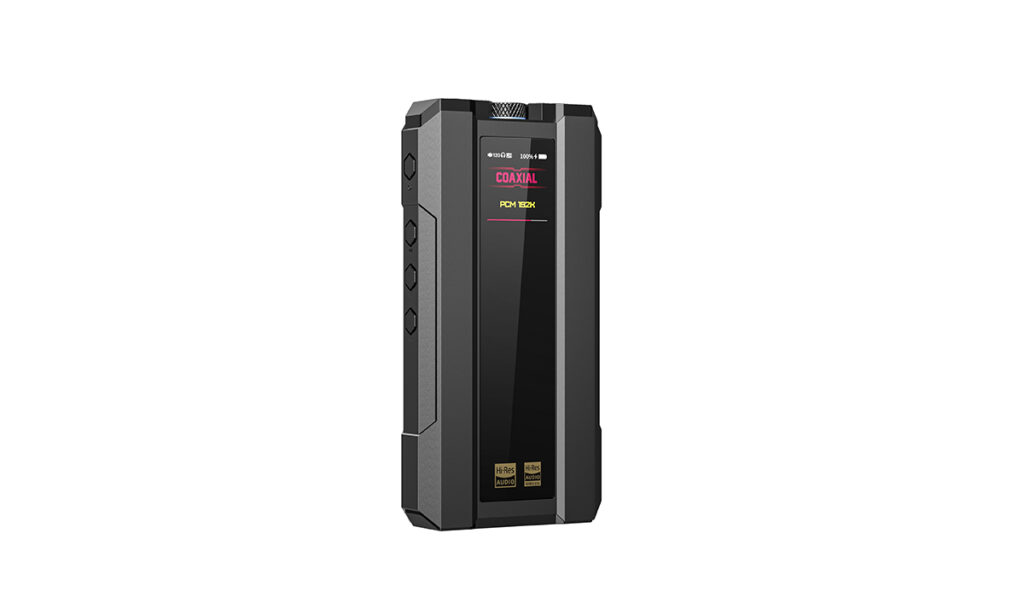
FiiO Q15 sits between a small mobile dongle and a fixed desktop DAC/amp. It has a battery, several digital input options and a separate powered desktop mode, so one unit can serve more than one location. That flexibility is the main reason to consider it. It is also a substantial object to carry beside a phone, and its highest output claims should not be mistaken for the behaviour of every mode or headphone connection.
Research-based review. This assessment draws on manufacturer documentation and the original independent evaluations linked below. Audio Review has not performed a hands-on test of this model.
Transportable rather than tiny
The official specification lists an approximately 305 g body and a 5500 mAh battery. USB, coaxial and Bluetooth reception are available, with separate single-ended and balanced headphone sockets. Its AKM converter system is an engineering detail, not a guarantee that every headphone attached to it acquires a particular musical character.
For a bag or a listening chair, the size can be manageable. For a trouser pocket alongside a large phone, it may be a different proposition. Before buying, think about the complete stack, cables and headphone lead rather than the Q15 alone. A transportable device is useful when you move between settled listening positions. It is less useful when your real need is the lightest possible way to add a headphone socket during a walk.
Sound quality and what the evidence supports
Headfonics’ original assessment is positive about the Q15’s resolving ability, noise control and construction, while flagging the size for stacking. Its broader verdict supports using the device with a range of headphones, but does not mean every owner requires its maximum output. These are the reviewer’s findings, not an Audio Review laboratory test.
Our recommendation centres on flexibility and an identifiable source need. Compare at similar perceived level before concluding the Q15 sounds better than an existing competent output. If your current source is quiet and reaches a comfortable level, the most obvious improvement may be connections and physical control. If it struggles or lacks the input you need, the Q15 can have a more direct practical benefit. Its converter chip name should not replace that assessment.
Desktop mode is a different operating condition
FiiO documents separate Phone and Desktop switches and a dedicated power-input port. The highest gain condition requires the relevant desktop power arrangement. Manufacturer output figures at a stated load therefore describe a particular setup, not the same result available automatically from every battery-powered connection.
Set up the power and data paths deliberately. A USB-C connector can carry different roles, and the coloured power socket should not be confused with the data connection. Check the intended mode before turning on playback and begin at low level. Someone who uses the product exclusively at a desk may prefer a simpler fixed unit. The Q15’s value is that it can change roles, provided you are willing to understand and use those roles correctly.
Phone mode and Bluetooth reception
Phone mode is intended to help manage the relationship with a connected phone and its power supply. Bluetooth reception offers another way to use the Q15 with a source that supports the required codec. It does not make the Q15 a standalone streaming player with its own music-service applications.
Choose the connection according to the task. USB can suit a settled listening session, while Bluetooth may reduce cable handling at the cost of depending on the source’s codec and wireless behaviour. An iPhone and an Android phone do not necessarily negotiate the same format. Confirm what is active on the display rather than assuming the highest supported label is always in use. The complete source path matters more than treating every input as interchangeable.
Headphone gain and output wiring
The 3.5 mm and 4.4 mm outputs provide different electrical arrangements, and line mode shares the sockets. Verify the selected mode before attaching headphones or another amplifier. A fixed line signal and a headphone-level output are not interchangeable simply because the same physical connector can be used.
Begin with low gain and use the setting that provides comfortable adjustment. Sensitive earphones need quiet low-level control, while demanding full-sized headphones can need more headroom. Check sensitivity as well as impedance, and use correct balanced wiring where applicable. A mechanical adapter does not safely convert every common-ground headphone lead into a balanced one. Buy a different lead or amplifier for a defined requirement rather than assuming a balanced label by itself makes every listening result better.
Battery figures and heat in the real routine
FiiO’s parameter table gives at least nine hours through the single-ended output and eight through balanced under its stated load, gain, level and playback conditions. Those are manufacturer figures, not an uninterrupted runtime measured by Audio Review. Higher output demand, different codecs and display use can change the practical result.
Plan reserve for the longest session and keep the unit in an arrangement that allows normal ventilation. Do not build a tightly wrapped stack that makes the controls inaccessible or places continuous strain on the ports. When changing between mobile and desktop use, check which device is supplying power and whether charging is enabled. A clear routine is more useful than the largest battery number if you regularly arrive at a listening position with the wrong operating mode selected.
Value against a simpler device
The Q15 makes the most sense when its USB, coaxial, Bluetooth and powered desktop roles are all potentially useful. If the system requires only one easy headphone and a phone socket, a small dongle can be a more convenient answer. If everything stays on one desk, a fixed DAC/amp avoids carrying a battery that contributes little to the job.
Compare the complete cost, including any necessary leads and suitable power accessories, with hip-dac 3 and a desktop option such as K7. Check local support for a product whose battery will age even when the electronics remain useful. The strongest value case is one well-understood unit replacing several awkward arrangements, rather than buying maximum flexibility as insurance against requirements that never appear.
Alternatives to consider
iFi hip-dac 3: The hip-dac 3 is a useful comparison for someone who wants a simpler transportable wired DAC/amp. Compare the size and the inputs you actually require rather than assuming the larger feature list of the Q15 is always the more convenient answer.
FiiO K7: For a system that stays on the desk, K7 is worth considering as a dedicated mains-powered arrangement. The Q15 battery and phone modes add flexibility, but also cost and setup complexity that may be unnecessary for stationary use.
FiiO Q15 key specifications
- Design
- Battery DAC and headphone amplifier with desktop mode
- DAC system
- AK4191EQ and AK4499EX
- Digital inputs
- USB-C, RCA coaxial and Bluetooth receiver
- Bluetooth
- 5.1; SBC, AAC and supported aptX/LDAC variants
- Headphone outputs
- 3.5 mm single-ended; 4.4 mm balanced
- Line outputs
- Shared sockets, mode-dependent
- USB maximum
- PCM 32-bit/768 kHz; native DSD512
- Power connections
- USB data/charging plus separate POWER IN USB-C
- Battery
- 5500 mAh, manufacturer specification
- Claimed USB/coax runtime
- At least 9 h single-ended; 8 h balanced under stated 32-ohm test conditions
- Weight
- Approximately 305 g
- Modes
- Phone and Desktop switches; multiple gain levels
Verdict
The Q15 is a convincing transportable DAC/amp for a listener with several source roles and wired headphones that benefit from a flexible output stage. The independent evidence is positive, and the official documentation makes clear that mode and power conditions matter. Its size is the most obvious practical qualification.
Choose it when the portable and desktop functions genuinely simplify the system. Compare hip-dac 3 for a more focused mobile arrangement and K7 for stationary use. Establish the correct power, gain and output mode before judging sound or maximum capability. A Q15 that fits a real routine is more valuable than one bought solely for an impressive peak-output figure.
Primary documentation and independent reviews
FiiO official Q15 product and mode information · FiiO official Q15 parameters and test conditions · Headfonics original Q15 evaluation · Headphonesty original Q15 evaluation
Editorial record
Sources and updates
Product specifications and factual claims were checked against Official FiiO Q15 product page ↗. Scores and buying advice follow our category-specific editorial methodology.
- Published
- November 17, 2026
- Last updated
- November 17, 2026