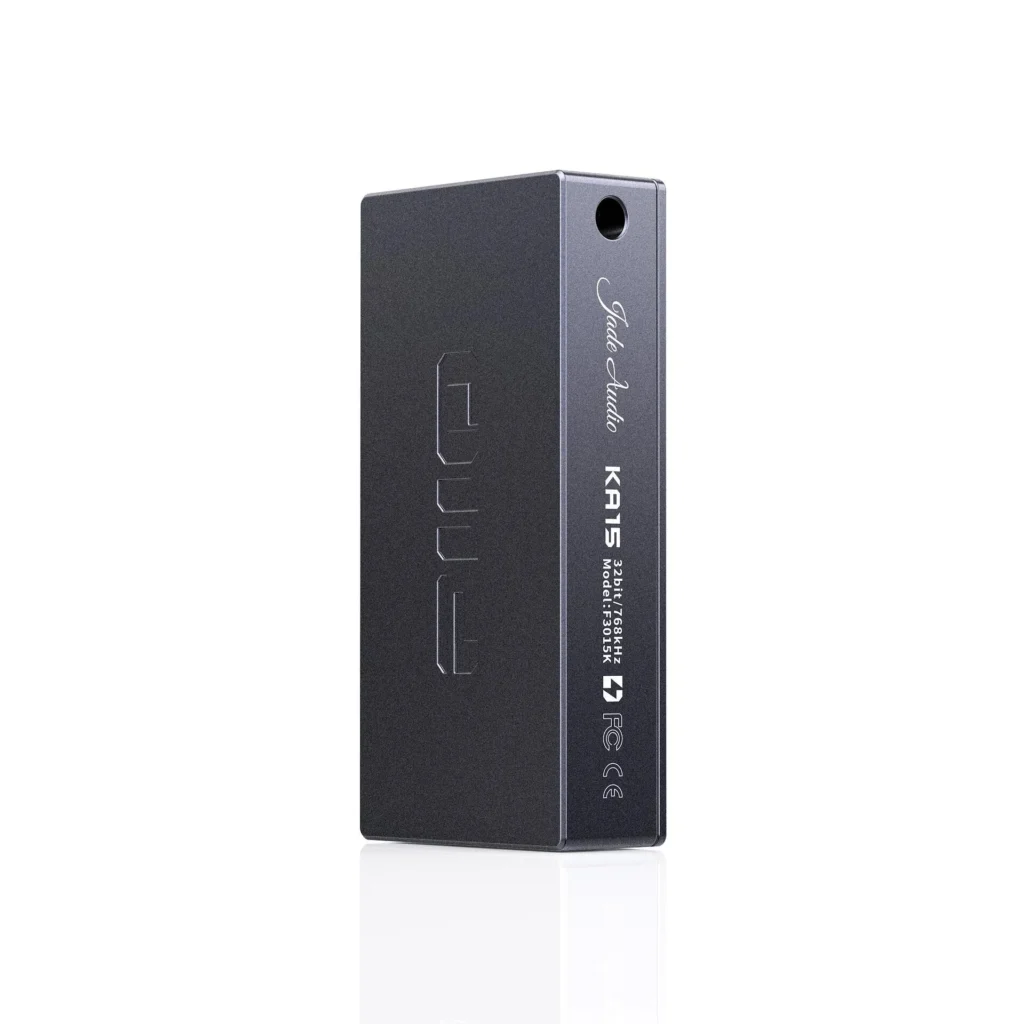
FiiO KA15 is a USB DAC and headphone amplifier that adds a small colour screen and substantial configuration to the familiar dongle format. Its cassette-style interface is distinctive, but the more practical attractions are visible status, physical controls, equalisation and two headphone connection types. It remains a host-powered device whose compatibility and power use depend on the source. Original listening evidence is favourable, with a specific reservation about background noise when using sensitive devices from the balanced output.
Research-based review. This assessment draws on manufacturer documentation and the original published evaluations linked below. Audio Review has not performed a hands-on test of this model.
The display can solve a real usability problem
The screen shows the current operating state, including volume and format information, rather than leaving every setting hidden behind a phone interface. FiiO’s guide also identifies power-related indicators and the selected USB Audio Class mode. These can help explain how the device is currently configured.
The practical benefit is confidence when changing headphones or moving between sources. Check the displayed volume and selected mode before beginning playback. A readable state is useful even if the decorative tape animation has no lasting appeal. Small buttons and menus still require learning, and Headfonics finds navigation less convenient than using the app. Try the ordinary volume and menu routine before purchase if quick operation matters more than the visual design. A screen is valuable when its information improves the routine, not merely because it makes the device look more elaborate.
What the original listening report says
Headfonics describes a smooth, detailed presentation with a mild warm emphasis in its tested combinations. It also identifies a low level of background noise with sensitive equipment from the balanced output. Those are observations from that review, not proof that the same tonal description or noise level will occur with every headphone.
Use the actual earphones intended for the KA15 and listen during a quiet passage as well as music. If noise is noticeable, compare the lower-demand connection or a different suitable source rather than assuming more output is always desirable. Match level when comparing with another DAC. An extra fraction of volume can dominate a quick judgment. The sensible goal is clean, adequate drive and useful controls for a particular headphone, rather than assigning a fixed musical character to a DAC chip name.
PEQ provides control, not an automatic correction
The ten-band parametric equaliser provision can be useful for deliberate sound adjustment. It is more flexible than selecting a single bass preset, but that flexibility also makes it possible to create an unsuitable setting if several parameters are changed without a clear reference.
Begin with the headphone fit and normal sound before editing. Make a small change aimed at a specific preference, save the original state and compare at a comfortable level. Allow appropriate headroom when using boosts rather than assuming every large adjustment is free of consequences. There is no need to use every band. A modest well-understood setting can be more useful than a complicated curve copied from another listener’s different headphone or fit. Keep a straightforward bypass comparison so that the effect remains easy to evaluate.
Host power and headphone connections
The KA15 is powered through USB rather than an internal battery. Desktop mode changes the available output arrangement, while the source still needs to provide sufficient power. FiiO’s guide notes possible device-specific compatibility differences and that warmth can occur in normal operation.
Use a suitable data cable and position the dongle so its weight does not strain the source connector. Start at an appropriate low volume before changing headphones. The balanced socket needs a correctly wired compatible cable; it is not a destination for a casual adapter from every single-ended lead. The official guide also tells owners not to plug headphones into both outputs simultaneously. Choose the connection that meets the actual requirement, rather than treating the larger connector as an obligation when the ordinary output already works well.
App control, calls and console claims need qualification
FiiO specifies Android-only companion-app control for the KA15, even though ordinary USB audio can work with other supported systems. It also provides CTIA microphone support with explicit restrictions on some iPhone and Android arrangements. Playback compatibility should not be confused with guaranteed microphone capture or identical configuration access.
If the main task is calls, make an actual recording in the intended application and confirm the selected input. If using a game console, choose the appropriate documented UAC mode and test the real system rather than assuming all USB audio devices behave identically. The shared SPDIF socket offers another configured role for an external decoder. These capabilities are useful for a planned connection, but do not turn the KA15 into a universal solution for every microphone, console and digital-input combination.
Choose the feature set that will be used
Compare the KA15 with a simpler dongle, a more elaborate model such as KA17 and a battery-powered device such as hip-dac 3. The relevant differences are not only output power: they include display, EQ, source energy use, connector arrangement and the number of objects carried together.
For a desk, decide whether a larger fixed unit would put the controls in a better place. For travel, try the phone, cable and dongle arrangement in the pocket or bag actually used. Include any source adapter and balanced headphone cable in the cost. The KA15 can offer strong value when its visible feedback and configuration make everyday listening easier. If those functions will be left untouched, a smaller and less complicated adapter may satisfy the same basic need with fewer settings to manage.
Alternatives to consider
FiiO KA17: KA17 belongs in the comparison if more elaborate power arrangements and controls are useful. Compare the actual portable setup and headphone requirement rather than choosing only from maximum output figures.
iFi hip-dac 3: hip-dac 3 offers a larger battery-powered approach. Decide whether an independent power source and its physical controls are more valuable than the KA15 compact display and host-powered simplicity.
FiiO KA15 key specifications
- Role
- USB DAC and headphone amplifier
- DAC architecture
- Two CS43198 chips
- USB input
- USB-C, detachable cable
- Headphone outputs
- 3.5 mm single-ended and 4.4 mm balanced
- Display
- 0.96-inch IPS colour
- EQ
- Ten-band parametric EQ provision
- PCM support
- Up to 32-bit / 768 kHz
- DSD support
- Up to DSD256
- Digital output
- SPDIF shared with 3.5 mm socket
- Battery
- None; USB host powered
- App control
- Android FiiO Control
- Headset microphone
- CTIA provision with source-dependent restrictions
- Dimensions
- Approximately 52 × 25 × 11 mm
- Weight
- Approximately 21 g
Verdict
KA15 is a capable compact DAC/amp with useful status feedback and substantial sound-control flexibility. The original listening evidence supports a positive assessment, tempered by the sensitive-earphone noise and menu-navigation qualifications.
Confirm the actual phone or computer connection, the available configuration platform and any microphone requirement. Use a suitable headphone cable and only the output capability needed. The KA15 is most persuasive when display and PEQ are meaningful everyday advantages, rather than decorative reasons to replace an adapter that already provides clean sound and sufficient level.
Documentation and original reviews
FiiO official KA15 features and platform limitations · FiiO official KA15 quick-start and operation guide · Headfonics original KA15 listening and usability evaluation
Editorial record
Sources and updates
Product specifications and factual claims were checked against Official FiiO KA15 product page ↗. Scores and buying advice follow our category-specific editorial methodology.
- Published
- November 17, 2026
- Last updated
- November 17, 2026