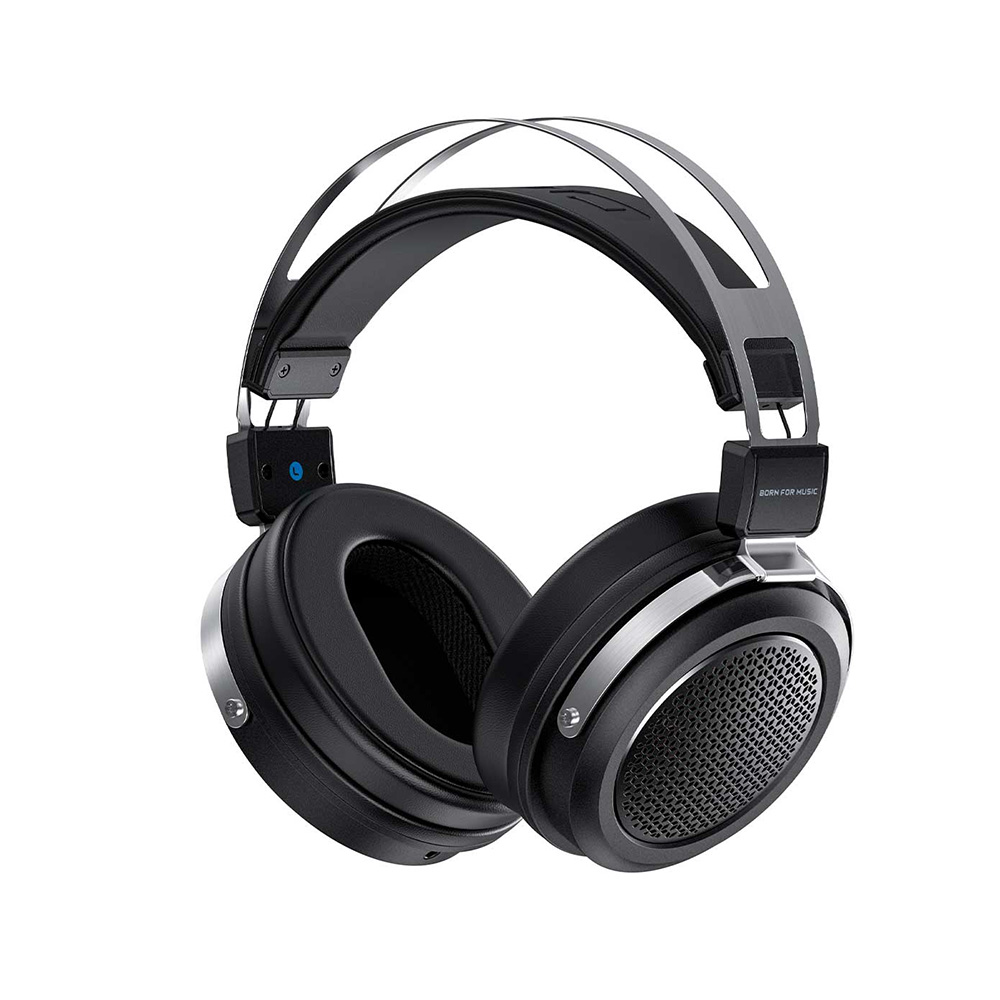
FiiO JT1 is an affordable closed headphone sold within the brand’s entry-level Jade Audio family. Its attraction is practical rather than complicated: a large dynamic driver, self-adjusting support, detachable lead and an inline microphone. Original evaluation describes a smooth bass-led sound with limits in detail and fit. It is a credible low-cost listening option when those characteristics suit the owner, but not a substitute for every studio, travel or gaming headset requirement.
Research-based review. This assessment draws on manufacturer documentation and the original published evaluations linked below. Audio Review has not performed a hands-on test of this model.
A simple closed headphone with useful basics
The official driver description combines a 50 mm dynamic unit with a PEK, PU and aluminium polymer diaphragm. The Japanese specification confirms closed construction and a detachable cable arrangement. The rear mesh-like appearance should not be used to classify it as an open headphone.
The practical appeal is a battery-free analogue listening system with parts that are not all permanently attached. There is no app configuration or wireless pairing routine. That may be welcome at a desk or beside a straightforward music source. It also means that ANC, transparency and Bluetooth switching are absent. Decide which functions are actually needed before treating the low price as a complete solution. Someone who wants dependable basic listening may be well served, while a frequent traveller or caller needing several wireless devices should compare a different class of product from the beginning.
Relaxed bass is the central listening character
Headfonics’ original evaluation describes prominent bass, more withdrawn lower mids and a smooth upper presentation. It also identifies a loss of vibrancy and fine detail compared with more incisive alternatives. Those observations support relaxed leisure listening rather than a strict neutral-monitoring recommendation.
Try the music normally played at home, including a dense arrangement and a vocal-led recording. Check whether the bass adds welcome body or takes too much attention from speech and instruments. A smooth presentation can be enjoyable over long sessions without being the best tool for finding every mix problem. Do not infer neutrality from the driver size or a wide advertised frequency range. If EQ is part of the routine, use consistent settings during comparisons. The best value is a balance that remains enjoyable across ordinary material, not a low price that persuades someone to tolerate a character they fundamentally dislike.
The suspension fit needs checking on the actual head
The official package uses a self-adjusting support, with an approximate weight of 355 g without the cable. The cushions are replaceable. This is not an especially tiny portable headphone simply because it occupies an inexpensive position in the range.
Headfonics finds the support comfortable on its sample but wants a tighter hold. Try looking down, shifting position and wearing normal glasses. Check ear clearance and whether the cups need repeated adjustment. A loose fit may be less troublesome at a stationary desk than while moving around, but it still deserves attention. On a used pair, inspect pad wear and the suspension movement. Replacement cushions should be selected for the model rather than assumed interchangeable from appearance alone. A useful fit is one that stays comfortable and stable during the normal session, not merely one that creates little pressure during a quick first impression.
The microphone cable changes the compatibility question
The official Japanese page lists dual 3.5 mm TRS connections at the cups and a 3.5 mm TRRS source plug on the microphone lead. That distinguishes the supplied cable from an ordinary stereo-only lead. A 6.35 mm adapter does not automatically preserve microphone operation through a music-only headphone socket.
Check whether the intended phone adapter or computer supports a combined headset connection. Separate microphone and headphone sockets can require the appropriate splitter, while some USB adapters provide playback without microphone input. Test the actual work or chat application before relying on it. The small inline microphone is a convenience rather than evidence of broadcast quality or professional noise rejection. A correctly wired alternative cable may serve a different purpose, but it should be chosen with the required functions understood. Connection compatibility means the whole path works, not merely that a plug physically enters the socket.
Cable handling and source choice affect everyday use
The supplied lead is approximately 1.5 m, a manageable length beside a laptop but potentially short for a distant amplifier. Headfonics reports audible cable movement noise on its sample. That is a practical point worth checking during a return period rather than overlooking in favour of the driver specification.
Route the lead so it does not rub repeatedly against clothing or pull sideways on the connectors. Make sure each cup connection is seated as intended before diagnosing a missing channel. The 32-ohm impedance suggests a different load from a high-impedance home headphone, but the actual output still needs testing with quieter tracks and normal processing. Check noise, control range and comfortable headroom. There is no need to purchase an expensive amplifier automatically. If an additional adapter is required, include its cost and microphone support in the budget instead of discovering those needs after buying the headphone.
Judge the complete affordable package
The supplied storage bag offers organisation and surface protection, not the impact resistance of a rigid carrying case. Keep heavy objects away from the cups and protect the detachable lead during packing. Closed construction can help in some settings, but it is not a promise of complete isolation from conversation or transport noise.
Compare current European price, return terms and replacement-cable availability with other budget wired models. Ask whether the actual package includes the microphone lead and adapter, particularly with used stock. The JT1 is strongest when its relaxed character, replaceable parts and uncomplicated connections meet the need directly. It is weaker value when a neutral production tool or a high-performance communication headset is required. Spending more should solve a specific problem such as fit, isolation or tonal preference. There is no reason to move up the range merely because a more expensive model exists if this simpler arrangement already works.
Alternatives to consider
FiiO FT1: A closed wired alternative to compare when the budget can stretch. Judge preferred balance, fit and package together, rather than assuming a more expensive sibling is automatically needed.
Audio-Technica ATH-M50x: An established closed headphone with a different practical brief. Compare the actual connection requirements and sound preference before deciding whether its higher total cost is worthwhile.
FiiO JT1 key specifications
- Design
- Closed-back over-ear dynamic
- Driver
- 50 mm
- Diaphragm
- PEK, PU and aluminium polymer composite
- Impedance
- 32 ohms
- Weight
- Approximately 355 g without cable
- Cable length
- Approximately 1.5 m
- Headphone connectors
- Dual 3.5 mm TRS
- Source connection
- 3.5 mm TRRS microphone cable
- Included accessories
- 6.35 mm adapter and storage bag
- Headband
- Self-adjusting suspension
- ANC and Bluetooth
- None
Verdict
JT1 offers a practical low-cost route to closed wired listening, with a detachable microphone cable and replaceable cushions. Original evidence points to a smooth, bass-led balance with limited fine-detail emphasis.
Check the fit, cable movement and full microphone connection path. When those suit the routine, the package has a sensible value argument. Choose something else when a tighter fit, more neutral sound or advanced communication features are essential.
Documentation and original reviews
FiiO official JT1 launch and driver description · FiiO Japan official JT1 package, connections and specifications · Headfonics original JT1 sound, comfort and cable evaluation · Headfonics original JT1 source and comparison evaluation
Editorial record
Sources and updates
Product specifications and factual claims were checked against Official FiiO JT1 product page ↗. Scores and buying advice follow our category-specific editorial methodology.
- Published
- November 17, 2026
- Last updated
- November 17, 2026