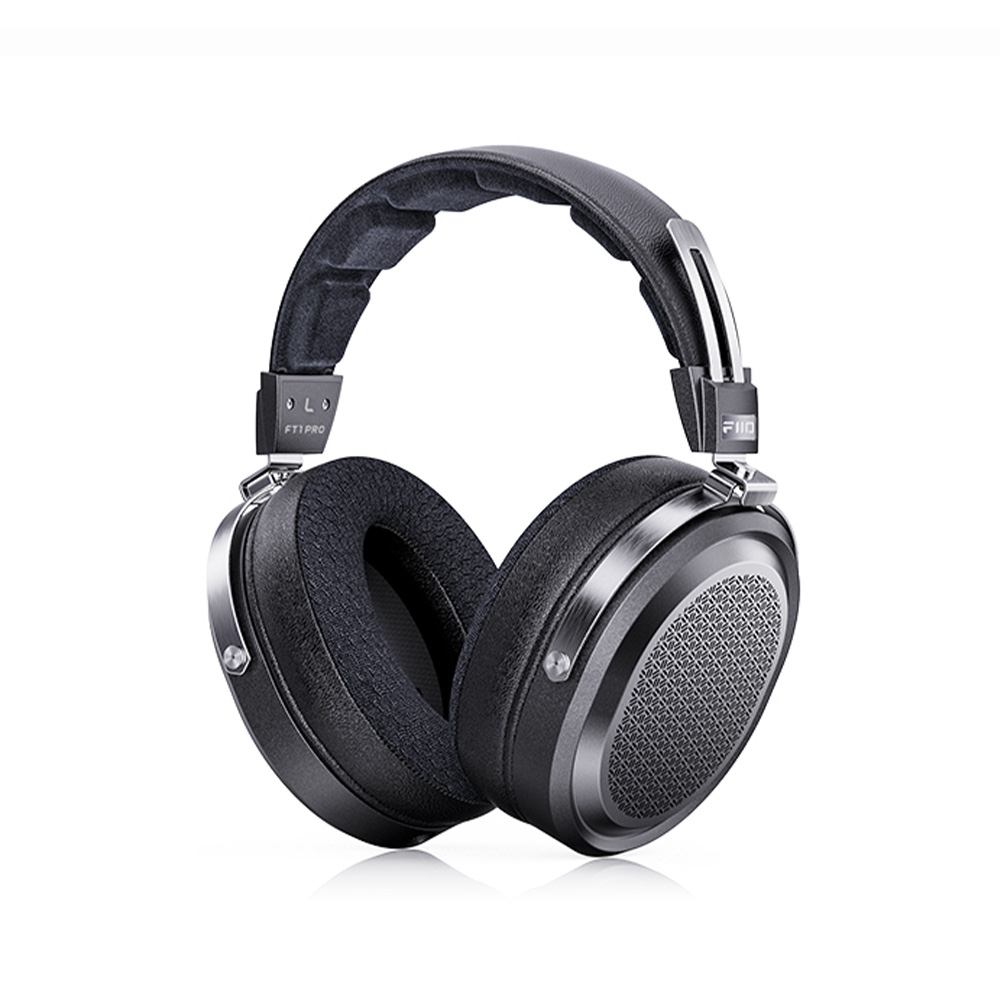
The FiiO FT1 Pro offers an accessible route into open-back planar headphones. Its name suggests a direct upgrade to the popular FT1, but its different driver and open construction make it a separate buying proposition. It is aimed at the listener who can provide a quiet room and wants a capable wired headphone without making the rest of the system unnecessarily complicated.
FiiO FT1 Pro — Design and the FT1 comparison
FiiO specifies a 95 by 86 mm planar driver with a one-micrometre diaphragm and a dual-coating construction. Those details explain the engineering approach, but they are not measurements of perceived detail. Diaphragm thickness by itself cannot rank the FT1 Pro against a dynamic headphone or another planar design.
The original FT1 has closed wooden cups and a dynamic driver. The Pro uses an open enclosure, allowing sound to pass into and out of the listening space. It is therefore not a straightforward replacement for someone who bought the FT1 to reduce leakage around other people. This is the first distinction to make before comparing price or accessories.
The official listed weight is approximately 374 g, with a twelve-position adjustable headband. That places fit above portability as an audition priority. A fairly substantial headphone can be comfortable if it spreads pressure effectively, but it will not behave like a small pair of travel headphones in a bag.
Sound quality
The Headphoneer’s original review reports a broadly neutral balance, well-extended bass and clear midrange, while noting occasional dryness and limits to imaging compared with more expensive headphones. Headfonics’ comparison page describes a somewhat U-shaped character. These different descriptions are a useful reminder that tonal impressions vary with preference, fit and the comparison being made.
The common practical implication is that the FT1 Pro deserves attention as a serious music headphone rather than a novelty planar experiment. It should still be assessed on the recordings the owner actually plays. A model praised for neutrality may seem restrained to someone who prefers a stronger bass shelf, particularly at quieter levels.
Bass extension and bass quantity are separate questions. A headphone can reproduce a low note clearly without giving it the prominence expected from a more heavily boosted tuning. During an audition, compare a sustained electronic note with an acoustic bass line. The former checks low-frequency reach; the latter helps reveal whether pitch and texture remain easy to follow.
Vocals should also be evaluated independently of the initial impression of space. Try a centrally mixed singer with simple accompaniment and then a dense chorus. If the voice sounds too distant or too sharp for your taste, an attractive sense of openness will not necessarily make long listening more satisfying. The complete balance matters more than one impressive characteristic.
Comfort and the open enclosure
The FT1 Pro makes the most sense at a desk or in a quiet listening chair. Noise from a nearby fan, television or conversation can obscure low-level musical information. Increasing volume to overcome the room defeats part of the benefit of an open headphone and is an inferior solution to choosing a more suitable environment.
People nearby will hear some of the music. This matters in a bedroom, shared office or room where another person watches television. It also matters for recording, where a microphone can capture headphone leakage. A closed model is the more appropriate starting point when monitoring isolation is essential.
Check the headband for a pressure point after at least a full track, rather than deciding from the first few seconds. The earcup rotation and pad opening need to suit your own head. If a pad presses unevenly against the jaw or the assembly slips when looking down, those practical issues should weigh heavily in the decision.
The pads are part of the tuning. Replacing them with a different material or thickness can alter the acoustic relationship between the driver and ear. Keep that in mind when reading advice about pad swaps: improved comfort does not automatically preserve the response described by an original review.
Amplification and everyday setup
The official figures are 20-ohm impedance and 95 dB sensitivity per milliwatt at 1 kHz, also expressed by FiiO as 112 dB per volt. The low impedance does not remove the need for an appropriate headphone output. Current delivery, output impedance and usable volume control are more informative than judging compatibility from impedance alone.
A compact DAC and headphone amplifier can be a sensible partner, especially if the computer’s analogue output is noisy or lacks clean reserve. The aim is a clean signal at the required level, not ownership of the most powerful amplifier available. Start with low gain and increase it only if the available range is insufficient.
When comparing amplifiers, match perceived volume carefully. A higher gain setting often sounds more immediate simply because it is louder. If the FT1 Pro is already driven cleanly, a change in tonal preference is more directly addressed through equalisation than by assuming a more expensive amplifier must reshape the response in the desired direction.
If equalisation is used, maintain digital headroom and make modest changes. A large bass boost asks more of both the driver and amplifier. The fact that a headphone uses a planar diaphragm is not proof that unlimited low-frequency boost will remain clean. Evaluate changes at normal levels and retain an easy way to return to the original setting.
Features, ownership and value
This is a passive wired headphone rather than a wireless lifestyle product. There is no battery charging routine, companion app or Bluetooth pairing process. That simplicity can be attractive for a desktop system that should behave consistently every time it is connected. It also means calls require a separate microphone arrangement.
Its value depends on the complete system. If it works well from an existing source, the cost of entry is straightforward. If a buyer adds several electronic boxes and replacement accessories immediately, comparing the resulting total against another headphone becomes more sensible than focusing on the FT1 Pro’s price alone.
European buyers should check authorised supply, returns and replacement pad availability. An audition or workable return policy is valuable because head shape and tonal preference are the largest unresolved variables. Historical prices in launch reviews are useful context, but current offers should be compared directly.
The FT1 Pro is particularly appealing to someone who wants to explore an open planar presentation without making a luxury purchase. It is less compelling as a substitute for an isolation headphone, and it should not be bought solely because Pro sounds more advanced. Its strongest argument is useful performance in the right room.
Alternatives to consider
HiFiMAN Sundara: A well-established open planar alternative; compare fit and tonal balance at matched volume rather than relying on reputation.
HiFiMAN Edition XS: A larger-format alternative whose earcup and headband fit can matter as much as its acoustic appeal.
Beyerdynamic DT 900 Pro X: An open dynamic option for buyers who also value studio-oriented construction and practical monitoring use.
FiiO FT1 Pro key specifications
- Driver
- 95 × 86 mm planar magnetic
- Design
- Open-back
- Diaphragm
- 1 micrometre; manufacturer specification
- Impedance
- 20 ohms
- Sensitivity
- 95 dB/mW or 112 dB/V at 1 kHz
- Weight
- Approximately 374 g
- Frequency response
- 7 Hz–40 kHz (manufacturer specification)
- Earcup connections
- Dual 3.5 mm TS
- Cables
- 1.5 m; 3.5 mm single-ended and 4.4 mm balanced
Verdict
The FiiO FT1 Pro is a strong-value open planar headphone for a quiet home system. Published reviews support its capable bass and balanced presentation, with fit and tonal preference remaining important. Choose it as a different tool from the closed FT1, with an appropriate source and realistic expectations about isolation and premium-model refinement.
Primary documentation and independent reviews
FiiO FT1 Pro official product information · FiiO official launch specifications · The Headphoneer original review · Headfonics original comparisons
Editorial record
Sources and updates
Product specifications and factual claims were checked against Official FiiO FT1 Pro product page ↗. Scores and buying advice follow our category-specific editorial methodology.
- Published
- November 7, 2026
- Last updated
- November 17, 2026