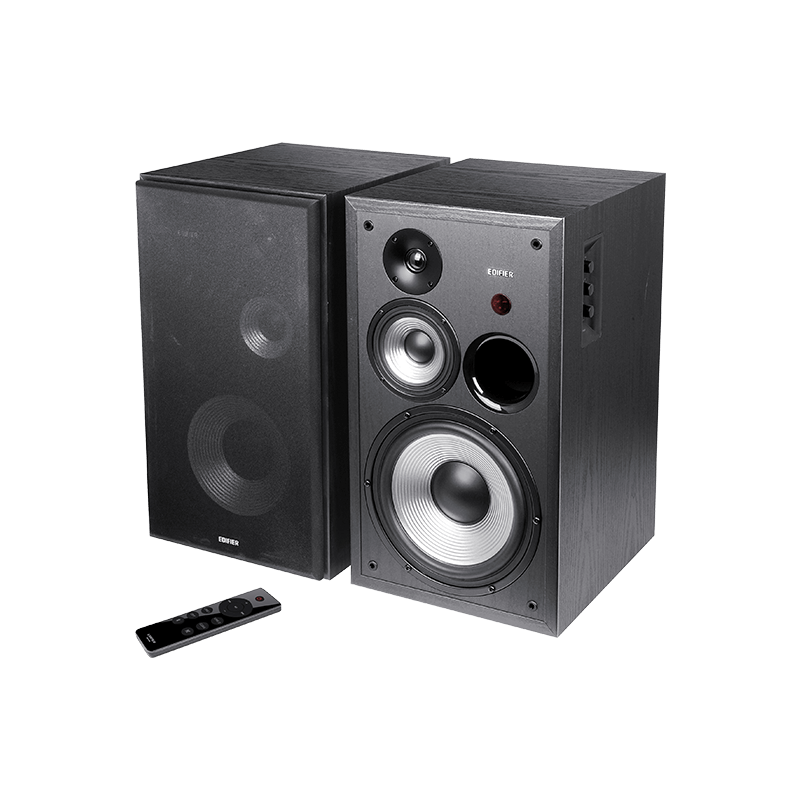
Edifier R2850DB takes the large powered-speaker approach seriously. It is a three-way stereo pair with substantial cabinets, physical tone controls and enough source connections for a straightforward music system. Bluetooth adds convenient phone playback, but there is no built-in network streamer, USB audio input or HDMI ARC. Original evaluation points to forceful bass and useful scale, with balance and treble qualifications that deserve attention. It should be considered as a sizeable room installation rather than a casual replacement for tiny computer speakers.
Research-based review. This assessment draws on manufacturer documentation and the original published evaluations linked below. Audio Review has not performed a hands-on test of this model.
Strong bass is an attraction and a buying condition
Hartware’s original review finds energetic, spacious music reproduction and clear separation in games, but considers the bass overly dominant at the default setting. The reviewer recommends reducing it for a more neutral balance. The same evaluation finds the treble less assured than its S1000W comparison and reports Bluetooth video delay that was absent in its optical setup.
These observations make a sensible audition especially important. Use a familiar vocal recording as well as bass-heavy music, and listen at the level normally used at home. Check whether a busy arrangement remains understandable rather than judging only the impact of a kick drum. Try the available tone controls gradually, keeping a note of a useful baseline. The reviewer’s particular setting is not a universal prescription for every room. A system that provides enjoyable physical weight for electronic music may need a different balance for speech or acoustic recordings. The right purchase is the one that remains convincing across the actual library without requiring constant adjustment.
The physical size should drive the installation plan
Edifier lists cabinets approximately 461 mm tall and a total pair weight around 23 kg. That is a substantial load and footprint for equipment commonly described as bookshelf speakers. The label should not be read as permission to place them on any available shelf.
Check the load rating, depth and stability of the proposed supports. Leave room for plugs and safe access to the controls. A narrow desk may not provide enough space for both a monitor and a useful stereo arrangement. Consider whether a dedicated stand or more substantial furniture is appropriate, including that expense in the comparison. Avoid unstable improvised supports or a position that leaves a cabinet vulnerable to being knocked over. Large speakers can be an advantage in a room that accommodates them, but they are a poor bargain if the only possible position makes everyday use awkward. Measure first, then judge the musical result from the intended seat. Cabinet size alone does not establish either good bass control or a coherent stereo image.
Physical controls offer straightforward adjustment
The side panel provides volume, bass and treble controls as well as source operation. That is a useful arrangement for a system used near a desk or an accessible piece of furniture. It does not amount to automatic room measurement or an app-led calibration platform.
Begin with sensible placement and a restrained playback level. Adjust the bass only after hearing familiar material at the normal seat, then reassess speech and a quieter recording. Avoid compensating for one room problem by making extreme changes that spoil the rest of the music. Keep enough access to the panel that ordinary adjustments do not require moving a heavy cabinet. If the speakers will serve a sofa-based system, confirm that the supplied remote and input routine cover the everyday tasks comfortably. A simple control scheme can be an advantage when it is clear and reachable. It is less convenient when the owner expects to manage everything through a phone application that the model does not provide. Match the control style to the room rather than assuming every powered speaker uses the same interface.
Optical and coaxial suit a source-led system
The documented digital connections are optical and coaxial. Two analogue line inputs and Bluetooth provide the other source routes. There is no USB computer audio input and no HDMI ARC connection, so the system needs an appropriate output from each intended source.
For television, establish a compatible stereo signal and test internal apps as well as external devices. Check volume control from the actual viewing position. Optical audio does not automatically give the same remote and standby behaviour as an HDMI arrangement. For a computer, identify the output actually available rather than buying an arbitrary cable because both products are described as multimedia equipment. If an adapter or external interface is needed, include its cost and operating routine before comparing another speaker pair. A source-led system can remain simple when these connections already match the equipment. It becomes less compelling if several extra boxes are required merely to obtain a basic daily function. A long input list is useful only when the listed inputs correspond to the sources in the room.
Bluetooth does not replace a network platform or phono stage
Bluetooth 5.1 and aptX support provide a direct wireless source option. The actual codec depends on the transmitting device. The line-level analogue inputs are also distinct from a phono input and cannot directly replace the required stage for a conventional unamplified turntable cartridge.
Test pairing and ordinary reconnection with the actual phone. For video or games, check synchronisation rather than assuming the Bluetooth version number establishes a particular latency result. A wired route may suit those tasks better. For records, determine whether the turntable contains a suitable internal stage or requires an external one. Set that chain correctly before judging noise or tonal balance. A network streamer can be connected through an appropriate input if independent service access is required, but this changes both the cost and the control system. Someone who mainly uses a line source or optical television may not need it. Someone seeking app-based multiroom music should compare a system designed around that requirement rather than expecting it from the wireless label alone.
The cable and complete ownership cost matter
Hartware’s construction conclusion notes an attached inter-speaker cable, making damage or replacement less straightforward than with ordinary detachable speaker wiring. This is worth understanding before placing the cabinets far apart or planning a route through furniture.
Confirm the supplied cable arrangement and available reach with the seller. Do not plan an undocumented modification merely to make the speakers fit a room. Check regional warranty and accessories, particularly when buying older stock or an imported offer. Compare the total with smaller powered pairs and with a modest amplifier and passive speakers, including any supports or external source hardware. The R2850DB is most persuasive when its size and bass capability are useful in their own right and the existing inputs already meet the plan. It is less attractive when a small desk, dialogue-focused use or network expectations make its strengths difficult to exploit. Current value depends on the complete installation, not simply the amount of cabinet and advertised wattage obtained for the price.
Alternatives to consider
WiiM Amp: A WiiM Amp and suitable passive speakers offer a more flexible component route with different source facilities. Compare the complete package and actual bass requirements rather than the amplifier price alone.
Audio Pro C20 W: This is a different one-enclosure approach to a connected room system. It may suit a simpler location, while two properly spaced cabinets remain a different stereo proposition.
Edifier R2850DB key specifications
- Speaker system
- Three-way powered stereo pair
- Manufacturer RMS rating
- 150 W across the pair. Per channel: 45 W bass, 16 W midrange and 14 W treble.
- Inputs
- Two line-level analogue inputs, optical, coaxial, Bluetooth
- Bluetooth
- 5.1 with aptX support on compatible sources
- Controls
- Side-mounted volume, bass and treble
- USB computer audio
- Not provided
- HDMI ARC
- Not provided
- Network streamer
- Not built in
- Phono stage
- Not built in
- Cabinet dimensions
- Approximately 258 × 461 × 316 mm each (W × H × D)
- Pair weight
- Approximately 23 kg
- Speaker link
- Cable required; original review notes attached cable
- Power source
- AC mains at the powered cabinet
Verdict
R2850DB can be an appealing affordable route to substantial stereo scale, particularly for listeners who enjoy bass-led music. Its balance needs auditioning and its size needs planning. Confirm supports, cable reach and source compatibility before purchase. Buyers prioritising a small desktop footprint, HDMI control or network streaming should compare a different complete package rather than adding complexity around this one.
Documentation and original reviews
Edifier official R2850DB specifications · Hartware original R2850DB sound evaluation · Hartware original R2850DB construction and ownership conclusion
Editorial record
Sources and updates
Product specifications and factual claims were checked against Official Edifier R2850DB product page ↗. Scores and buying advice follow our category-specific editorial methodology.
- Published
- November 17, 2026
- Last updated
- November 17, 2026