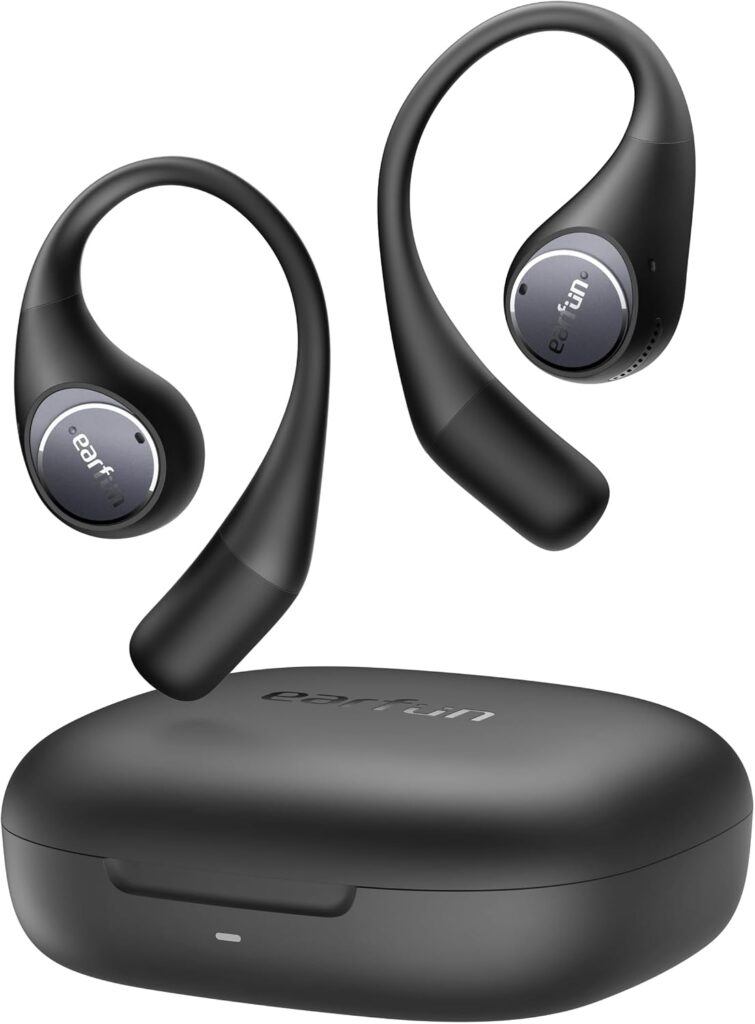
EarFun OpenJump combines open-ear hooks, app adjustment and substantial claimed battery life in an accessible package. It is designed for listening without a sealing ear tip, but that does not make every sports or travel recommendation automatic. Original reports differ in their enthusiasm for the sound and identify movement-related fit concerns. The most useful purchase case is comfortable everyday open listening, with the intended activity tested directly before treating the hooks as a guarantee of security.
Research-based review. This assessment draws on manufacturer documentation and the original published evaluations linked below. Audio Review has not performed a hands-on test of this model.
Open hooks serve a different role from sealed earbuds
The official design places a 14.2 mm speaker near the ear with a flexible hook extending behind it. It is an air-conduction arrangement, not bone conduction. Surrounding sound remains audible and there is no ANC function to create an isolated listening mode.
Consider the intended environment first. Household tasks, a quieter walk or an office where conversation is welcome can suit an unsealed design. A noisy train or a setting that requires privacy creates different demands. Check playback leakage with someone nearby rather than assuming that directional sound prevents anyone else hearing it. Open construction supports awareness but does not guarantee attention to every surrounding event. The right recommendation follows the actual listening role. A person who mainly wants to shut out the world should start with a sealed alternative instead of expecting volume or processing to turn OpenJump into something it is not.
Comfort and running stability are separate questions
Scarbir finds OpenJump comfortable for ordinary wear but reports the speaker bouncing and needing adjustment during a run. TechRadar also identifies a less-than-perfect fit experience. Soft flexible supports can reduce pressure while allowing more movement than a particular listener wants.
Try walking, looking down and the relevant exercise in a controlled setting. Wear normal glasses, a cap or other equipment that shares the space behind the ears. Check whether both speakers remain at a consistent distance from the canals. A comfortable stationary fit is useful, but it should not be used to promise the same result through vigorous movement. Someone who mainly listens at a desk may find the compromise entirely acceptable. A runner should prioritise secure positioning and reliable control access. Choose from the actual activity rather than assuming that an ear hook is inherently superior to every other support style.
The sound evidence supports an audition
Scarbir praises smoothness, vocal clarity and an enjoyable open presentation. TechRadar is less impressed by the energy and detail, despite recognising some bass support from the design. Those differing original accounts are more useful as audition priorities than as a reason to select whichever description sounds most attractive.
Try familiar voices, bass-led music and an acoustic track in the normal environment. Check whether the speaker placement changes while moving, since position affects the listening result. Compare the ordinary profile with the app’s extra processing, keeping loudness consistent. A theatre or surround effect can be enjoyable for one recording and unnecessary for another. Do not assume that a large driver compensates for the absence of a seal in every noisy location. The most convincing reason to choose OpenJump is enjoyable listening at a comfortable level with the actual routine, not a specification that implies full-size headphone performance from a small open speaker.
LDAC adds a choice with practical costs
EarFun lists LDAC alongside Bluetooth 5.3 and dual-device connectivity. The advanced codec requires a compatible source and is not a feature an iPhone gains through pairing. Scarbir reports that enabling LDAC on its setup disables multipoint and affects other practical behaviour, so simultaneous operation should be checked on current firmware.
Begin with the stable configuration that fits the routine. Test the actual phone and computer, including an incoming call and a return to music. Compare the advanced codec only after normal playback is dependable. A higher data-rate setting is not inherently more useful if it shortens runtime or removes a connection function used every day. App updates may change behaviour, so record settings rather than presenting an old software result as permanent. The best connection choice is the one that works consistently with the owner’s devices, not necessarily the option with the most prominent audio badge.
The long runtime headline has a codec condition
The official figures distinguish up to 11 hours from the earbuds and 42 hours including the case with LDAC off, versus eight and 30.5 with it on. These are manufacturer maxima and the cumulative total requires intervening recharges.
Plan around the longest uninterrupted session needed. Calls, volume, processing and battery age can reduce available time. Check both earbuds seat properly after use and keep the contacts clean according to the instructions. The case is broad enough that pocket convenience deserves a trial rather than an assumption based on small earbud size. Decide where it will be carried and how USB charging fits the day. A long published maximum is appealing for someone who dislikes frequent breaks, but it does not overcome a poor fit. Compare rivals under the same codec and use conditions instead of placing their largest headline figures side by side without context.
Controls and durability complete the practical check
The app supports EQ and control adjustment, and the official earbud rating is IPX7. The manufacturer’s FAQ explicitly says the charging case is not waterproof. Resistance claims should therefore stay attached to the earbuds rather than the complete package.
Try the main touch gestures while wearing the hooks normally. Check whether reaching for a sensor disturbs the speaker position or presses uncomfortably against the ear. Test calls in the real application before relying on an AI microphone description. Dry the earbuds before charging and follow the care limits rather than treating a rating as a swimming recommendation. Compare current European offers, warranty and return terms with other open models. OpenJump makes most sense when its comfort and long charging intervals work together. A different support style is more useful when vigorous movement repeatedly alters the fit, while sealed ANC is preferable when isolation leads the decision.
Alternatives to consider
Shokz OpenFit Air: A relevant open-hook comparison when movement stability and long-session wear matter. Try both with normal glasses and the actual activity before choosing from marketing images.
Bose Ultra Open Earbuds: A different open support arrangement to consider if hooks compete with headwear or glasses. Compare comfort and the current total price before assuming that the premium option is necessary.
EarFun OpenJump key specifications
- Design
- Open-ear air-conduction with flexible hooks
- Driver
- 14.2 mm wool-composite
- Bluetooth
- 5.3
- Codec option
- LDAC on compatible sources
- Noise cancellation
- None
- Connections
- Dual-device support, mode restrictions need checking
- Battery claim, LDAC off
- Up to 11 h earbuds; 42 h including case
- Battery claim, LDAC on
- Up to 8 h earbuds; 30.5 h including case
- Resistance
- IPX7 earbuds; case not waterproof
- App
- EQ, touch controls and firmware
- Pairing
- Google Fast Pair support
- Case charging
- USB-C and wireless charging
- Charging time
- Approximately 1 hour for earbuds; 2 hours wired or 3.5 hours wireless for the case
Verdict
OpenJump offers a feature-rich open listening package with long manufacturer battery claims and useful app adjustment. Original evidence is divided on sound and more consistently points towards checking flexible-hook stability during exercise.
Consider it for comfortable casual listening after a personal fit trial. Test the intended movement and codec settings before relying on sports security or simultaneous advanced features. Another open design or sealed pair may better fit a different routine.
Documentation and original reviews
EarFun official OpenJump construction and specifications · Scarbir original OpenJump listening and sports evaluation · TechRadar original OpenJump sound, fit and daily-use evaluation
Editorial record
Sources and updates
Product specifications and factual claims were checked against Official EarFun OpenJump product page ↗. Scores and buying advice follow our category-specific editorial methodology.
- Published
- November 17, 2026
- Last updated
- November 17, 2026