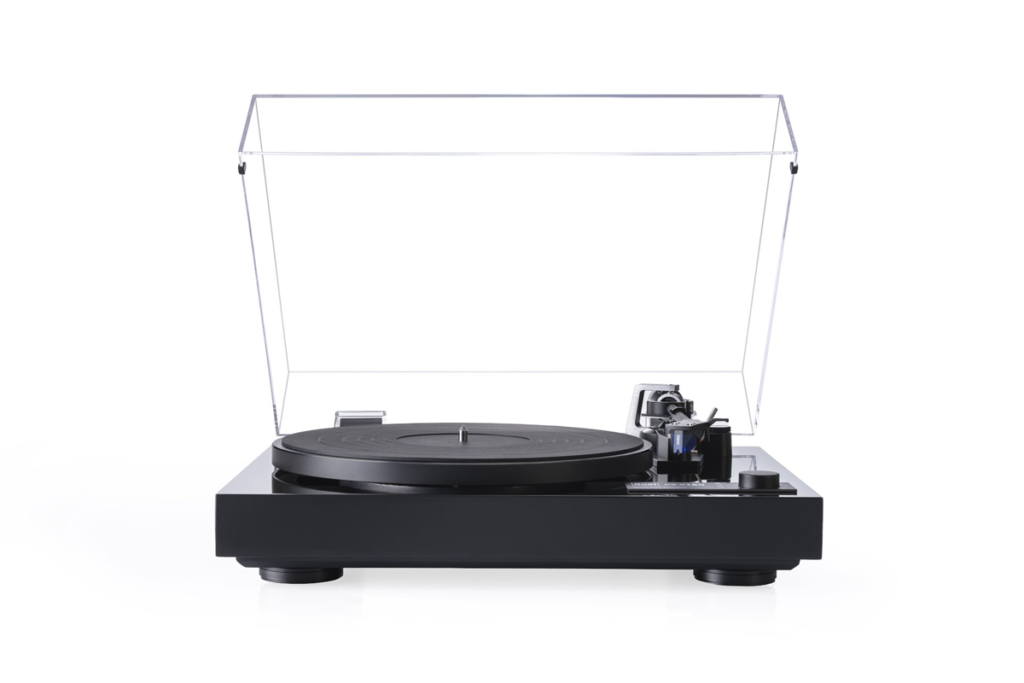
Dual CS 618Q combines a manual record-playing routine with quartz-controlled direct drive and an automatic end-of-side lift-and-stop function. It aims to make vinyl listening convenient without becoming a fully automatic arm-return design. A factory-fitted Ortofon 2M Blue and switchable phono stage complete an appealing specification. The listening decision is more qualified: the original independent evaluation admires its composure and features while wanting more rhythmic involvement against strong rivals at this price.
Research-based review. This assessment draws on manufacturer documentation and the original independent evaluations linked below. Audio Review has not performed a hands-on test of this model.
What automatic operation actually means here
The end function can stop the platter and lift the arm when enabled, but the owner returns the arm to its rest manually. It is not the same sequence as pressing start on a fully automatic player and having the arm place itself on the record and return later.
Ask for a demonstration with a normal record side. Check how the feature is enabled and what the owner still needs to do afterwards. For someone who occasionally becomes distracted at the end of an album, the lift can be a useful convenience. For someone requiring fully automatic operation, compare the correct product category instead of assuming that every deck with an auto-stop description provides the same mechanical assistance.
Quartz direct drive and speed selection
The three speeds are selected electronically, and quartz regulation controls the direct-drive system. That makes changing between supported record speeds straightforward. It is a design and usability feature, not an independent guarantee that every recording will sound more engaging than through a belt-driven alternative.
Try sustained piano or strings with a familiar record during an audition, along with the ordinary handling routine. If a particular disc sounds unstable, compare another pressing or known record before blaming the drive. An imperfect record can complicate the assessment of a turntable. The most useful test is a repeatable comparison using clean, familiar material, rather than treating a motor technology label as the complete explanation of what reaches the speakers.
A composed presentation with a clear qualification
What Hi-Fi’s original evaluation describes detailed, balanced and organised playback, while finding rivals more involving in dynamics and rhythmic drive. It also regards the internal phono stage as a weaker part of the package. That is a coherent reason to audition rather than simply copying a high overall score from the feature list.
Include music whose rhythm and expressive changes matter to you. A calm presentation can be relaxing for one listener and too reserved for another. Compare at similar level through an equivalent phono arrangement so that a change of supporting equipment does not dominate the judgment. The ideal result is a deck you enjoy across a full side, not one selected because its cartridge or motor specification appears more impressive on paper.
The supplied cartridge and headshell
The current official package uses an Ortofon 2M Blue moving-magnet cartridge on a removable headshell. Follow the setup instructions for balance, tracking force and anti-skating even though the cartridge is supplied fitted. A removable headshell simplifies access but does not eliminate alignment and compatibility requirements.
Keep the original setup documented before experimenting with another cartridge. Confirm a replacement’s mass and geometry against the arm requirements, and use the correct stylus for the record type. The seventy-eight speed option alone does not establish that the supplied stylus is suitable for every older disc. A dealer can help establish the right arrangement for a mixed collection. Convenience and correct consumables should work together rather than be treated as alternatives.
Switchable phono output and system planning
The internal stage can feed an appropriate line input, while bypass mode allows a suitable external phono stage. Match the switch to the destination before playback and start with the volume low. Two phono stages in succession are not the intended signal path.
The internal option can get a first system running without another box. If evaluating an external stage later, compare with familiar records and similar perceived level rather than assuming that higher price alone establishes the result. Include the stage and cables in any comparison with a turntable sold without one. The Dual flexibility is useful because it permits a sensible choice now and another later, not because it requires an immediate upgrade to justify ownership.
Support and handling remain important
A stable level support with space around the arm and lid helps make the semi-automatic convenience useful. Keep the deck away from strong loudspeaker vibration and avoid placing it where cables pull against the rear sockets. Automatic lift does not protect the stylus from poor handling while changing records.
Learn how to cue and return the arm calmly, and secure it as instructed before moving the deck. Keep records and the stylus clean using an appropriate method. If operation becomes inconsistent, check setup and the manual before changing several adjustments. A turntable can be easy to live with while still benefiting from routine mechanical care. The best convenience feature is one that remains predictable because the rest of the installation is sensible.
Value beside the most relevant rivals
Compare SL-1500C for another direct-drive convenience package and Planar 3 for a different listening and manual-operation approach. The correct choice depends on the importance of end lift, speed selection, cartridge package and the sound you prefer. There is no need to assume one drive type wins every comparison.
For used stock, inspect the arm, headshell contacts, stylus and end-function operation. For a new purchase, weigh dealer support and a meaningful audition opportunity alongside price. A premium deck is a long-term mechanical purchase, so an attractive finish should not obscure an uncertain service or return arrangement. CS 618Q is strongest when its useful daily conveniences and composed balance are exactly what the listener wants at a competitive total system cost.
Alternatives to consider
Technics SL-1500C: SL-1500C is an important comparison for a convenient direct-drive system. Compare the actual cartridge, phono output and end-of-side behaviour, then listen to the complete package rather than assuming all direct-drive decks have the same character.
Rega Planar 3: Planar 3 offers a different manual belt-drive proposition. Include the cartridge and phono-stage arrangement in the total cost, and decide whether the Dual automatic end lift is a convenience you would genuinely miss.
Dual CS 618Q key specifications
- Drive
- Quartz-controlled direct drive
- Operation
- Manual cueing with switchable automatic end stop and arm lift
- Arm return
- Manual, not fully automatic return
- Speeds
- 33⅓, 45 and 78 rpm
- Cartridge
- Ortofon 2M Blue moving magnet
- Tonearm
- Twin-gimbal design
- Headshell
- Removable
- Phono stage
- Switchable internal stage
- Output
- RCA, phono or line mode
- USB / Bluetooth
- Neither
- Weight
- 7.5 kg
Verdict
CS 618Q offers a thoughtful set of conveniences: quartz direct drive, electronic speed selection, a fitted 2M Blue and automatic end lift. It is a credible choice for a listener who values those functions and enjoys a composed presentation.
Audition against SL-1500C and Planar 3, particularly for rhythmic involvement and the chosen phono arrangement. Keep its manual arm return distinct from full automation. The Dual earns a qualified recommendation through a well-matched combination of sound and usability, rather than specification alone.
Primary documentation and independent reviews
Dual official CS 618Q product information · Dual CS 618Q official operating manual · What Hi-Fi original CS 618Q evaluation
Editorial record
Sources and updates
Product specifications and factual claims were checked against Official Dual CS 618Q product page ↗. Scores and buying advice follow our category-specific editorial methodology.
- Published
- November 17, 2026
- Last updated
- November 17, 2026