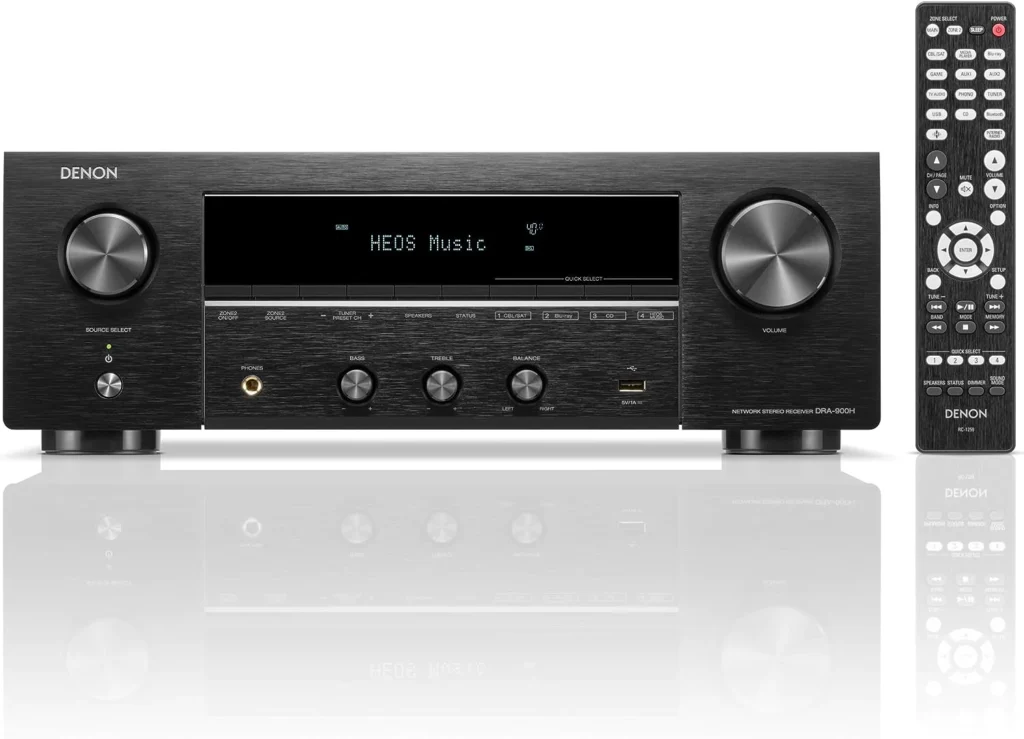
The Denon DRA-900H sits between a traditional stereo receiver and a multichannel AV hub. It combines two amplified channels with several HDMI inputs and built-in HEOS music playback. That makes it useful for a television and music system whose owner deliberately wants two main speakers rather than a future surround installation.
Denon DRA-900H — Design and the stereo AV concept
The front panel resembles a familiar Denon AV receiver, with a broad display and large source and volume controls. That conventional layout can be reassuring in a shared living room, although the enclosure needs more space than a miniature streaming amplifier. Allow for ventilation and for the bend radius of several HDMI leads behind the cabinet.
The important limitation is architectural: there are two power-amplifier channels. This is not a seven-channel receiver temporarily configured for stereo. Adding a centre speaker, rear speakers or height channels is not a matter of enabling a setting. Choose the DRA-900H when a two-speaker system is the intended final arrangement, and choose a multichannel receiver if expansion is likely to be part of the plan.
HDMI inputs and real television use
Six HDMI inputs and one output let the receiver switch several video sources as well as their audio. Three inputs support the highest advertised 8K capability, so check the socket and signal-mode requirements for a demanding games console or player. A headline video resolution does not mean every input and every menu setting is interchangeable.
The European manual documents ARC return audio. Some generic product-page language refers to wider AV features, but a stereo receiver should not be credited with Atmos loudspeaker reproduction simply because a shared HDMI description mentions it. Configure sources for a supported stereo audio signal and verify picture, sound and control with the actual television. Successful picture output and successful TV-app return audio are separate checks.
Consider whether switching should happen in the receiver or in the television. The Denon’s input bank is valuable when the TV lacks enough suitable sockets or cable routing favours a central hub. If every source already connects cleanly to the TV, a compact amplifier with one return-audio connection may achieve the same everyday goal with less equipment space.
Power and loudspeaker planning
The official European rating is 100 watts per channel into eight ohms, across 20 Hz to 20 kHz at 0.08 percent distortion. The 120-watt six-ohm figure uses a one-kilohertz condition, so it is not the same comparison. The full-bandwidth eight-ohm specification is the clearer starting point when matching ordinary stereo loudspeakers.
Speaker sensitivity, impedance and listening distance determine what that power means in the room. Dialogue at moderate levels is not the same demand as loud music with strong bass peaks. Leave sufficient headroom and avoid using a volume-control position as a universal indicator of output; source levels and gain structures vary across equipment.
The A/B speaker facility does not create another independent stereo amplifier. Follow the manufacturer’s load guidance if two pairs are used together. The independent AUDIO review examined the receiver’s power and impedance-selector behaviour, but its laboratory configuration should not replace the manual’s operating instructions. Match the speakers within the documented requirements rather than treating a review’s stress test as everyday setup advice.
Streaming, radio and physical music sources
HEOS integrates network playback, with Wi-Fi and Ethernet offering different installation options. AirPlay 2 and Bluetooth add convenience for compatible sources. Check the services available on current firmware in the intended European market; software support can change after an original review, and an old absent-feature list should not be copied into a current buying recommendation without verification.
The European model’s DAB/FM provision is relevant to listeners who still use terrestrial radio. Reception depends on aerial placement and local coverage. This regional version should not be described using a different market’s tuner specification. Internet radio remains an alternative where the network is reliable, but it has different dependencies from a broadcast aerial.
An MM phono input, line sources, two optical inputs and coaxial digital input support established music equipment. The front USB connection handles supported storage media rather than acting as a general computer DAC. A second USB-shaped socket used for power should not be treated as another audio input. Plan each source by its actual signal format, particularly a turntable with an internal phono stage and a computer that only offers USB output.
Subwoofers and additional connections
Two subwoofer output sockets make it convenient to connect more than one bass unit, but socket count does not establish independent room measurement or correction. The European manual describes a 2.1 speaker arrangement. Setup still requires sensible placement, crossover, phase and level choices, with the main speakers and listening seat taken into account.
Main preamp connections and a second-zone line output offer expansion options. An additional room with passive speakers needs suitable amplification; the receiver’s two main power channels do not multiply when another output is connected. Check source availability for the zone, because multiroom network playback and routing a specific HDMI source are different requirements.
A headphone output is useful for quiet listening, while Bluetooth headphone operation offers another route. Television delay and reconnection behaviour should be tested with the actual headphones. Those practical checks matter more than assuming every wireless connection is interchangeable. If private listening is the system’s main role, compare a dedicated headphone arrangement before paying for an HDMI receiver whose loudspeaker functions will rarely be used.
Sound evidence and value
AUDIO’s original DRA-900H evaluation described a smooth, comfortable balance with substantial bass and a restrained upper range. Its laboratory work found low distortion and useful output, while also identifying the effect of the impedance setting. That evidence supports an approachable all-round stereo receiver rather than a claim that Audio Review has independently measured or listened to it.
The reported balance makes a personal audition worthwhile with the intended speakers and seating position. Assess speech clarity as well as music: without a physical centre speaker, dialogue placement depends more strongly on stereo geometry. Try an ordinary programme and a busy soundtrack at realistic levels, then familiar music, instead of choosing only from a spectacular demonstration clip.
The DRA-900H offers good functional value when the HDMI inputs, music platform and conventional sources all replace separate hardware. A smaller network amplifier may suit a simpler television arrangement, and a full AV receiver makes more sense for future surround. Compare current European offers with that complete plan in mind. The Denon is a useful specialist in everyday stereo convenience, provided its two-channel limit is a conscious choice.
Alternatives to consider
Marantz MODEL M1: Consider a smaller return-audio streaming amplifier if video switching can remain in the television.
WiiM Amp Ultra: Compare a compact app-led stereo alternative when six HDMI inputs are unnecessary.
Denon DRA-900H key specifications
- Type
- Network stereo AV receiver
- Rated output
- 100 W/channel at 8 ohms, 20 Hz–20 kHz, 0.08% THD
- HDMI
- Six inputs, three 8K-capable; one output
- TV return audio
- ARC documented in EU manual
- Digital audio
- Two optical, one coaxial, front USB media
- Phono / EU tuner
- MM / DAB and FM
- Network
- HEOS, Ethernet, Wi-Fi and AirPlay 2
- Expansion
- Main preamp, two subwoofer sockets and Zone 2 line out
Verdict
A versatile stereo AV receiver for owners who want several HDMI sources, records and streaming through two main speakers. Its connection range is the attraction; permanent stereo operation and careful source configuration are the essential conditions.
Primary documentation and independent reviews
Denon official European DRA-900H product details · Denon official European DRA-900H manual · AUDIO original DRA-900H listening and laboratory review
Editorial record
Sources and updates
Product specifications and factual claims were checked against Official Denon DRA-900H product page ↗. Scores and buying advice follow our category-specific editorial methodology.
- Published
- November 8, 2026
- Last updated
- November 8, 2026