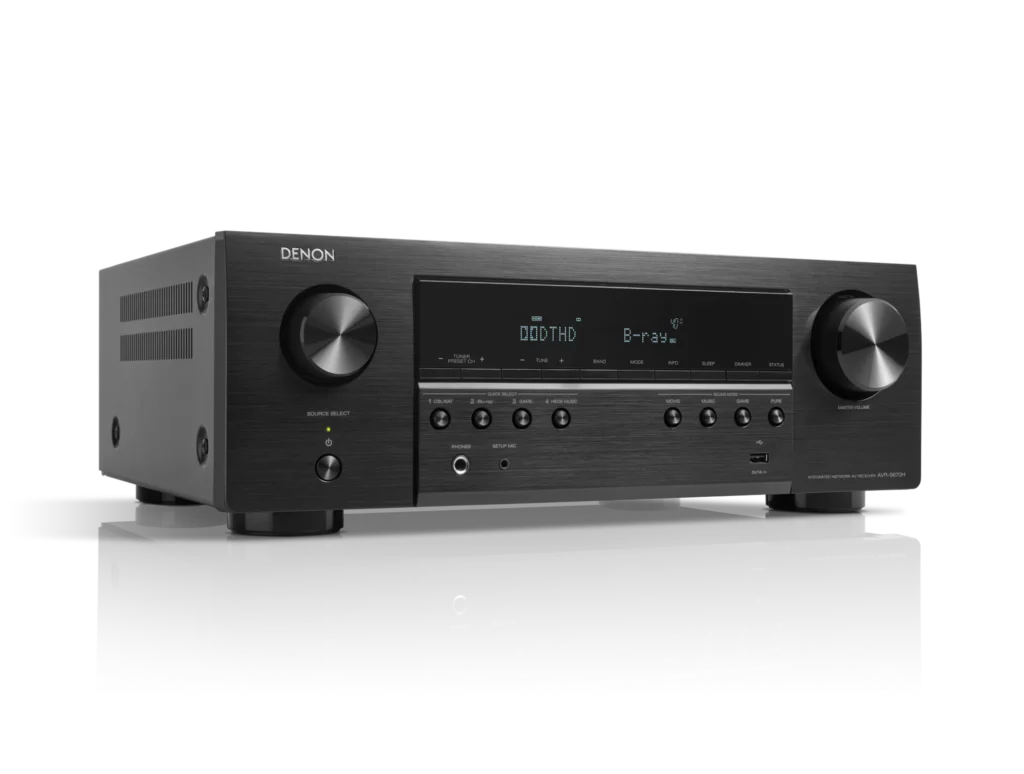
Denon AVR-S670H is a five-channel receiver for a conventional surround system, with network music and a useful set of modern HDMI connections. Its specification can look attractive for a first separate-speaker cinema, but it has two important limits. There is no Dolby Atmos or DTS:X height-speaker path, and the original independent listening review is less enthusiastic about its cinematic performance than about its setup and connectivity. It should therefore be considered carefully against current alternatives, not recommended solely from the feature list.
Research-based review. This assessment draws on manufacturer documentation and the original independent evaluations linked below. Audio Review has not performed a hands-on test of this model.
A five-speaker plan should be deliberate
The receiver can power front left and right, a centre and a pair of surrounds, with subwoofer connections alongside. That is a sensible layout for many rooms. The limitation is that adding height speakers later requires a different receiver; unused binding posts or a software update do not create amplifier channels that are absent.
Start by deciding where real speakers can be placed. A well-arranged five-channel system can be more useful than an ambitious layout with badly positioned speakers, but future plans still matter. If ceiling or height speakers are a realistic next step, compare a seven-channel model now. The extra cost may be smaller than replacing the receiver once the initial speaker purchase has already been made.
What the original listening test changes
What Hi-Fi’s original test praises clear dialogue, precise timing and energy, but criticises a lightweight presentation, restricted dynamics and less cohesive surround effects. Those are substantial reservations for a product bought to make films convincing. They temper the recommendation rather than being ignored because Denon has other successful receivers.
Audition dialogue, music and a demanding film scene if possible. Check whether voices have enough body and whether effects connect naturally across the room. The result will also depend on speakers and setup, so a published review is not a guarantee of the same impression in every home. It is a reason to compare carefully, particularly when a higher-series model costs little more. The brand’s reputation cannot substitute for the performance of this specific product.
HDMI is a stronger part of the package
Six HDMI inputs provide room for several sources, and three support the higher-bandwidth video modes listed in the technical table. Identify those inputs for a high-frame-rate console or computer rather than treating every socket as equivalent. The single output also deserves attention if both a television and projector are intended.
Test the complete chain at the desired resolution, frame rate and HDR setting. The source, receiver input, cable and display all need to support the selected mode. A picture appearing at a lower setting is not proof that the intended gaming configuration works. Rename the inputs to match the connected sources so that a household member can choose the correct device without needing to remember the rear-panel numbering.
eARC and the television path
ARC/eARC lets compatible television audio return to the receiver through the appropriate HDMI connection. That can be useful for built-in apps or sources connected directly to the screen. The available audio format depends on the television, app, source and output settings, not only on the receiver’s decoder list.
Check the received audio information when the sound differs from expectations. A streaming service badge does not establish that the same format reaches the receiver in every programme or connection route. Keep the television and receiver settings documented after a successful setup. A clear source path helps resolve missing dialogue, unexpected stereo playback or an input-switching problem without repeatedly changing unrelated options and losing the configuration that previously worked.
Audyssey is a starting point, not an installation substitute
The guided setup and microphone calibration can make a first receiver easier to configure. Use the supplied microphone and follow the actual placement instructions. Keep the room quiet during measurement and check the resulting speaker identification before settling into normal playback.
The original evaluation finds reasons to review the calibration results rather than accepting every setting without inspection. Check practical issues such as speaker polarity, subwoofer operation and obvious channel-level imbalance. Do not change unfamiliar settings randomly to chase a more impressive first impression. Sensible speaker and subwoofer placement comes first, followed by calibration and listening checks. No basic room-correction system makes an obstructed centre speaker or poorly placed surround pair disappear as a physical problem.
Music features and a simple shared system
HEOS, AirPlay 2 and Bluetooth provide several routes to music, while an MM phono input can accommodate an appropriate turntable connection. Verify current service support and the exact cartridge or phono-stage arrangement instead of assuming every source plugs into the same kind of input.
For a shared living-room system, practise the normal sequence from standby to television or music playback. Set sensible startup and maximum volume preferences where available, and keep the remote functions clear. The advantage of a receiver is bringing several activities into one organised system. That advantage is reduced if the household needs a complicated sequence of apps and input changes simply to play the news or start an album.
Value depends on the alternatives today
The S670H is most plausible at a price that clearly reflects its five-channel limit and the original review’s performance reservations. Compare X1800H and X2800H offers directly rather than assuming an entry-level product remains cheaper after discounts elsewhere. Do not use an old price in a review as a current market quote.
For used or imported units, verify the regional version, power requirements, remote and calibration microphone. A missing accessory can erode a small saving, while an uncertain return policy makes an audition harder to act on. Include the speakers, subwoofer, stands and cables in the complete budget. The receiver should support that system sensibly; it is not automatically the best place to minimise cost if doing so forces a near-term replacement.
Alternatives to consider
Denon AVR-X1800H: X1800H deserves comparison if height speakers or more flexibility are likely. Use the current actual price difference and required layout rather than assuming the less expensive series is automatically the best-value entry point.
Denon AVR-X2800H: X2800H is particularly important when local discounts bring it close in price. Compare its channel and calibration package and audition with the same speakers; old launch-price positions are a poor guide to a current buying decision.
Denon AVR-S670H key specifications
- Role
- Network AV receiver
- Amplified channels
- Five
- Speaker layout
- Up to 5.2; no height-speaker layout
- Subwoofer sockets
- Two
- Audio decoding
- Dolby TrueHD and DTS-HD Master Audio
- Dolby Atmos / DTS:X
- Not supported
- HDMI
- Six inputs, one output
- High-bandwidth HDMI
- Three inputs, up to 4K/120 Hz or 8K/60 Hz
- TV return audio
- ARC/eARC
- Room correction
- Audyssey MultEQ
- Network music
- HEOS, AirPlay 2 and supported services
- Turntable input
- MM phono
- Rated power
- 75 W/ch, 8 ohms, 20 Hz–20 kHz, 0.08% THD, two channels driven
- Dimensions (W × H × D)
- 434 × 151 × 339 mm with antennas horizontal; height 215 mm with antennas upright
- Weight
- 7.8 kg
Verdict
AVR-S670H has useful HDMI connectivity and approachable setup for a conventional five-channel room. Its network and phono options can also make it a practical shared audio hub.
The recommendation remains cautious because of its lack of a height-speaker route and the original test’s sound reservations. Compare the current X1800H and X2800H prices before purchase, and audition where possible. Choose the S670H only when its exact layout, demonstrated result and price make a clear case in the system you intend to build.
Primary documentation and independent reviews
Denon official AVR-S670H product information · Denon AVR-S670H European operating manual · What Hi-Fi original AVR-S670H listening evaluation
Editorial record
Sources and updates
Product specifications and factual claims were checked against Official Denon AVR-S670H product page ↗. Scores and buying advice follow our category-specific editorial methodology.
- Published
- November 17, 2026
- Last updated
- November 17, 2026