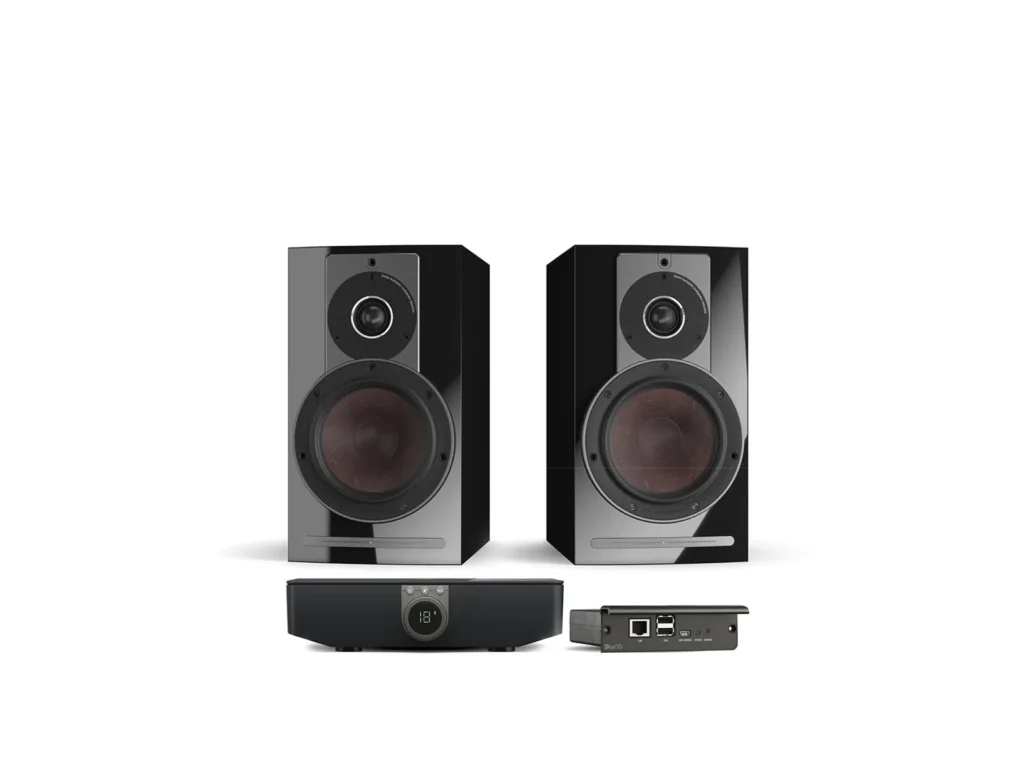
DALI RUBICON 2 C aims to provide serious stereo performance without a conventional amplifier stack or signal cables running to both cabinets. Its standmount form is familiar, but the active electronics and DALI hub arrangement make it a system purchase. The hub chosen alongside the speakers determines much of the day-to-day experience, including source connections and network options. Original evaluations are encouraging about musical coherence and involvement. The buying decision still needs to include stands, power locations and the precise control package rather than stopping at a speaker-only price.
Research-based review. This assessment draws on manufacturer documentation and the original published evaluations linked below. Audio Review has not performed a hands-on test of this model.
Musical coherence is the strongest reason to audition
What Hi-Fi’s original review finds cohesive reproduction, clear vocals and engaging rhythm, while noting that well-chosen separates can reveal more subtle detail at a comparable system price. Alpha Audio’s evaluation also supports an involving, substantial presentation and shows that placement can materially change the bass balance. These are listening observations from those reviewers, not Audio Review measurements.
The useful next step is an audition with music that reveals vocal balance, timing and low-level information. Listen at the level normally used at home, not just an impressive demonstration setting. If the system will serve a living room rather than one dedicated chair, check how intelligible the result remains away from the central position. Avoid treating an active architecture as an automatic guarantee of superiority over passive alternatives. Its value lies in the achieved result and the practical arrangement. A coherent performance from a system that is easy to use every day may matter more than a marginal specification advantage that does not improve the room.
The hub is part of the system, not an incidental accessory
The wireless arrangement uses a compatible DALI hub to receive sources and transmit audio to the speakers. The full Sound Hub provides analogue and digital inputs, Bluetooth and expansion slots. The optional BluOS module adds a network-streaming platform; it is not a prerequisite for every ordinary analogue or digital source.
Check the exact retail bundle. A price that includes speakers, full hub and network card should not be compared directly with a speaker-only listing. Ask the dealer to demonstrate the intended input and volume control using the supplied package. If a simpler hub is offered, establish its facilities and expansion limits before assuming it is interchangeable with the larger unit. A music listener who wants one network service may have a different ideal package from someone connecting a television, disc player and turntable. Make that decision from the source list rather than from the prestige of a module name. A well-chosen hub turns the active pair into a convenient system; an unsuitable one can leave an expensive collection of boxes short of a basic requirement.
Wireless signal distribution still needs thoughtful positioning
DALI specifies a proprietary wireless link carrying up to uncompressed 24-bit/96 kHz audio. This is separate from ordinary home Wi-Fi streaming and should not be confused with a promise that the speakers are battery powered. Each cabinet needs mains power, and the hub requires its own installation space.
Locate the sockets and furniture first. Proper stands can help place the tweeters at a sensible height and keep the speakers away from resonant shelving. Include safe power routing and room for the cabinet depth. A wireless signal route makes it possible to keep sources somewhere convenient, but it does not mean the speakers can be positioned arbitrarily without affecting the sound. Follow the manufacturer as a starting point, then assess bass and image focus at the actual seats. Small changes are easier to evaluate when the same familiar passage and playback level are used. The objective is a stable, comfortable listening arrangement that makes the system’s compact form an advantage rather than an excuse for compromised placement.
Turntable use requires the right signal level
The ordinary full Sound Hub analogue connections are line-level inputs, not a built-in MM or MC phono stage. A turntable therefore needs a suitable phono stage somewhere in the chain, whether integrated into the record player or provided by a separate component.
Identify the cartridge type and the turntable’s actual output before ordering cables. A player with a switchable internal stage should be configured for the intended line input. A conventional deck without one needs an appropriately matched external stage. Do not stack two phono stages simply because both products have RCA sockets. Keep the turntable on stable support, separate from surfaces excited by the speakers, and allow for grounding where the source requires it. Include that component and its cables in the complete cost comparison. The system can be attractive for vinyl, but its wireless speaker link does not remove the record player’s electrical and mechanical needs. Clear planning makes source switching straightforward and avoids disappointment caused by an incomplete package.
Streaming and television options should be chosen explicitly
The full Sound Hub can accept an optional BluOS network module and an optional HDMI module. DALI documents up to 7.1-channel Dolby and DTS playback through the latter; that is not the same as adding an Atmos height-channel processor. The Compact hub takes a different approach and does not share the full unit’s module slots.
Demonstrate the streaming service, phone or tablet and television route actually intended for use. Confirm source switching, volume control and ordinary reconnect behaviour. A launch-era list of supported services is not proof of every current account feature or regional integration. If the system is music-first, avoid paying for surround expansion that will never be installed. If television is central, check the display’s output format and everyday remote operation before judging convenience. The relevant comparison is with another complete active system or a properly equipped amplifier, not a feature list assembled from several different DALI packages. This keeps the decision grounded in the hardware and software that will actually be supplied.
Premium value depends on the finished installation
RUBICON 2 C occupies a price level where the supporting choices deserve as much attention as the cabinet finish. Stands, hub hardware, optional modules and any external source stage can significantly change the total. Current availability and local support also matter for an established product generation.
Compare complete offers with the same sources and listening requirements. Ask which accessories, remote and warranty are included, and confirm the documented firmware route. Think about future changes in terms of realistic needs: adding a compatible source is different from replacing the whole control ecosystem. A buyer who values flexible source placement and a tidy active pair may find the package worthwhile even when a conventional system offers more component choice. Someone who changes amplifiers or speakers frequently may prefer separates. Neither preference is settled by the word wireless. The strongest purchase is a system that already sounds convincing and is easy to operate now, with a clear support path, rather than one justified mainly by unspecified future upgrades.
Alternatives to consider
KEF LS50 Wireless II: This is a useful comparison for another premium active stereo route. Compare the actual streaming, television connection and placement requirements, with stands and any subwoofer included in the total.
WiiM Amp Pro: An amplifier with carefully chosen passive speakers is a different approach to the same room. It retains ordinary speaker cabling and broader speaker choice, so compare the full combination rather than the amplifier price alone.
DALI RUBICON 2 C key specifications
- Speaker format
- Pair of active two-way standmounts
- Bass/mid driver
- 6.5-inch wood-fibre cone per speaker
- Tweeter
- 29 mm soft dome per speaker
- Wireless audio
- Proprietary DALI link, up to uncompressed 24-bit/96 kHz
- Control system
- Compatible DALI Sound Hub required for the reviewed wireless arrangement
- Crossover
- Hybrid DSP and analogue design
- Power
- Mains connection at each speaker
- Network streaming
- Depends on hub and optional BluOS module
- Television
- Depends on hub / optional HDMI module
- Turntable
- Suitable external phono stage required for ordinary hub line inputs
- Stands
- Budget separately if not included
- Dimensions (W × H × D)
- 195 × 353 × 335 mm per speaker
- Cabinet weight
- 8.4 kg per speaker
Verdict
RUBICON 2 C is an appealing premium active standmount system with strong original evidence for musical integration and involvement. The required hub arrangement can simplify source placement, provided the exact package suits the intended routine. Count stands, modules and any phono stage in the budget. Choose it after comparing complete systems in a realistic room, rather than assuming wireless convenience alone establishes value.
Documentation and original reviews
DALI official RUBICON 2 C specifications · DALI official Sound Hub and optional modules · What Hi-Fi original RUBICON 2 C review · Alpha Audio original RUBICON 2 C listening evaluation
Editorial record
Sources and updates
Product specifications and factual claims were checked against Official DALI RUBICON 2 C product page ↗. Scores and buying advice follow our category-specific editorial methodology.
- Published
- November 17, 2026
- Last updated
- November 17, 2026