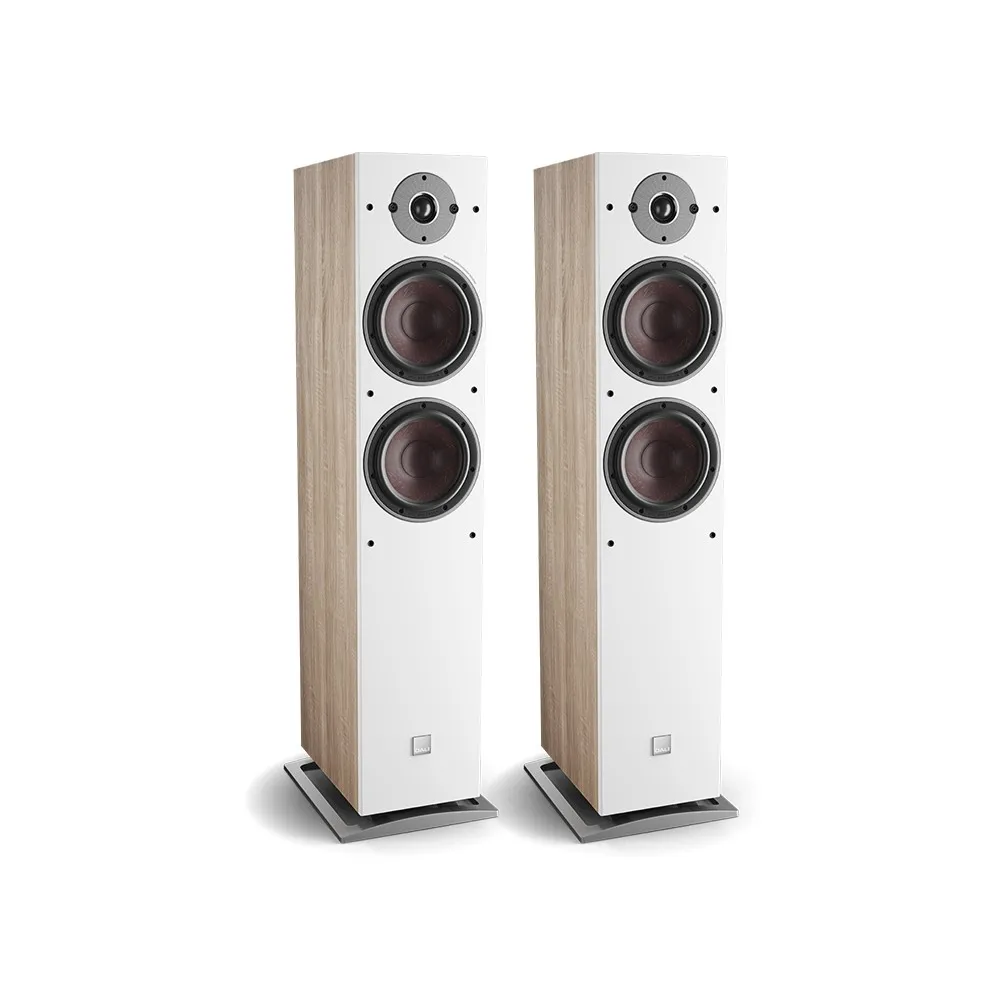
DALI OBERON 7 C brings active amplification and wireless signal distribution to a familiar floorstanding stereo format. It is designed around a compatible DALI hub rather than ordinary direct Bluetooth pairing with each speaker. That extra box is central to the buying decision: it determines the inputs, streaming route and possible expansion. Original listening evidence supports an appealing musical system, while the practical value depends on the complete bundle, the available room and whether reducing signal cables actually simplifies the installation. This is an older-generation model, not a newly launched 2026 floorstander.
Research-based review. This assessment draws on manufacturer documentation and the original published evaluations linked below. Audio Review has not performed a hands-on test of this model.
A proper stereo system with encouraging listening evidence
Audioholics’ original evaluation describes a generally balanced, clear presentation with satisfying bass and a convincing central image. It also identifies finite output limits rather than treating the system as a replacement for much larger high-output speakers. That is a useful basis for a home audition, with expectations kept realistic.
The purchasing question is whether the pair can provide the scale and clarity needed at the actual listening distance. Try dialogue-like vocals, busy music and a quieter recording at normal household levels. Check several seats if the system serves more than one listener. A dramatic showroom demonstration is less useful than finding that voices remain intelligible and bass stays controlled where the speakers will live. The floorstanding format removes the need for ordinary standmount stands, but it still requires sensible spacing. Place the speakers as a stereo pair rather than treating them as convenient furniture at opposite ends of a room. That gives the active system a fair opportunity to justify its size.
Wireless removes signal cables, not every installation requirement
The proprietary DALI link carries audio from the hub to the speakers at up to uncompressed 24-bit/96 kHz. Each cabinet nevertheless needs its own mains supply. The hub also needs a suitable location and the appropriate connections to the sources.
Draw the system before ordering it. Locate the sockets, television, turntable and any disc player, then decide where the hub makes those connections easiest. A room with power available near each speaker may suit this arrangement especially well. A room with only one convenient socket may need more planning than the wireless label initially suggests. Avoid stretching power cables across walkways simply to eliminate a discreet speaker cable. Establish the documented pairing arrangement before hiding the control unit in furniture. Wireless convenience is meaningful when everyday source selection and listening become easier, not when installation compromises are merely transferred from one kind of cable to another. The lack of a signal wire between cabinets also does not remove acoustic placement considerations.
The full Sound Hub and Compact are different buying routes
The full Sound Hub has analogue and digital inputs, Bluetooth and two expansion ports. DALI documents optional BluOS and HDMI modules for that larger unit. Sound Hub Compact is a different, simpler control route and does not provide those same modular upgrade slots.
Ask the retailer to identify the precise hub and modules included in the advertised price. A speaker-only offer, a basic hub bundle and a network-streaming package are different products in practical terms. Write down the required sources before choosing. Someone playing television and occasional phone audio may need a different package from someone building a networked music library across several rooms. Do not pay for an expansion route solely because it is available. Equally, do not choose the cheaper hub assuming a full-hub module can be fitted later. If streaming is essential, demonstrate the intended service and control device before committing. The purpose of the ecosystem is to make a defined system convenient; its name alone does not establish that every useful function is included.
Television and surround need a specific connection plan
DALI’s optional HDMI module for the full Sound Hub supports up to 7.1-channel Dolby and DTS playback. That is distinct from a height-channel Atmos installation. The television connection and available configuration depend on the actual hub hardware and installed module.
Start with the intended job: stereo television sound, a music-first system or a larger surround arrangement. Check that the television provides a compatible output and that normal remote-volume operation works as expected. Test switching between a broadcast, an app and any external source used regularly. Do not assume that the presence of HDMI guarantees every television format will pass through unchanged. For expansion, include compatible additional speakers, power locations and setup time in the plan. An existing AV receiver system should not be mixed into the wireless arrangement without a documented route. The attractive feature is flexible source placement and an integrated DALI system. It is not an automatic promise that arbitrary wireless speakers or height channels can be added later.
Bass and room placement deserve attention before extra purchases
Two bass/mid drivers in each cabinet and a floorstanding enclosure do not make room acoustics irrelevant. Rear-wall distance, seating position and the surfaces around the speakers remain important. Use the manufacturer’s placement guidance as a starting point and assess the result in the actual room.
If bass becomes excessive, try a sensible placement adjustment before concluding that an additional processor is required. If the result feels too lean at one seat, check another position before immediately adding a subwoofer. The original Audioholics setup discussion found the contemporary hub’s bass-management controls relatively limited. That observation should be tied to the tested configuration rather than assumed to describe every current software or hub combination. For a subwoofer purchase, establish the documented crossover and connection behaviour of the selected package. Make changes one at a time and keep a reliable starting configuration. A system that sounds coherent with ordinary music at normal levels is more useful than one assembled around impressive specifications without checking the room.
Judge the complete older-generation package
Availability and support matter because this is no longer a new launch. Confirm the regional version, warranty, included remote and hub accessories, and current firmware route. A dealer demonstration should use the same basic hardware package being offered, not a more expensive modular configuration.
Compare the full cost with a conventional amplifier and passive floorstanders as well as other active systems. Include stands where competing speakers need them, any network module, television connection hardware and installation requirements. Think about future replacement too: the hub-based arrangement makes some changes convenient, while keeping the speakers within a defined ecosystem. That can be a good trade if the present system already meets the long-term source plan. It is less convincing if the purchase depends on an unspecified future module or a service that has not been demonstrated. OBERON 7 C earns its place through a usable combination of stereo performance and everyday simplicity. The most attractive offer is the one that achieves both without hidden additions.
Alternatives to consider
KEF LS50 Wireless II: Compare this active standmount system when a smaller speaker and a different streaming platform fit the room. Include appropriate stands and any bass extension in the complete price.
WiiM Amp: A WiiM Amp with suitable passive speakers offers a different route to a connected stereo. It brings speaker-cable routing and separate component choices, so compare a complete working package rather than the amplifier alone.
DALI OBERON 7 C key specifications
- Configuration
- Pair of active two-way floorstanding speakers
- Drivers per speaker
- Two 7-inch wood-fibre bass/mid units; 29 mm soft-dome tweeter
- Amplification
- Two 50 W peak amplifier channels per speaker, manufacturer rating
- Wireless speaker link
- Proprietary DALI, up to uncompressed 24-bit/96 kHz
- Required control unit
- Compatible DALI Sound Hub or Sound Hub Compact
- Streaming
- Depends on hub and optional modules
- Power
- Mains connection required at both speakers
- TV connection
- Depends on selected hub / HDMI module
- Network module
- Optional BluOS on the full Sound Hub
- Surround expansion
- Optional full-hub HDMI module supports up to 7.1, not height-channel Atmos
- Product status
- Older-generation model; availability varies
- Dimensions (W × H × D)
- 200 × 1015 × 340 mm per speaker
Verdict
OBERON 7 C is a persuasive active floorstanding option for a buyer who wants proper stereo scale and flexible signal routing. Original evaluation supports a balanced musical result, with realistic output limits. Confirm the exact hub, streaming and television facilities before comparing prices. Buy the complete working package when it suits the room and routine; the speakers alone do not define the whole system.
Documentation and original reviews
DALI official OBERON 7 C specifications and archive information · DALI official full Sound Hub connections and expansion · Audioholics original OBERON 7 C evaluation
Editorial record
Sources and updates
Product specifications and factual claims were checked against Official DALI OBERON 7 C product page ↗. Scores and buying advice follow our category-specific editorial methodology.
- Published
- November 17, 2026
- Last updated
- November 17, 2026