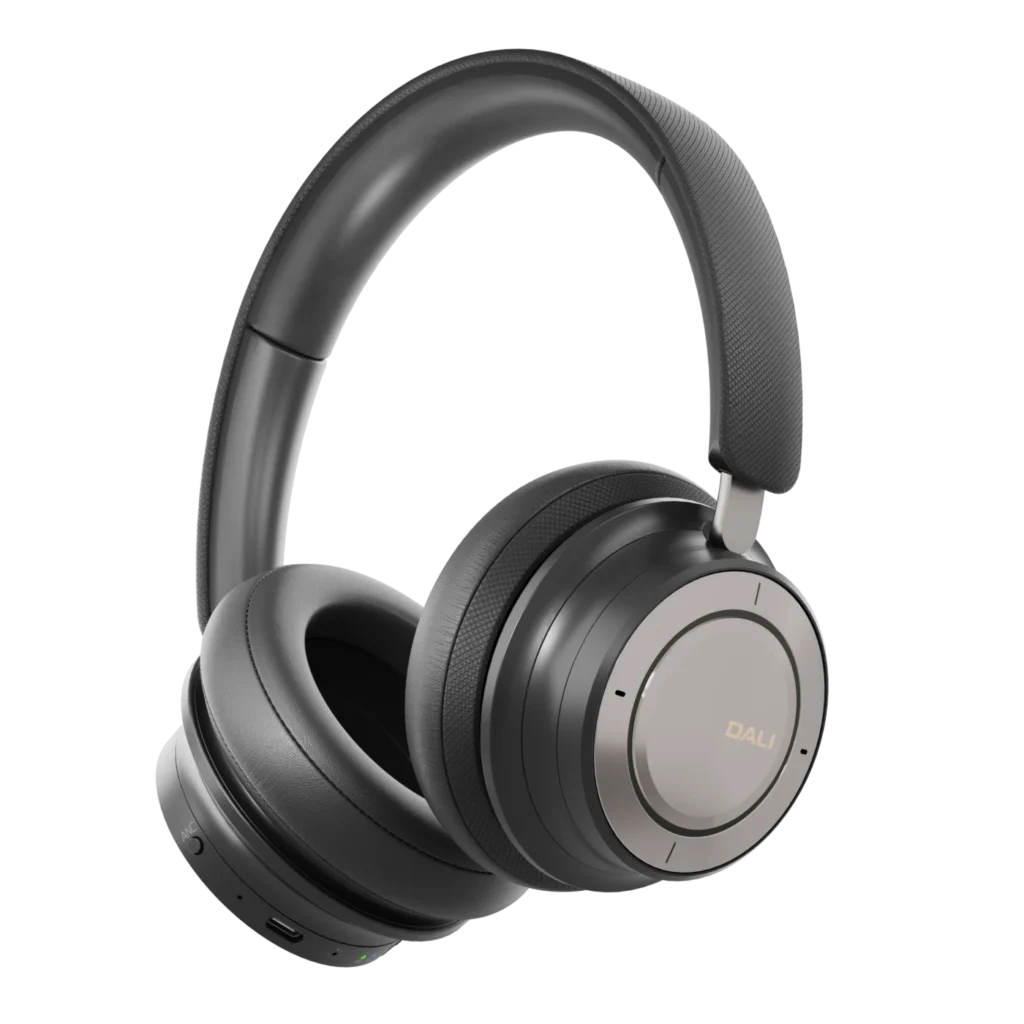
The DALI IO-8 is a wireless closed-back headphone with physical controls, ANC and several wired source options. Its appeal is a relatively direct control routine with Bluetooth, USB-C and analogue listening, provided the substantial fit and two sound profiles suit the listener.
Research note: This article assesses manufacturer documentation and practical system requirements. We have not performed hands-on listening, battery tests, microphone recordings or independent measurements. Performance specifications are manufacturer claims.
IO-8 connections and passive listening
DALI lists Bluetooth 5.2, USB-C and a 3.5 mm input, with 25 Ω impedance in passive mode. The USB audio specification covers up to 24-bit/96 kHz. Choose the connection for the actual source and compare active and passive operation deliberately; a different signal path should not be mistaken for a controlled comparison of headphones.
Physical controls and two sound profiles
There is no required companion app. The headphone uses multifunction buttons and Hi-Fi or Bass sound modes. This can suit listeners who prefer operating the headphone directly, while users wanting extensive app EQ should check whether the available choices are sufficient. Try the controls during normal movement, including adjusting the headband and taking a call.
ANC and the 35-hour battery claim
The product page advertises up to 35 hours of noise-cancelling playback and three ANC modes. That is not an independently measured travel result. Check how the chosen mode, volume and source affect the routine on a long journey, and leave charging margin. Listening with ANC is not a guarantee that every nearby voice or sudden sound becomes inaudible.
Fit, weight and the 50 mm driver
The published weight is 325 g, with a custom 50 mm paper-fibre driver. Assess pad clearance, headband pressure and stability during a longer session, especially with glasses. Driver diameter and materials alone do not establish comfort, bass response or a sound preference against another headphone.
An app-free control approach
The IO-8’s physical controls and Hi-Fi/Bass profiles provide a different ownership proposition from a headphone built around extensive app adjustment. Try those controls while wearing the pair, including changing noise modes and playback level. A simple set of options can be convenient for someone who wants fewer software steps, while another listener may prefer a detailed equaliser and device-management screen. Decide which approach fits the normal routine instead of assuming that more app functions always mean a better purchase.
The two sound profiles are choices to audition at similar volume. Use familiar voices, bass lines and a mixture of recordings rather than selecting a mode from one impressive demonstration. A stronger low-frequency balance can be enjoyable without proving greater extension or accuracy. Keeping the chosen profile identified also makes source comparisons clearer, because a changed preset can otherwise be mistaken for a difference between USB and Bluetooth.
Three connections, three practical checks
Start with the source used most often. For Bluetooth, confirm the supported codec on that phone or computer and test calls in the intended application. For USB, check that the host selects the audio device correctly and that the required file format is within the supported range. For analogue use, follow the documented powered or passive arrangement rather than borrowing behaviour from another wireless headphone. A shared connector shape is not a complete operating description.
Use familiar material and comparable levels when moving between routes. The receiving source and processing state can affect the result, so a casual change of connection does not isolate one engineering feature. The practical benefit may simply be using one headphone with several devices without another dedicated headset. That is valuable when the switching and controls are convenient in real use.
A travel trial should include more than ANC
Try the IO-8 with glasses and normal head turns, and check the 325 g mass over a realistic session. Pad pressure, ear clearance and warmth remain personal questions. Assess how the controls work while walking or reaching into a bag. A physical-control design is useful only if its placement suits the owner, just as a lighter competitor may still fit poorly despite a lower weight figure.
Then consider the case, required leads and charging routine. The 35-hour noise-cancelling playback figure is a manufacturer claim rather than our measured endurance. Leave margin for calls, standby, settings and battery age. A cable route may help with certain sources, but verify the exact operating conditions before treating it as a universal answer to a depleted battery or unsupported wireless connection.
Noise control and the physical seal
A correctly fitted closed cup is part of the noise-control arrangement. Glasses or pad gaps can affect the result, so establish fit before comparing ANC modes or another headphone. Use a normal room or journey relevant to the buyer and keep playback volume comfortable. Increasing music level can hide noise while obscuring whether the cancellation itself has changed. This research does not provide an independent isolation measurement.
An awareness or reduced-cancellation mode should also be tested for its purpose: hearing a conversation or interacting with the surroundings more conveniently. Do not assume that the mode recreates every external sound naturally or removes the need to pay attention. The best default may differ between a quiet desk and a busy journey.
The value of a simpler feature set
The IO-8 is most persuasive for someone who likes its fit, wants direct controls and will use the documented connection options. Someone whose priority is a large collection of app presets or particular software integrations should compare those requirements explicitly. Neither approach establishes better sound without a controlled audition.
Include local support, suitable replacement pads and the complete supplied cable package in the price comparison. On used stock, check battery and connector condition as well as appearance. The design’s driver and materials are meaningful product facts, while the purchase decision should still rest on personal fit, a working source combination and whether the simpler control philosophy remains convenient after the novelty of a demonstration.
Alternatives and verdict
The Sennheiser ACCENTUM Plus is a useful comparison for app controls, ANC-on endurance and wired listening. The JBL Tour One M3 offers a different source and package proposition. Choose IO-8 when its direct controls and connection options fit daily use, after checking comfort rather than relying on a premium-material description. This research does not provide a first-hand tonal ranking.
Primary documentation
DALI IO-8 official specifications.
Use our headphone comparison alongside the exact source, platform and fit requirements.
Editorial record
Sources and updates
Product specifications and factual claims were checked against Official DALI IO-8 product page ↗. Scores and buying advice follow our category-specific editorial methodology.
- Published
- July 1, 2026
- Last updated
- November 8, 2026
DALI IO-8 key specifications
- Model
- DALI IO-8
- Type
- Closed-back circumaural wireless headphones
- Driver
- 50 mm custom driver with paper-fibre cone
- Frequency range
- 10 Hz–43 kHz (±3 dB)
- Passive impedance
- 25 ohms
- Wireless
- Bluetooth 5.2
- Bluetooth codecs
- AAC, aptX, aptX HD and aptX Adaptive
- Inputs
- Bluetooth, 3.5 mm mini-jack and USB-C
- USB audio
- 16–24 bit; 32/44.1/48/96 kHz sample rates
- Battery life
- Up to 35 hours of noise-cancelling playback (manufacturer claim)
- Weight
- 325 g
- Sound modes
- Hi-Fi and Bass
- Noise control
- Active noise cancellation; three ANC modes
- Companion app
- No app required; physical controls and Hi-Fi/Bass profiles