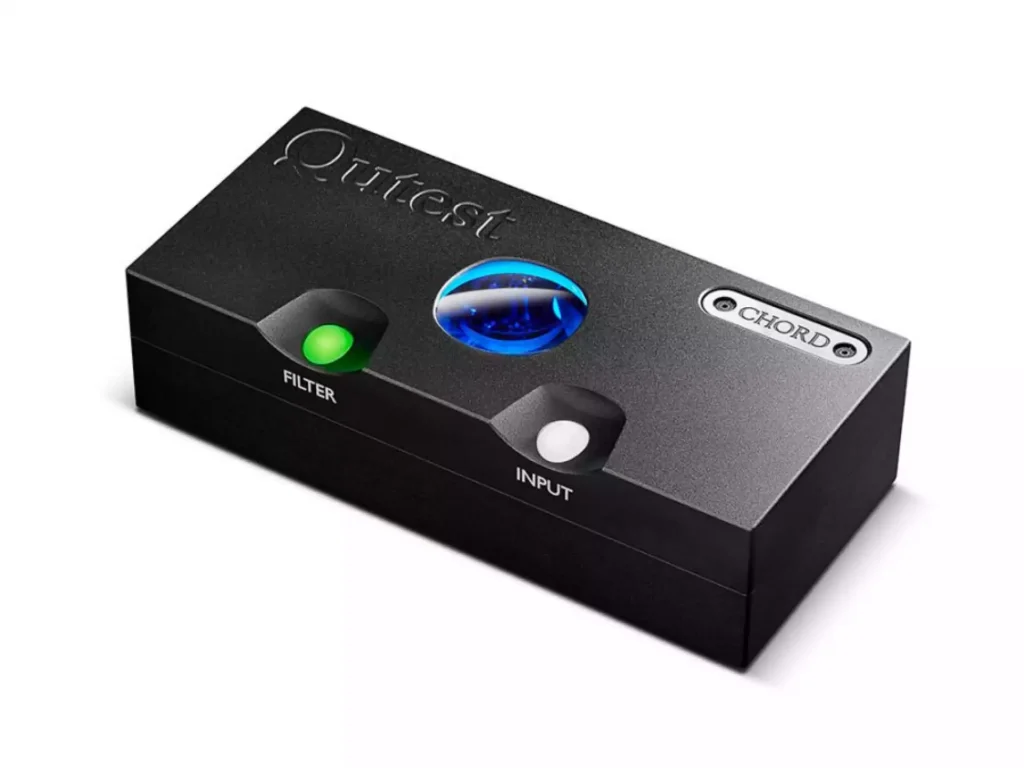
The Chord Qutest is a standalone DAC for an existing hi-fi system. It does not include a headphone amplifier or a conventional listening-volume control, so the rest of the system must provide those functions. That clear role matters more to a buying decision than the unusual enclosure, coloured controls or conversion architecture.
Chord Qutest — A DAC-only role needs the rest of the system
Chord documents RCA analogue line outputs for connection to an integrated amplifier, preamplifier or headphone amplifier. Passive headphones and loudspeakers do not connect directly as the intended load. Choose the downstream component before treating the Qutest as a complete listening solution.
If active speakers are used, there must still be an appropriate volume-control arrangement. A source application’s slider should not be assumed to be the only dependable protection against full-level playback. Plan the complete chain and check how its volume behaves after restarting or changing sources.
Selectable output voltage is not a volume knob
The Qutest offers 1, 2 and 3 V RMS output settings. These allow level matching to downstream equipment, rather than acting as a normal continuous listening-volume control. Consult the receiving input’s headroom and gain structure before selecting the highest setting.
A higher voltage can make one comparison louder and therefore seem more impressive without demonstrating better sound. Match levels when evaluating another DAC. We have not auditioned the Qutest or measured its output, so no claim of greater detail follows from a voltage choice or the presence of a separate DAC chassis.
Digital inputs and rates differ
Chord lists galvanically isolated USB-B, optical and BNC coaxial digital inputs. USB supports a different maximum format range from optical and coaxial, and dual-data connections have a specific system role. Check the actual source output and supported mode rather than assuming every input accepts the largest advertised rate.
BNC coaxial and ordinary RCA coaxial connections may need the appropriate cable or adapter, but analogue RCA and digital coaxial signals are still different. Optical can be convenient for electrical separation in a system, while the best practical choice depends on source compatibility and reliable operation.
FPGA filters and a realistic value decision
Chord uses a custom-coded FPGA and lists four user-selectable filters. Those are documented design features rather than proof that the DAC has a particular musical personality. Explore settings at matched levels, using familiar material, without treating colour-coded controls as a hierarchy from ordinary to best.
The device uses a separate 5 V, 2 A micro-USB power supply. Keep the power connection distinct from USB-B audio input when planning cable routes. Follow the manufacturer’s supply requirements instead of assuming any physically compatible adapter is appropriate.
The Qutest weighs 770 g and is designed for a fixed system. Its total cost should include any missing headphone amplifier, preamplifier and source hardware. If the existing DAC already supplies clean, reliable audio at the required level, there may be no urgent problem to solve. We have not reproduced Chord’s measurements or established an audible benefit against a less expensive converter.
What to expect in a real setup
Can headphones plug directly into Qutest? No headphone output is provided. Feed a suitable headphone amplifier from its line outputs instead.
Are the 1, 2 and 3 V settings normal volume control? No. They select line-output level for system matching. The listening chain still needs appropriate volume control.
Give the Qutest a clearly defined job
The Qutest is a DAC for a system that already has suitable volume control and amplification. A complete headphone setup therefore needs a separate headphone amplifier, and passive speakers require their own power amplification. Include those components and the interconnects in the cost comparison. Its compact case does not make it an all-in-one listening system. For an owner who already has a preferred amplifier, that focused role can be attractive; for a first system, a combined device may be more convenient and economical.
The selectable output voltages should be matched to the receiving input and a sensible operating range. They are not a substitute for a normal listening-volume control. Start conservatively when changing the setting or connecting a different amplifier, and verify the intended downstream control before playing music. Comparing DACs at different output levels can also bias impressions, so match listening levels rather than assuming the louder source has more detail or stronger dynamics.
Treat filters as an experiment within a working system
The filter choices offer a way to explore the available processing, but the first priority is dependable playback through the input in use. Establish a baseline, keep the source and recording unchanged, and compare at similar perceived volume. A preference for a filter can be personal and recording-dependent. It does not prove that FPGA conversion is inherently superior to every conventional DAC implementation or that the device can correct unrelated problems in headphones, loudspeakers or the room.
Input compatibility deserves equal care. Check the cable type for the digital source and the format supported by that route; the maximum USB specification is not a promise for every optical or coaxial connection. The analogue RCA output is another distinct part of the chain. A digital coaxial cable and an analogue interconnect may look superficially similar, but they connect different functions. Label cables if several sources share a shelf to make later changes less confusing.
For long-term ownership, leave access to the controls and provide the documented power arrangement. With a used unit, verify the supply and condition rather than replacing it with a guessed electrical equivalent. The Qutest’s strongest case is a well-defined digital-conversion role inside an otherwise satisfactory system. If the buyer also needs remote volume, headphone sockets, network playback or extensive source switching, those missing functions should shape the shortlist before any discussion of conversion architecture. A product can be a good DAC and still be the wrong centre for a particular system.
Alternatives to consider
Chord Mojo 2: A different Chord role to investigate when headphone output, battery operation and local volume control are needed.
RME ADI-2 DAC FS: A more integrated desktop-control approach to compare when headphone facilities and adjustment tools matter.
Chord Qutest key specifications
- Role
- Standalone stereo DAC
- Conversion
- Custom-coded FPGA
- Digital inputs
- USB-B, optical, BNC coaxial
- Analogue output
- RCA line output
- Selectable output levels
- 1 / 2 / 3 V RMS
- Filters
- 4 selectable
- Headphone amplifier
- None
- Power requirement
- 5 V / 2 A micro-USB supply
- Weight
- 770 g
- Dimensions H × W × D
- 45 × 160 × 88 mm
Verdict
The Qutest is worth considering only within a complete, correctly levelled system. Its input choices and output-voltage settings are practical features; the rest is a question for a controlled audition and measurements. Buy it for a defined DAC role rather than expecting it to supply missing streaming, volume or headphone functions.
Primary documentation
Specifications and feature descriptions were checked against the following official documents on 6 November 2026. Compatibility advice is our interpretation of those documented capabilities; it does not establish measured sound quality. Regional bundles, software features and service availability can change, so verify the exact European model and current support information before purchase.
- Chord Qutest official product information and specifications
- Chord Qutest official specification sheet
Editorial record
Sources and updates
Product specifications and factual claims were checked against Official Chord Qutest product page ↗. Scores and buying advice follow our category-specific editorial methodology.
- Published
- November 7, 2026
- Last updated
- November 8, 2026