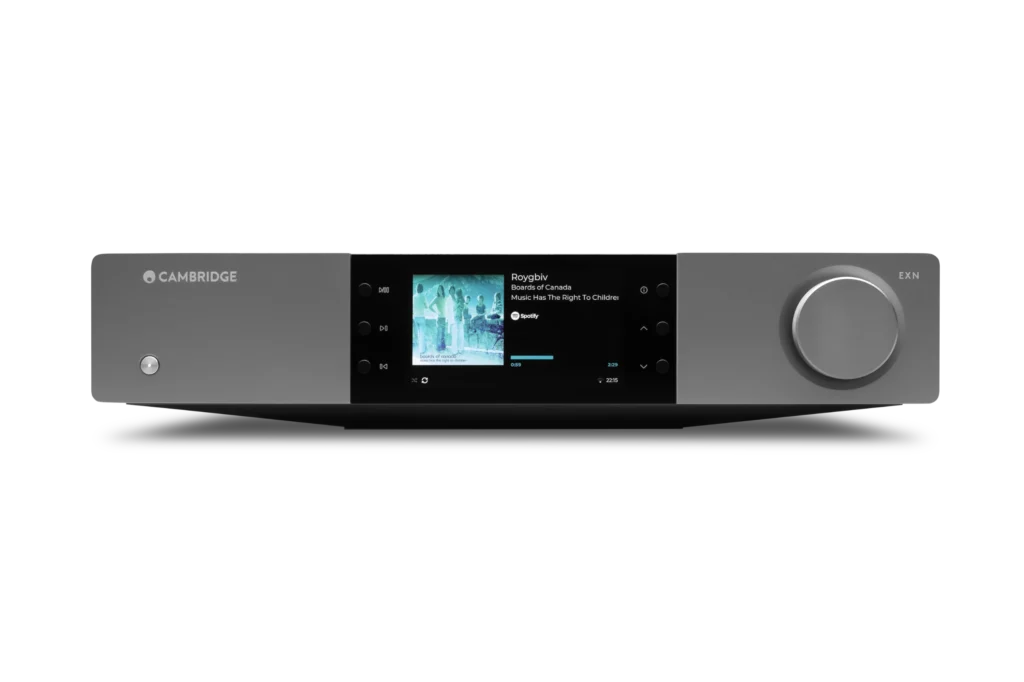
Cambridge Audio EXN100 brings network music, digital sources and television audio into a separate stereo front end. It is a streamer and DAC with a variable-output option, not a complete amplifier that can directly power passive speakers. That distinction sets the purchase decision: the EXN100 is most interesting when the system already has suitable amplification and the owner wants a polished digital source with a useful display and a broad connection set.
Research-based review. This assessment draws on manufacturer documentation and the original independent evaluations linked below. Audio Review has not performed a hands-on test of this model.
Where the EXN100 belongs in a system
The rear panel provides analogue outputs for an integrated amplifier, power amplifier or compatible active speakers. There is no headphone socket, and a record player cannot be connected as an analogue source. Owners combining vinyl and streaming should plan a separate analogue path through their amplifier rather than assuming every premium source is a universal control centre.
This separation can be an advantage. You can keep an amplifier and speakers you enjoy while replacing an ageing streaming component. It also means the total system cost remains important: buying a streamer is only one part of building a complete stereo. For a first system with no amplifier, compare a streaming amplifier before assembling a stack whose extra boxes add little practical benefit.
Streaming services and everyday operation
StreamMagic is the central control platform, with network playback and a choice of supported service connections. AirPlay, Google Cast and Bluetooth offer different routes from compatible devices. Check the particular service and account you use, including regional availability, before treating every playback logo as interchangeable.
A useful audition should include ordinary tasks: opening the app, finding an album, starting a saved radio station and returning to the previous queue. These operations matter far more often than the highest supported local file rate. A family system also needs a clear way for another person to start music without learning several apps. If one Connect or Cast workflow already meets that need, a longer list of integrations may be reassuring without being a reason to spend more.
What the independent listening evidence supports
What Hi-Fi’s original evaluation describes a clear, controlled and balanced presentation with a spacious stereo image. Its comparison places the EXN100 above CXN100 for refinement, while acknowledging that the cheaper model shares many headline features. That supports an audition shortlist, rather than a promise of a dramatic improvement in every system.
The relevant test is the complete playback path. When using the analogue output, the EXN100’s conversion and output stage remain part of the chain. When using a digital output into another DAC, those analogue stages are bypassed. Do not pay primarily for a reported analogue improvement and then connect the player in a way that does not use it. Use the same recordings and comparable volume when deciding how much the difference is worth to you.
HDMI and a two-channel television system
The HDMI ARC/eARC connection is a meaningful addition for an owner who wants the main stereo system to handle television as well as music. It can reduce the need to switch to a separate TV speaker arrangement. It does not turn a two-channel streamer into a multichannel cinema receiver.
Confirm the television’s return-audio connection, audio-output settings and volume behaviour before buying. Ask for a demonstration with a compatible stereo signal and the type of source you actually watch. Broadcast television, a console and an external streaming box can pass through different settings in the television. If dialogue timing or switching is the main frustration, verify those behaviours directly rather than assuming a newer HDMI label automatically resolves every part of the chain.
Fixed output versus preamplifier mode
The manual distinguishes fixed and variable analogue output. Fixed output is appropriate when another component provides volume control; preamp mode lets the EXN100 control the analogue level. Select the intended arrangement before connecting a power amplifier or active speakers, and begin at low volume.
Avoid leaving the system with two competing everyday controls unless that is intentional. An integrated amplifier can be straightforward with a fixed source, while active speakers may make variable output the more useful role. Check what happens after standby, a source change or a firmware update. A clear, repeatable volume arrangement makes a mixed television-and-music system easier for everyone to use and is a more concrete advantage than treating all output modes as equally useful.
Display, controls and the missing remote
The front display gives the player a stronger physical presence than a hidden streaming puck. Source and playback information can be useful across a room, while the front control avoids relying entirely on a phone for every interaction. The official manual confirms that a separate remote is not included, so account for that if a conventional handset is important.
Try the display at your listening distance and under the lighting in which the system is used. Check that the component fits the rack with room for connectors and ventilation. A full-width enclosure can look natural with existing separates but may be unnecessary in a compact active-speaker setup. The best interface is the one that stays convenient after the novelty of album artwork has worn off.
Value and the right upgrade priority
EXN100 makes most sense when several advantages matter together: a desirable analogue presentation, the television connection, suitable outputs and a control experience you prefer. A buyer needing only a reliable network feed into an existing DAC has a different requirement and should compare simpler transports.
Keep some budget for the parts that determine the result in the room. Speaker placement, room behaviour and a suitable amplifier can matter more than replacing an already competent digital source. If those foundations are settled, an audition of a more refined streamer becomes easier to judge. Compare current local prices and warranty support without assuming that a premium chassis or converter chip alone establishes the value of the complete player.
Alternatives to consider
Cambridge Audio CXN100: The CXN100 is the first comparison if the aim is to add StreamMagic to a conventional amplifier. Identify which EXN100 connections and controls you will actually use, then audition the analogue output at matched level before accepting the price difference.
WiiM Ultra: WiiM Ultra offers a different compact hub approach. Compare the exact streaming ecosystem, television connection, analogue requirements and control preferences rather than deciding from display size or a list of supported file formats alone.
Cambridge Audio EXN100 key specifications
- Role
- Network player, DAC and digital preamplifier
- Platform
- StreamMagic
- DAC
- ESS ES9028Q2M
- Network
- Wi-Fi and Ethernet
- Television input
- HDMI ARC/eARC
- Other digital inputs
- USB-B, coaxial, optical; USB-A storage
- Analogue outputs
- Stereo RCA and balanced XLR
- Digital outputs
- Coaxial and optical
- Wireless reception
- Bluetooth with SBC, aptX and aptX HD
- Headphone output
- None
- Speaker amplification
- None
- Dimensions (W × H × D)
- 430 × 89 × 325 mm (Cambridge Audio user manual)
Verdict
The EXN100 is a persuasive premium source for an established stereo, especially where television audio and network music should share one front end. The official connections are useful, and the original listening evaluation supports a refined and well-controlled analogue presentation.
Choose it for a system that can use those strengths. Compare CXN100 when streaming is the main requirement, and consider an integrated streaming amplifier when starting without amplification. The EXN100 earns its place through the combined experience and system fit, rather than through a service list that overlaps with less expensive alternatives.
Primary documentation and independent reviews
Cambridge Audio official EXN100 information · Cambridge Audio EXN100 operating manual · What Hi-Fi original EXN100 evaluation
Editorial record
Sources and updates
Product specifications and factual claims were checked against Official Cambridge Audio EXN100 product page ↗. Scores and buying advice follow our category-specific editorial methodology.
- Published
- November 17, 2026
- Last updated
- November 17, 2026