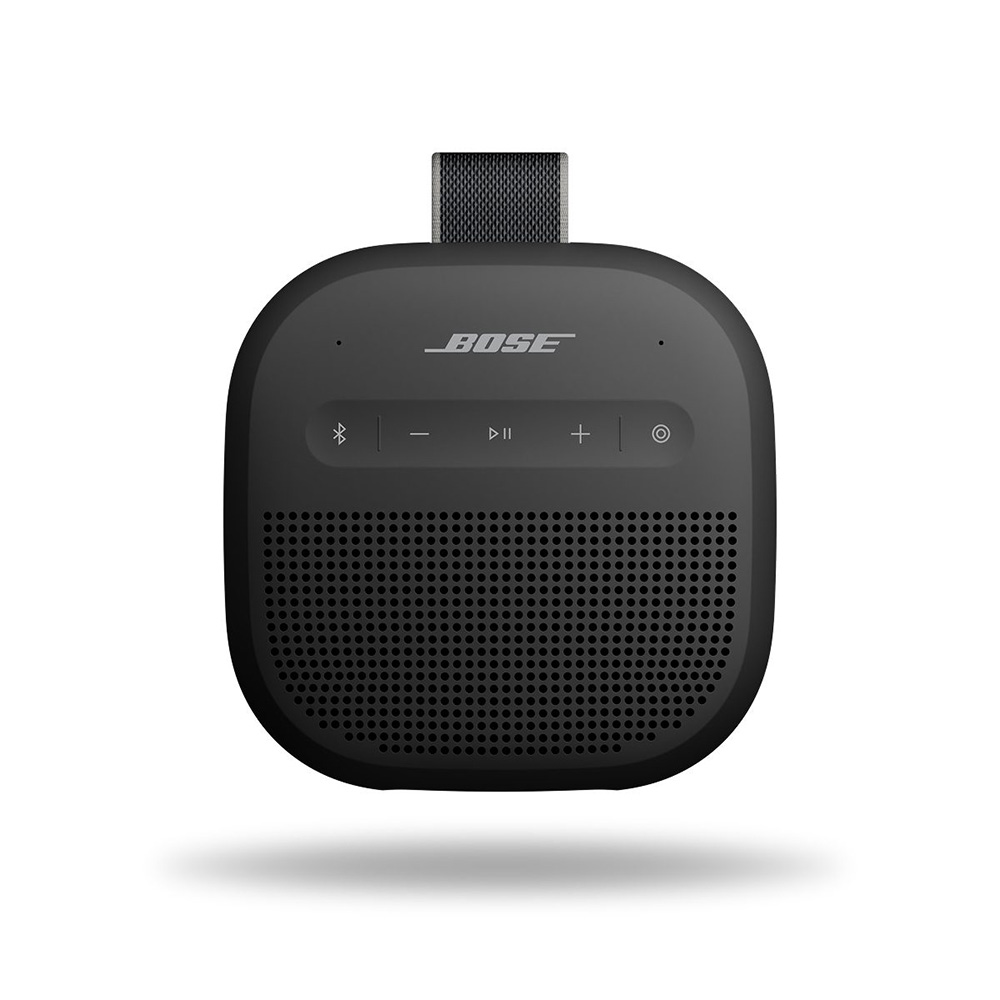
Bose SoundLink Micro 2nd Gen updates a long-running small-speaker idea with USB-C, app adjustment and a replaceable strap. It remains a product for people who place portability first. The most important qualification is not hidden in the sound description: maximum battery claims can look very different from endurance at a louder outdoor level. The second generation also removes the original model’s microphone, so an upgrade decision needs more care than simply comparing the charging sockets.
Research-based review. This assessment draws on manufacturer documentation and the original independent evaluations linked below. Audio Review has not performed a hands-on test of this model.
The second generation and its practical changes
The move to USB-C removes an inconvenient legacy connection from the original Micro. A removable fabric strap is another sensible change because damage to the attachment need not mean accepting a permanently awkward speaker. App EQ and shortcut configuration bring the small model closer to Bose’s more recent portable range.
Those refinements do not make every change an upgrade for every owner. The microphone has been removed, so phone calls through the speaker are no longer part of the package. If you used the original for hands-free conversations, this matters more than a newer Bluetooth version. Establish what the current speaker does for you before replacing it; a refresh should solve your actual problems rather than simply provide a newer name.
Sound quality and the limits of the cabinet
SoundGuys’ original evaluation is positive about the clarity and fullness available from the small enclosure, while recognising the expected output and bass limits. That supports the Micro as a close-range listening companion. It does not make it a substitute for a much larger outdoor or room speaker.
Try it at a normal distance with familiar music rather than judging only from a short, loud demonstration. Vocals should remain understandable without forcing the level up, and bass should support the song without encouraging unrealistic expectations of sub-bass. Placement near a surface can change the balance, so compare a couple of stable positions. For a larger group, moving the speaker nearer the listeners can be more useful than running it at its maximum setting.
Battery claims need a volume context
Bose’s advertised maximum is up to twelve hours under stated conditions. Its owner guide also makes clear that louder playback reduces endurance, and SoundGuys obtained roughly four and a half hours in its own test. These are different conditions, not a single universal promise about how long your particular unit will run.
This distinction is central for a speaker intended to leave the house. Quiet background music during a working day and a louder afternoon outdoors put different demands on the battery. Plan a margin and a charging opportunity if the event matters. The product is easier to recommend for shorter nearby listening than for someone who expects the headline maximum while keeping the volume near the top all day.
Strap, protection and outdoor handling
The replaceable strap makes the Micro relevant to a bag or other suitable attachment point, but the mounting arrangement still needs checking. Make sure it is secure and that fabric does not cover the radiating surfaces. A speaker carried against a bag can sound different from one placed upright nearby, so convenience and acoustic placement should both be considered.
IP67 protection is useful around dust and incidental water exposure, but charging should still be done with the connection dry and according to Bose’s instructions. Do not extend a water-resistance label into a guarantee against every drop, contaminant or harsh environment. For regular outdoor use, sensible cleaning and storage are part of the ownership routine, particularly around the strap and charging area.
Multipoint and linking another speaker
Multipoint lets the Micro maintain connections with two source devices, which can be convenient when sharing playback duties. That is separate from linking two speakers. Bose’s owner guide describes linking one other compatible shortcut-button Bose speaker and distinguishes shared playback from separated stereo operation.
Check the exact supported pairing before buying a second unit. A common brand name is not enough to establish compatibility with every older speaker, soundbar or Wi-Fi product. Likewise, two connected sources do not mean two songs are mixed together or that every application automatically receives priority. A brief test of the actual phone-and-laptop routine is more useful than reading multipoint as a universal solution to all switching behaviour.
Controls, missing inputs and value
The app offers tonal adjustment and shortcut configuration, while physical buttons keep basic playback available without using the screen. These are useful everyday facilities, but there is no auxiliary input for an analogue source and no microphone for speakerphone duties. A USB-C charging connector should not be mistaken for a promise of USB audio playback.
The premium is easiest to justify if you prefer the Bose sound and handling after comparing other small speakers. The JBL Clip 5 and Tribit StormBox Micro 2 are relevant because they address similar carrying needs with different prices and features. If the budget approaches that of a larger speaker, decide how often the smaller footprint will actually matter. Portability can be worth paying for, but it should be a deliberate priority rather than a surprise limitation after purchase.
Alternatives to consider
JBL Clip 5: The Clip 5 is a useful lower-cost comparison when small size and bag attachment dominate the decision. Check its carabiner against the Bose strap, then compare sound and runtime at the level you will actually use.
Tribit StormBox Micro 2: The Micro 2 offers another compact strap-equipped approach and a different feature package, including emergency phone charging. Compare the complete requirements rather than assuming that similarly named small speakers are interchangeable.
Bose SoundLink Micro 2nd Gen key specifications
- Format
- Compact portable mono Bluetooth speaker
- Generation
- SoundLink Micro 2nd Gen
- Bluetooth
- 5.4
- Multiple sources
- Multipoint
- Battery claim
- Up to 12 hours under Bose test conditions
- Charging
- USB-C
- Protection
- IP67
- Attachment
- Removable, replaceable fabric strap
- Microphone
- None
- Auxiliary input
- None
- App
- Bose app with EQ and shortcut configuration
- Speaker linking
- One compatible Bose shortcut-button speaker; mode restrictions apply
- Weight
- 0.7 lb (approximately 318 g)
- Driver arrangement
- Single driver and two passive radiators
- Dimensions (W × H × D)
- 103 × 103 × 39 mm
Verdict
The second-generation SoundLink Micro is a well-targeted modernisation for listeners who want Bose’s small-speaker approach with USB-C, app adjustment and a replaceable strap. Its independent sound assessment is encouraging for the cabinet size, and the source and speaker-linking facilities add useful flexibility.
Endurance at louder levels is the main qualification, followed by the absence of a microphone and auxiliary input. Existing original-Micro owners should check those differences before calling it an automatic replacement. Compare the Clip 5 and StormBox Micro 2 on carrying method, sound and real use, then choose the Bose if its compact package genuinely suits you best. It is a close-listening companion, not a promise of all-day high-output party playback.
Primary documentation and independent reviews
Bose official SoundLink Micro 2nd Gen owner guide · SoundGuys original SoundLink Micro 2nd Gen review · RTINGS original SoundLink Micro 2nd Gen test
Editorial record
Sources and updates
Product specifications and factual claims were checked against Official Bose SoundLink Micro 2nd Gen product page ↗. Scores and buying advice follow our category-specific editorial methodology.
- Published
- November 17, 2026
- Last updated
- November 17, 2026