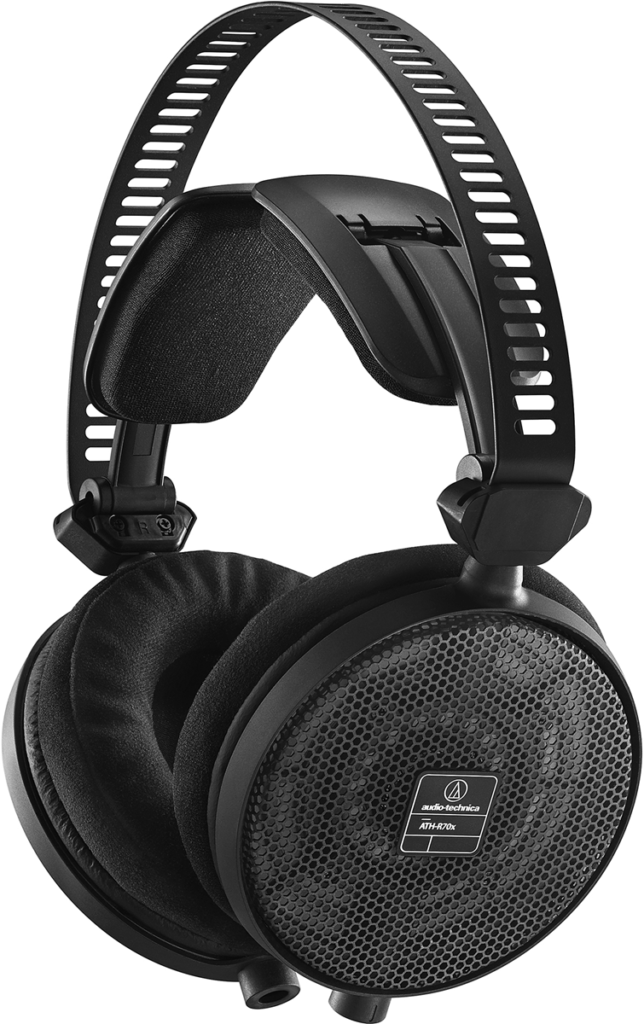
Audio-Technica ATH-R70xa is an open reference headphone that puts low weight ahead of visual bulk. It is the revised xa model, rather than the original ATH-R70x, and should be assessed as its own product. For a quiet editing or mixing desk, its physical design and the encouraging independent studio evaluation make a strong starting point. The qualification is equally clear: open cups and a high-impedance load need an appropriate room and source.
Research-based review. This assessment draws on manufacturer documentation and the original independent evaluations linked below. Audio Review has not performed a hands-on test of this model.
The revised reference model
The official manual specifies a 45 mm driver, 470-ohm impedance and approximate weight of 199 g without the cable. It also lists a three-metre detachable lead, adapter and protective pouch. Replacement pads and head padding are documented. The dual-sided locking cable is designed so either cable branch can attach to either cup without reversing stereo orientation.
Those details describe a tool intended to remain in a working setup. A long lead can be useful at a desk with an interface or equipment rack, while being awkward beside a phone. The important question is whether your usual listening position makes those choices convenient. Someone seeking a compact foldable travel headphone is solving a different problem from the engineer who wants to forget the weight of the monitor during a long edit.
Comfort as a working advantage
MusicRadar’s original evaluation is strongly positive about long-session comfort and the lightweight construction. It also describes a generally restrained presentation that suits sustained work. That combination is more relevant to this model than a list of wireless conveniences, because neither battery operation nor an app is part of the basic design.
At a demonstration, check more than the initial lack of weight. Make sure the ear opening clears your ears, the head padding sits properly and the cups remain stable as you move between screen and instrument. A very light headphone can still be a poor fit for a particular person. Conversely, a visually delicate construction need not be uncomfortable or impractical. The meaningful test is whether the frame and adjustment suit your normal posture without repeated correction.
Sound quality and a useful reference
MusicRadar reports a fairly neutral overall character, a present middle region and a high end that is less forward than some competing headphones. Its assessment is positive about the low-frequency substance without describing an exaggerated punch. These are the reviewer’s listening findings; they are not measurements made by Audio Review.
Our interpretation is that the ATH-R70xa is particularly worth auditioning if a bright presentation makes long sessions difficult. A more restrained top end can be useful, provided you learn how that balance translates elsewhere. Avoid choosing a reference purely because cymbals leap out during a short demonstration. The goal is to hear changes consistently and make decisions that still work on another playback system, rather than to maximise the apparent amount of detail in the first thirty seconds.
Why 470 ohms needs context
Impedance is not a sound-quality score. It describes part of the electrical load, and must be considered alongside sensitivity and the output’s capabilities. With this model, adequate voltage from the headphone socket is a worthwhile check. A weak output can leave too little level or headroom even when a connector physically fits.
Start with your actual interface or headphone amplifier at conservative volume. Check the quietest material you normally use, not only a loud modern master. If the source provides comfortable level with adjustment left in reserve and no audible strain, another amplifier may not be necessary. If it does not, choose an output suited to the task rather than buying the most powerful unit available. Excess gain can be inconvenient at low levels, and a larger specification is not automatically a better working match.
Open monitoring and the recording workflow
The open enclosure lets room noise enter and listening sound escape. That makes it a poor default for tracking a quiet acoustic source beside a sensitive microphone. A closed headphone for recording and an open pair for editing can be a sensible division of work, even if owning one model initially seems simpler.
For editing, choose a room quiet enough that low-level decisions are not masked by conversation, fans or traffic. Do not respond to a noisy environment by repeatedly increasing monitoring volume. When checking a recording for background noise, pause playback and distinguish room noise around you from noise actually in the take. That simple discipline avoids processing a recording to solve a problem the microphone never captured.
Learning a new tonal baseline
Even a well-regarded reference headphone requires familiarity. Begin with a small collection of finished tracks you know well, then compare your own work at similar listening levels. Pay attention to whether bass, vocal presence or cymbal balance prompts repeated corrections that disappear when you return to another system.
Keep the monitoring configuration stable while learning. Frequent changes of EQ, replacement pads and source settings make it harder to identify the reason for a different impression. If you use correction software, save the preset and keep an unprocessed comparison available. The ATH-R70xa should be judged as a complete monitoring arrangement in your room and workflow, rather than as a promise that one factory frequency balance removes the need for reference listening.
Maintenance, cable routing and value
Both cable branches need room to move without catching on clothing or desk edges. The locking connection is useful against accidental unplugging, but also means a snag can transfer force to the headphone. Route excess length away from chair wheels and avoid hanging the entire lead’s weight from the cups when storing the product.
Pads gradually compress, and replacement parts should be factored into long ownership. A soft pouch protects against dust and light contact; it is not the same as a rigid transport case when packing heavy equipment. For value, compare the complete arrangement: headphone, any genuinely necessary source upgrade and replacement-part availability. The light design is an everyday advantage only when it fits you and the rest of the setup can drive it conveniently.
Alternatives to consider
Audio-Technica ATH-R70x: The earlier ATH-R70x is the necessary generation comparison, particularly for an existing owner. Compare actual fit and working results before replacing a familiar pair; the xa name identifies a revised product, not proof that every user needs to upgrade.
Sennheiser HD 560S: The HD 560S provides another open-back reference-style option. Include source requirements and fit in the comparison, then judge whether the Audio-Technica construction and monitoring presentation deliver enough practical benefit at your local price.
Audio-Technica ATH-R70xa key specifications
- Design
- Open-back, over-ear
- Driver
- 45 mm dynamic
- Nominal impedance
- 470 ohms
- Sensitivity
- 97 dB/mW, manufacturer specification
- Weight without cable
- Approximately 199 g
- Cable
- 3 m detachable, dual-sided locking connection
- Source plug
- 3.5 mm with 6.3 mm adapter
- Included storage
- Protective pouch
- Replaceable parts
- Ear pads, head pad and cable
- Microphone
- None
Verdict
The ATH-R70xa is a persuasive shortlist candidate for quiet-room production and focused home listening. Its unusually low stated weight, maintainable wear parts and encouraging independent tonal assessment form a coherent package. It concentrates on the physical and acoustic priorities of reference listening rather than adding unrelated features.
Check the source and fit before buying, and compare the original ATH-R70x if you already own it. The HD 560S is also a useful alternative when cost and system simplicity matter. Choose the xa because it makes long sessions and repeatable decisions easier in your setup. That is a more durable reason than assuming an updated professional model must automatically replace every familiar reference.
Primary documentation and independent reviews
Audio-Technica official ATH-R70xa user manual and specifications · MusicRadar original ATH-R70xa evaluation · Audio-Technica official ATH-R70xa product page
Editorial record
Sources and updates
Product specifications and factual claims were checked against Official Audio-Technica ATH-R70xa product page ↗. Scores and buying advice follow our category-specific editorial methodology.
- Published
- November 17, 2026
- Last updated
- November 17, 2026