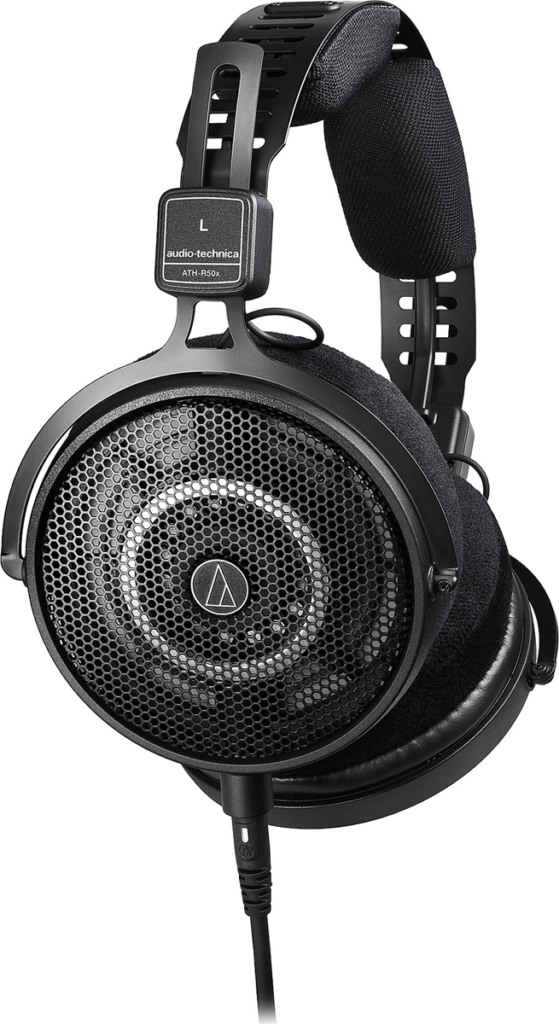
Audio-Technica ATH-R50x offers an open reference-style headphone without the size and mass of many enthusiast designs. It is aimed at a desk where monitoring should be comfortable, easy to connect and affordable enough to leave room for the rest of the recording system. Its strongest practical points are low weight and two useful cable lengths. The important tonal qualification is a prominent region between the upper mids and treble, which deserves a longer audition.
Research-based review. This assessment draws on manufacturer documentation and the original independent evaluations linked below. Audio Review has not performed a hands-on test of this model.
The reference format at a lower cost
The official manual specifies a 45 mm dynamic driver, 50-ohm nominal impedance and approximately 207 g weight without cable. Two detachable leads, 1.2 metres and three metres, are included with an adapter and pouch. Ear pads, head padding and cables are listed as separately available parts. This is a straightforward analogue product rather than an app-controlled listening system.
That simplicity is useful at a workstation where a reliable monitoring path matters more than automatic switching between wireless devices. It also means the source needs a real headphone output or an appropriate DAC and amplifier. A USB socket alone is not an analogue connection. Establish how the headphone will attach to your existing equipment before comparing optional accessories or assuming another component is automatically necessary.
Fit and the headband compromise
Headphonecheck’s original test praises the low weight and wearing comfort, but finds the headband awkward to adjust while it is under tension on the head. This is exactly the kind of detail that can be missed in a quick specification comparison. The adjustment procedure matters when the headphone will be shared or repeatedly taken on and off.
Try setting the size before putting it on, then check whether the chosen position remains stable during normal movement. Allow time to notice pressure with glasses and whether the ear opening suits you. A light design is a promising starting point, but not a universal comfort guarantee. If you must keep changing the fit to maintain a seal or avoid pressure, an apparently more expensive alternative may be the more usable long-term purchase.
Sound quality and the forward region
Headphonecheck is positive about detail, dynamics and spatial presentation, while identifying a pronounced upper-midrange-to-treble region that can become tiring. Its assessment also finds useful low-frequency reach. This supports an audition for editing and analytical listening, with a clear warning against assuming that every open reference model has the same tonal balance.
Our judgment is that the R50x is most attractive when its clarity helps you work without encouraging excessive corrections. Check a familiar vocal and bright percussion at a normal level, then listen for longer than the most exciting first excerpt. If consonants or cymbals continually dominate attention, that preference mismatch is real. A lower price does not make fatigue irrelevant, and a more conspicuous detail is not necessarily a more accurate representation of the recording.
A sensible learning process for production
Changing a monitoring system can change decisions before you fully notice the new baseline. Spend time with finished recordings you already know, then compare your own balances on another trusted playback device. A small collection of consistent references is more useful than continually browsing unfamiliar demonstration material.
If the new headphone makes you reduce a frequency region repeatedly, check those changes elsewhere before treating the result as an improvement. The purpose of reference listening is repeatable judgment, not an impression that the equipment sounds unusually revealing. Save any monitoring EQ clearly and avoid changing it in the middle of a project without noting the change. The R50x can be a useful tool, but the working method still determines whether its presentation helps the finished production.
Two cables and a simpler desk
The short lead is useful for a nearby laptop or interface; the longer one accommodates a separate rack or instrument position. The single-entry arrangement keeps the opposite side of the head free from a second branch. Check the locking plug is seated correctly and choose the lead that gives freedom without leaving excessive cable around the chair.
For recording, trace the entire signal path if there is delay. The headphone itself is passive, while software monitoring, buffers and interface routing can introduce latency. For meetings, select a separate microphone because the supplied listening lead is not a communications headset cable. Keeping these roles distinct prevents purchases that change the connector shape without solving the actual workflow problem.
Source matching beyond one number
The R50x has a lower nominal impedance than the R70x family, but impedance alone does not establish output requirements. Sensitivity and the source’s clean level matter too. Check your actual interface at a conservative setting with both loud and quiet recordings, rather than treating a model-family comparison as a calculation.
If level is comfortable, noise is low and the volume range is convenient, start with that arrangement. Another amplifier may add physical control or useful connections, but should solve an identifiable need. If using EQ boosts, leave digital headroom and compare at similar apparent volume. A larger amplifier specification will not remove the upper-midrange character or change whether the headband fits, so settle those fundamentals before building a more elaborate system around the headphone.
Open cups and realistic use cases
The open enclosure is best suited to a reasonably quiet room where leakage is acceptable. It is a poor default when recording a quiet voice near a sensitive microphone, because cue playback can reach the take. A separate closed tracking pair may be more useful than trying to make the R50x cover every stage of production.
Background noise also competes with the quieter parts of music. If a fan or conversation masks details, change the environment instead of repeatedly increasing the level. The supplied pouch helps protect against dust and light contact, but is not a rigid case for heavy equipment transport. Check replacement parts and store the lead without sharp strain. These small habits support the long-term value of a modest passive headphone more effectively than speculative upgrades.
Alternatives to consider
Sennheiser HD 560S: The HD 560S is a relevant affordable open-back comparison. Try the fit and tonal balance with familiar work, and include the source and replacement-pad cost rather than making the decision from impedance alone.
Audio-Technica ATH-R70x: The original ATH-R70x offers a different reference design and electrical load. Compare it as a separate product rather than assuming its higher position in the range guarantees the most convenient match for a modest workstation.
Audio-Technica ATH-R50x key specifications
- Design
- Open-back reference, over-ear
- Driver
- 45 mm dynamic
- Nominal impedance
- 50 ohms
- Sensitivity
- 93.3 dB/mW, manufacturer specification
- Weight without cable
- Approximately 207 g
- Cable arrangement
- Single-entry detachable locking lead
- Supplied cable lengths
- 1.2 m and 3.0 m
- Source connection
- 3.5 mm with 6.3 mm adapter
- Included storage
- Pouch
- Microphone and wireless
- None
Verdict
The ATH-R50x is a worthwhile affordable open-monitoring candidate, combining low weight and practical cable choices with an encouraging independent assessment of detail and dynamics. Its limitations are visible: a potentially forward upper region, a headband that needs a handling check and an enclosure that requires a suitable room.
Compare it with the HD 560S and the original ATH-R70x, using familiar recordings and enough time to judge comfort. Choose the R50x when its presentation helps your work and the simple connection fits your existing source. If the tonal balance is tiring or isolation is necessary, another model is a better value even if this one initially appears to offer more reference credibility for the money.
Primary documentation and independent reviews
Audio-Technica official ATH-R50x user manual and specifications · Headphonecheck original ATH-R50x evaluation · Audio-Technica official ATH-R50x product information
Editorial record
Sources and updates
Product specifications and factual claims were checked against Official Audio-Technica ATH-R50x product page ↗. Scores and buying advice follow our category-specific editorial methodology.
- Published
- November 17, 2026
- Last updated
- November 17, 2026