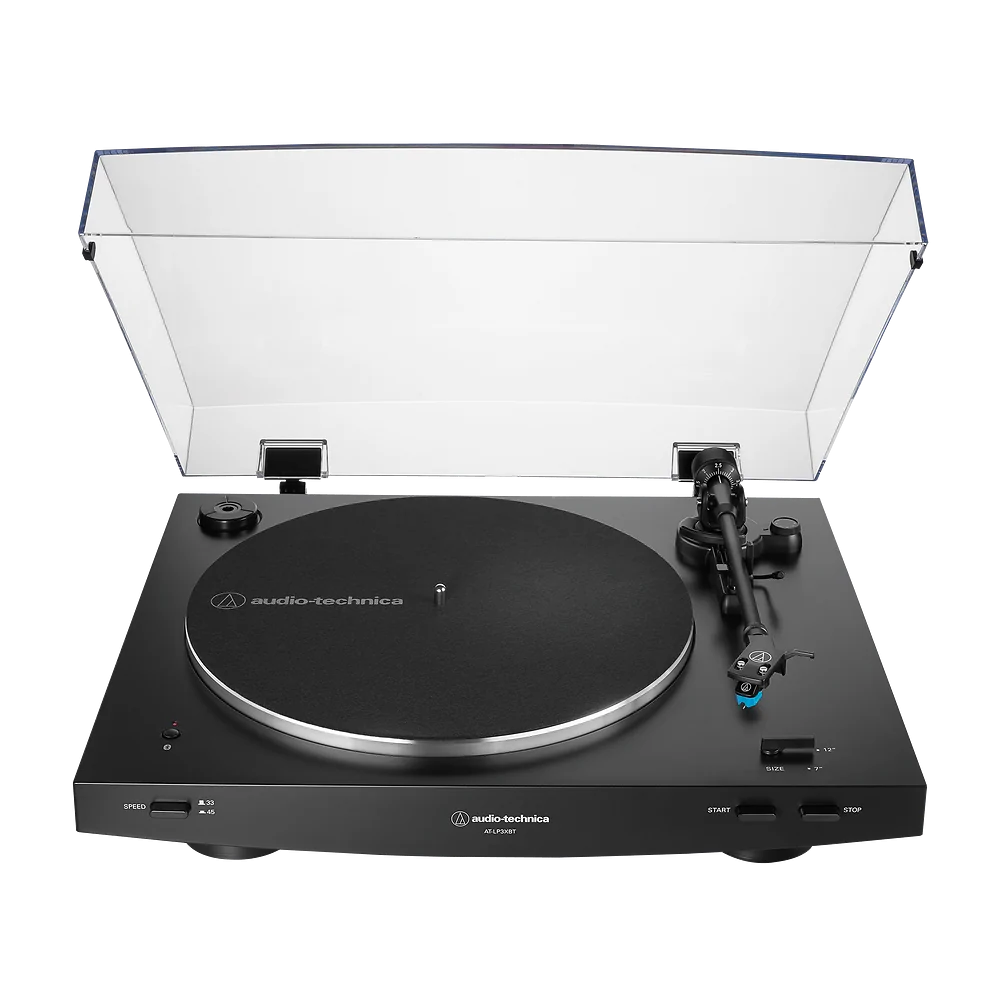
The Audio-Technica AT-LP3XBT combines automatic record playback with an adjustable arm, a replaceable cartridge system and Bluetooth transmission. That makes it a useful middle ground for buyers who want convenience without treating the turntable as a sealed appliance. Its wireless function also creates a few compatibility questions that a conventional wired deck does not have.
Audio-Technica AT-LP3XBT — Automatic does not mean setup-free
The deck is a fully automatic belt-drive design, with a balanced straight arm and removable headshell. Automatic start and return can be useful in a shared household, but the counterweight, tracking force and anti-skate still need to be set according to the manual.
Do not assume that an automatic mechanism can compensate for a poorly installed cartridge or an uneven support. Follow the initial assembly sequence, secure the headshell and verify the stylus guard is removed only when appropriate. A basic tracking-force check is more meaningful than immediately buying accessories intended to improve sound.
The VM95 cartridge family adds options
Audio-Technica supplies an AT-VM95C cartridge. The VM95 family offers compatible replacement-stylus options, which can make maintenance and later changes more straightforward. Check the exact stylus model, condition and recommended settings instead of buying a vaguely described replacement needle.
A stylus change does not guarantee an improvement with every record or installation. Clean records, correct alignment and stable support remain important. If moving to a different complete cartridge, recheck the relevant arm and tracking adjustments rather than assuming the original settings remain correct.
Bluetooth transmits the record signal
The documented Bluetooth function sends the turntable’s audio to compatible speakers or headphones. It is not a Bluetooth input for playing phone music through the turntable, and it does not allow pairing directly with an ordinary phone as though the phone were automatically a speaker receiver.
aptX and aptX Adaptive support requires a compatible receiving device for the corresponding mode. Wireless playback also introduces digital encoding into the signal path. That may be an entirely sensible convenience choice, but it should not be described as an unchanged all-analogue route. For video-style lip-sync expectations or instrument monitoring, wireless delay must be considered.
Wired outputs and complete-system cost
The built-in phono stage allows a line-level route to suitable powered speakers or an amplifier line input. If using an external phono stage or amplifier phono input, select the appropriate phono output instead. Applying phono equalisation twice can produce an overloaded and incorrectly balanced result.
The deck plays 33⅓ and 45 rpm records; record size and speed are separate settings in automatic use. Match them to the actual disc rather than assuming every seven-inch record has the same speed. Check unusual or valuable records before starting an automatic cycle.
For value, price the complete playback chain and local support. Bluetooth speakers may already provide amplification and volume control, while passive speakers need an amplifier. We have not measured the automatic mechanism, speed stability or wireless sound quality, so this review supports feature matching rather than a claim of superior vinyl reproduction.
What to expect in a real setup
Can my phone send music into the turntable over Bluetooth? That is not the purpose of the documented wireless function. The turntable transmits its record audio to a compatible Bluetooth receiver.
Should LINE output feed an amplifier PHONO input? No. Use LINE with a line input, or the appropriate PHONO route with a phono stage. Avoid applying phono amplification twice.
Alternatives to consider
Audio-Technica AT-LP70XBT: Compare the simpler automatic Bluetooth route if ease of setup matters more than the LP3XBT’s adjustment and cartridge arrangements.
Audio-Technica AT-LP120XUSB: A different manual direct-drive option to investigate when controls and wired/USB use matter more than automatic playback.
Automatic playback with an adjustable starting point
The AT-LP3XBT combines an automatic routine with a cartridge and arm arrangement that still deserves correct initial setup. Follow the manual’s sequence rather than assuming that automatic start makes the counterweight and tracking guidance irrelevant. Protect the stylus while assembling the deck and use the instructions for the actual supplied cartridge. Once the setup is correct, the automatic movement can reduce everyday handling, which is a different benefit from eliminating setup altogether.
For a shared household, show each user how to select the appropriate record size and speed and how to stop playback correctly. Keep the cover and control area clear. A convenient player should not require moving nearby objects before every side. Test the routine with an ordinary record before using a valuable disc or leaving another person to work it out unaided.
Choosing a wireless destination
Bluetooth is useful when the receiver cannot sit conveniently beside the turntable. Check the actual speaker or headphones for the receiving role and supported codec, then test the intended distance and room layout. The turntable’s codec list does not force another device to support the same option. If a suitable analogue input is already nearby, a cable may be a simpler everyday arrangement.
For wired use, identify whether the destination expects line level or a cartridge-level signal and set the output route accordingly. Passive speakers require amplification elsewhere. Compare the total cost of the complete system, not just the deck, because a convenient connection may remove an extra box while a mismatched one creates another purchase.
Maintaining the VM95 route
Before replacing the stylus, identify the exact compatible part and follow the fitting instructions. Treat a stylus upgrade as one change within an established system, with clean records and consistent listening levels for comparison. It cannot cure damaged vinyl or vibration from poor placement. The AT-LP3XBT is most attractive when its automatic handling and supported cartridge-maintenance route both have value. A buyer who wants unrestricted manual experimentation or no setup involvement at all should check those different expectations before ordering.
Keep a note of the fitted stylus and tracking setup with the manual. When a replacement is due, that record is more reliable than remembering which similar-looking part appeared in a retailer photograph, and helps preserve the correctly established automatic playback routine.
Audio-Technica AT-LP3XBT key specifications
- Drive
- Belt drive
- Operation
- Fully automatic
- Speeds
- 33⅓ and 45 rpm
- Arm
- Balanced straight arm
- Supplied cartridge
- AT-VM95C
- Headshell
- Removable AT-HS3
- Phono stage
- Built in, selectable phono/line route
- Wireless role
- Bluetooth transmitter
- Codec options
- aptX / aptX Adaptive with compatible receiver
Verdict
The AT-LP3XBT makes sense when automatic operation and connection flexibility are both useful. Set it up carefully and choose the receiving equipment deliberately. Its cartridge family supports practical ownership, but sound-quality and speed-performance claims still require a real test.
Primary documentation
Specifications and feature descriptions were checked against the following official documents on 6 November 2026. Compatibility advice is our interpretation of those documented capabilities; it does not establish measured sound quality. Regional bundles, software features and service availability can change, so verify the exact European model and current support information before purchase.
- Audio-Technica AT-LP3XBT official user manual
- Audio-Technica AT-LP3XBT official product and codec information
Editorial record
Sources and updates
Product specifications and factual claims were checked against Official Audio-Technica AT-LP3XBT product page ↗. Scores and buying advice follow our category-specific editorial methodology.
- Published
- November 7, 2026
- Last updated
- November 8, 2026