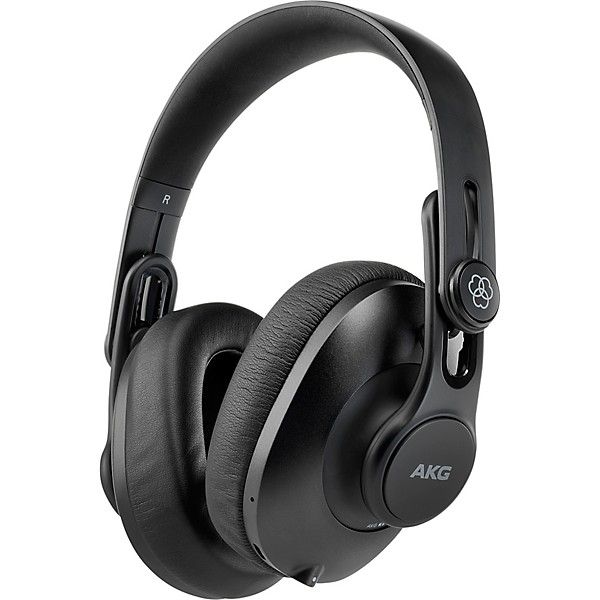
AKG K361 is the lighter, simpler wired member of an established studio-oriented family. It can be an economical way to obtain a full-size headphone without batteries, wireless setup or a complex source chain. Its main reservation is not the absence of a premium finish: the sound can vary considerably when the pad seal changes. That makes an honest fitting trial more important than a low advertised price or the professional wording on the box.
Research-based review. This assessment draws on manufacturer documentation and the original published evaluations linked below. Audio Review has not performed a hands-on test of this model.
The wired version has a clear role
AKG identifies a closed over-ear design with 50-millimetre drivers, 32-ohm impedance and a 219-gram weight. This review concerns K361, not K361-BT. Similar naming does not establish that the wireless version has identical acoustics, accessories or behaviour.
Choose the connection routine first. The wired K361 is appropriate for a headphone output on an interface, computer adapter or ordinary music source. It does not pair directly with a phone, provide a built-in microphone or include active listening modes. Those omissions can be advantages at a simple editing desk, where there is no charging or Bluetooth profile to manage. They can also make it the wrong choice for calls and mobile convenience. A clear role prevents money being spent later on accessories that attempt to turn a passive headphone into a different kind of product.
Sound is balanced only when the fit cooperates
RTINGS’ original evaluation describes a broadly balanced presentation with some low-end warmth, but finds substantial variation in bass between different fits. Glasses, hair and head shape are relevant. It also notes that the upper range is not entirely smooth.
For a useful trial, keep the source and level unchanged while adjusting the cups gently. If a familiar bass line changes dramatically as the head moves, that is a fitting issue to resolve before making tonal judgements. Do not use one brief favourable position as proof that the same result will remain throughout a work session. For editing, compare known reference material and verify important decisions on another system. A headphone that sounds pleasant can still be difficult to use as a repeatable monitor if its balance changes every time it is put on. The fitting result matters more than whether a review broadly calls the tuning neutral or warm.
Lightness and comfort need a longer trial
The low specified weight is one of the K361’s attractions. RTINGS finds it comfortable and lightweight, while also noting modest stability. The folding construction is useful for storage, but the headphone is not designed to be a sports accessory.
Wear it during the intended task rather than checking comfort only while standing in a shop. Look down at a keyboard, turn toward a second screen and use the normal glasses. Check whether one cup slides enough to disturb the seal. Very soft initial pressure is not always an advantage if it requires constant readjustment. On a used pair, inspect cushion wear and the headband adjustment before drawing conclusions about the design. Replacement pads can help restore comfort, but a different material or thickness may also change sound. Keep that trade-off explicit when a consistent reference is the reason for buying.
Two straight cables suit different distances
AKG’s accessory sheet lists 1.2-metre and 3-metre straight leads, a larger stereo adapter and a carry pouch. The cables are detachable. Their physical connection should not be assumed interchangeable with the mini-XLR arrangement of the K371 simply because the products are related.
Use the shorter cable when the source is close and reserve the longer one for a console or listening chair. This reduces loose cable around a small desk and avoids pulling a source from a pocket. Check both channels after connecting and use a compatible replacement if a lead is damaged. The adapter is for a larger headphone socket, not a way to convert a shared-ground headphone into balanced wiring. If the source is a phone without an audio jack, a suitable output adapter remains necessary. A modest cable package can be useful, provided it matches the actual physical setup rather than accumulating unused accessories.
Passive isolation has predictable limits
The K361 has no ANC. RTINGS finds that it does little to reduce low rumble or nearby conversation, although some sharper environmental sound is attenuated. It also reports leakage, so closed construction should not be interpreted as complete privacy.
For monitoring near a microphone, record a short sample at the intended headphone level and check for spill. For commuting, compare a real ANC product before assuming the closed cups provide the required relief. At an ordinary home desk, moderate passive isolation may be sufficient, especially when the room is already fairly quiet. The right choice depends on that environment. Increasing volume to overpower the surroundings is not a substitute for selecting a suitable headphone. If isolation is the priority, it can be more economical to buy the appropriate design once than to keep changing pads and accessories in search of a different result.
A small source chain and a realistic budget
The passive design needs no battery, and its specifications do not imply a mandatory expensive amplifier. Start with a known clean headphone output and check available level on quieter recordings. Source noise and pad-seal problems should be diagnosed separately.
Include adapters, protection and any replacement cushions when comparing current European offers. On older or used stock, inspect the joints, adjustment and cable sockets rather than buying solely on the model’s reputation. A slightly more expensive headphone that fits reliably can be better value than a cheaper one that needs constant correction. Conversely, if the K361 fits well and the existing output drives it comfortably, extra equipment may bring little practical benefit. Its strongest case is a simple affordable listening or editing tool. The case weakens when the owner expects wireless convenience, meeting functions or a dependable bass reference that the individual fit cannot deliver.
Alternatives to consider
Audio-Technica ATH-M50x: ATH-M50x is relevant when a closed wired headphone with detachable cables is wanted. Compare comfort and sound at the current price rather than assuming that extra weight or a higher model tier automatically improves the fit.
Sennheiser HD 560S: HD 560S is an alternative for a quiet room where open-back leakage is acceptable. Decide whether a closed design is actually required before comparing the perceived openness or detail of the two headphones.
Audio-Technica ATH-M50xBT2: ATH-M50xBT2 addresses a different requirement if wireless playback is part of everyday use. It deserves a separate connection and battery assessment rather than being treated as the same product with an optional cable removed.
AKG K361 key specifications
- Model covered
- Wired K361, not K361-BT
- Design
- Closed over-ear
- Driver
- 50 mm
- Impedance
- 32 ohms
- Weight
- 219 g
- Supplied leads
- 1.2 m and 3 m straight
- Cable
- Detachable
- Source plug
- 3.5 mm with larger stereo adapter
- Frame
- Folding
- Battery
- None
- ANC
- No
- Microphone
- No
Verdict
AKG K361 can be a sensible inexpensive wired choice with a light body and useful cable lengths. The original evaluation supports its generally agreeable sound while making fit-dependent bass the main concern.
Try it with normal eyewear and through a realistic session, then check whether the balance remains consistent. If it does, the simple passive design can serve well without an elaborate source. If it does not, choose a better-fitting alternative rather than assuming a new DAC, a larger driver specification or the studio label will solve the problem.
Documentation and original reviews
AKG official K361 product description · AKG official K361 specifications and accessories sheet · RTINGS original K361 sound, fit and isolation evaluation
Editorial record
Sources and updates
Product specifications and factual claims were checked against Official AKG K361 product page ↗. Scores and buying advice follow our category-specific editorial methodology.
- Published
- November 17, 2026
- Last updated
- November 17, 2026