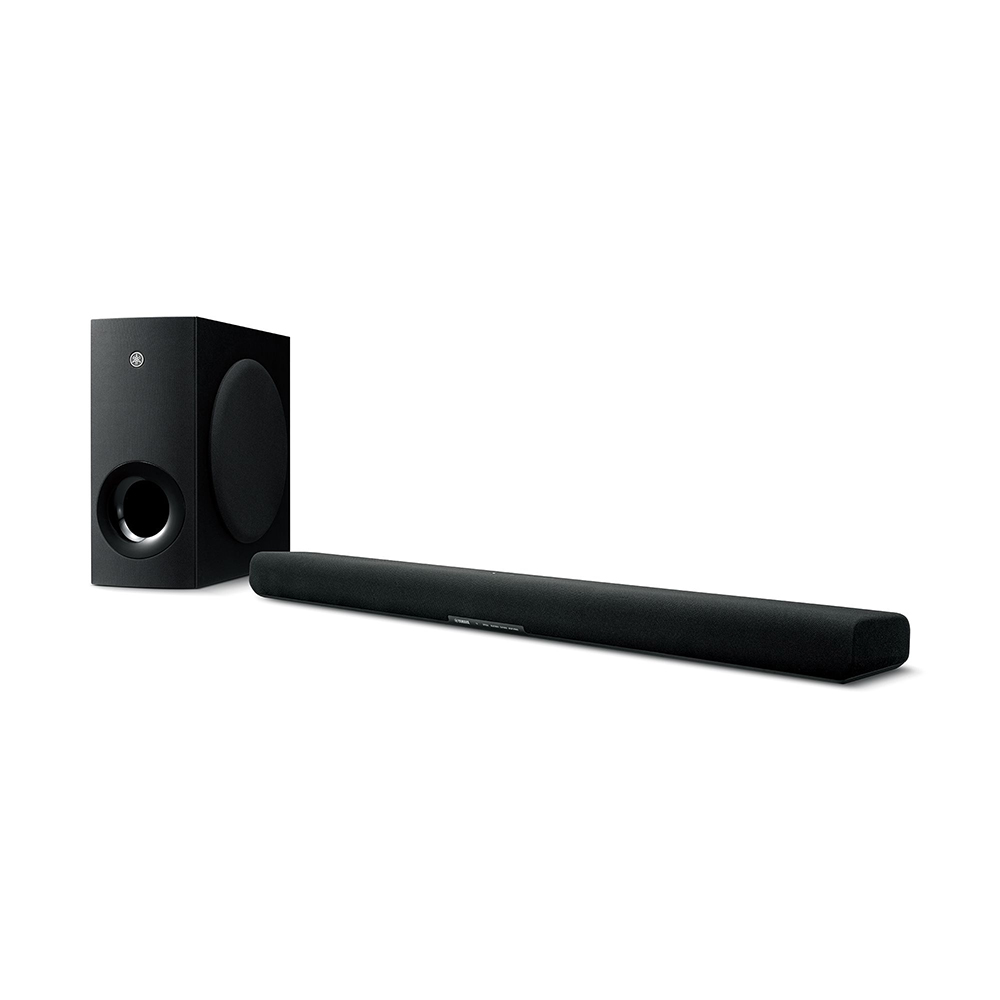
Yamaha SR-B40A is a simple soundbar-and-subwoofer package with virtual Dolby Atmos, HDMI eARC and Bluetooth music. It avoids the network setup and account decisions associated with more elaborate systems, while the separate bass enclosure aims to add film weight beyond the main bar. This research-based review considers the exact supplied arrangement rather than assuming the features of Yamaha’s MusicCast or True X products. Original listening evidence supports scale and bass, but gives useful reasons to check vocal balance before choosing it as the household’s everyday television system.
Research-based review. This assessment draws on manufacturer documentation and the original published evaluations linked below. Audio Review has not performed a hands-on test of this model.
Film weight is stronger than the refinement case
Tom’s Guide’s original evaluation finds a broad virtual presentation and substantial bass, while criticising the thin character of voices and some lack of bass detail. Its Clear Voice setting made speech more prominent but did not resolve the tonal concern for that reviewer. These are useful audition points rather than a universal instruction to use or avoid a particular preset.
Start with ordinary dialogue at the level normally used in the room. Try both lower and higher voices, then a scene with music or effects beneath speech. Check whether words remain easy to follow without sounding unnaturally light. Introduce a demanding film passage only after that basic assessment. Bass impact is a meaningful improvement over many television speakers, but it is not the sole measure of a successful upgrade. A package that sounds impressive during an explosion should remain comfortable for a long drama or live broadcast. Compare another current option at a similar total price before deciding whether the Yamaha’s balance fits the listener.
Virtual height and a wireless subwoofer describe different things
Atmos processing does not give this model physical up-firing speakers or rear channels. The supplied subwoofer provides bass through a wireless signal link, while the soundtrack’s spatial impression is generated from the front arrangement. Neither facility should be described as a full physical surround installation.
Position the main bar openly beneath the screen and follow the official setup guidance. Check the frequently used seats with appropriate material instead of expecting the same effect as a larger speaker array. The absence of rear units may be a sensible compromise in a shared room where permanent surround placement is impractical. It becomes a drawback when sound from behind is the main reason for buying. Do not assume that optional Yamaha speakers can be added merely because they share the brand. A documented True X or MusicCast system is a different proposition. Choose the feasible layout first, then decide whether the SR-B40A’s simple two-piece approach provides enough involvement within that layout.
Source planning is straightforward but important
The official manual identifies one HDMI OUT/TV connection with eARC/ARC and an optical input. There is no separate HDMI source input. It also distinguishes the supported Dolby and PCM routes from optical playback, and labels USB as update-only. DTS decoding is not part of the documented format set.
Connect a console or player to the television and verify what the display can send to the bar. Test each source independently, including internal apps, because a working ordinary programme does not prove every format is configured correctly. A disc collection with a particular soundtrack requirement deserves attention before purchase. Check synchronisation and remote volume operation after standby. Optical can be useful for an older display, but it should not be treated as an equivalent route for all eARC formats. Avoid converters unless the source requirement and their limits are clear. The Yamaha is a clean solution when the television already handles the required return path reliably. A more complicated source collection may benefit from different switching facilities.
No network platform can be a benefit or a limitation
Yamaha’s European specification lists no Wi-Fi, MusicCast Surround or AirPlay for this model. Bluetooth 5.1 supports SBC and AAC reception, and Sound Bar Remote mirrors useful control functions. The app does not turn the unit into an independent network music streamer.
For occasional phone music or podcasts, that may be enough. Check connection, volume adjustment and return to television playback with the actual handset. If the bar is expected to appear directly in a particular music application or join existing network speakers, verify the requirement rather than assuming it follows from the Yamaha name. A simpler design removes some setup decisions but also sets a clear boundary on future use. For music, compare the Stereo and other relevant modes with a familiar vocal and a dense arrangement. Listen for separation and timing as well as low-end quantity. The most useful platform is the one that fits the ordinary routine, not the one that seems simplest before its intended sources have been considered.
The bass cabinet needs a real place in the room
The official guide specifies a bass enclosure approximately 194 mm wide, 419 mm high and 407 mm deep, weighing around 8.1 kg. It needs mains power despite the wireless signal connection. The main bar is approximately 910 mm across, so both parts should be included in the installation check.
Measure the floor and furniture space, including the cable route and operating clearance. Try practical bass positions before permanently hiding the unit. Assess whether low notes support the main bar coherently at the normal seats; a corner that creates more rumble may not produce the most natural balance. Use a moderate level adjustment and replay the same passage rather than changing several settings at once. Check quieter evening listening as well as action films, because the preferred amount of bass may differ. A separate cabinet is an advantage only when it can be accommodated sensibly. If the available floor position is unsuitable, an all-in-one design or a differently shaped bass unit may be the better practical choice.
A fair value comparison uses the complete package
The SR-B40A includes its own bass unit, while some competing bar prices do not. It also omits the source switching, independent streaming and expansion facilities offered by more elaborate systems. Both sides of that comparison matter at the current local price.
Check the exact regional model, accessories, warranty and condition, particularly for remaining stock. Avoid treating an old launch price or an original review’s contemporary alternative price as permanent. A buyer wanting one uncomplicated television system may reasonably prefer the Yamaha’s limited setup burden. A buyer already planning extra sources, multiroom music or rear speakers may quickly outgrow it. Those priorities should be settled before judging a discount. The strongest case is a room where the supplied two-piece layout fits, the television passes the desired audio and an audition confirms acceptable dialogue. If those conditions are met, the lack of a large feature ecosystem may be less important than reliable everyday use.
Alternatives to consider
Sonos Beam Gen 2: Compare vocal character and network convenience against the Yamaha supplied bass. Include any desired optional subwoofer in the total price.
Samsung HW-Q800F: Consider a more extensively equipped package if physical height, network music or expansion is important. Compare the actual current complete offer rather than the launch price.
Yamaha SR-B40A key specifications
- Supplied arrangement
- Front soundbar and wireless-signal subwoofer
- Spatial approach
- Virtual Dolby Atmos; no physical up-firing drivers
- TV audio
- HDMI eARC/ARC; optical
- HDMI source input
- None
- Phone playback
- Bluetooth 5.1; SBC / AAC
- Wi-Fi / MusicCast / AirPlay
- Not supported
- Sound modes
- Stereo; Standard; Movie; Game
- Other adjustments
- Clear Voice; Bass Extension; subwoofer level
- App
- Yamaha Sound Bar Remote
- Bar dimensions / weight
- 910 × 68 × 133 mm; approximately 2.9 kg
- Subwoofer dimensions / weight
- 194 × 419 × 407 mm; approximately 8.1 kg
- USB
- Firmware update only
- Power
- Mains required for bar and subwoofer
- Physical speaker layout
- Two front channels and a separate powered subwoofer. Yamaha lists 50 W per front channel and 100 W for the subwoofer.
Verdict
SR-B40A provides substantial supplied bass and a straightforward television route, with virtual spatial processing as an additional facility. Original evidence qualifies dialogue and musical refinement, so those deserve an audition. Confirm the source formats and room fit, then compare the complete local package. It is a practical option for a simple film system rather than an open-ended network surround platform.
Documentation and original reviews
Yamaha official UK SR-B40A / SR-B30A comparison specifications · Yamaha official SR-B40A operating guide, sources and format table · Toms Guide original SR-B40A listening and setup review
Editorial record
Sources and updates
Product specifications and factual claims were checked against Official Yamaha SR-B40A product page ↗. Scores and buying advice follow our category-specific editorial methodology.
- Published
- November 17, 2026
- Last updated
- November 17, 2026