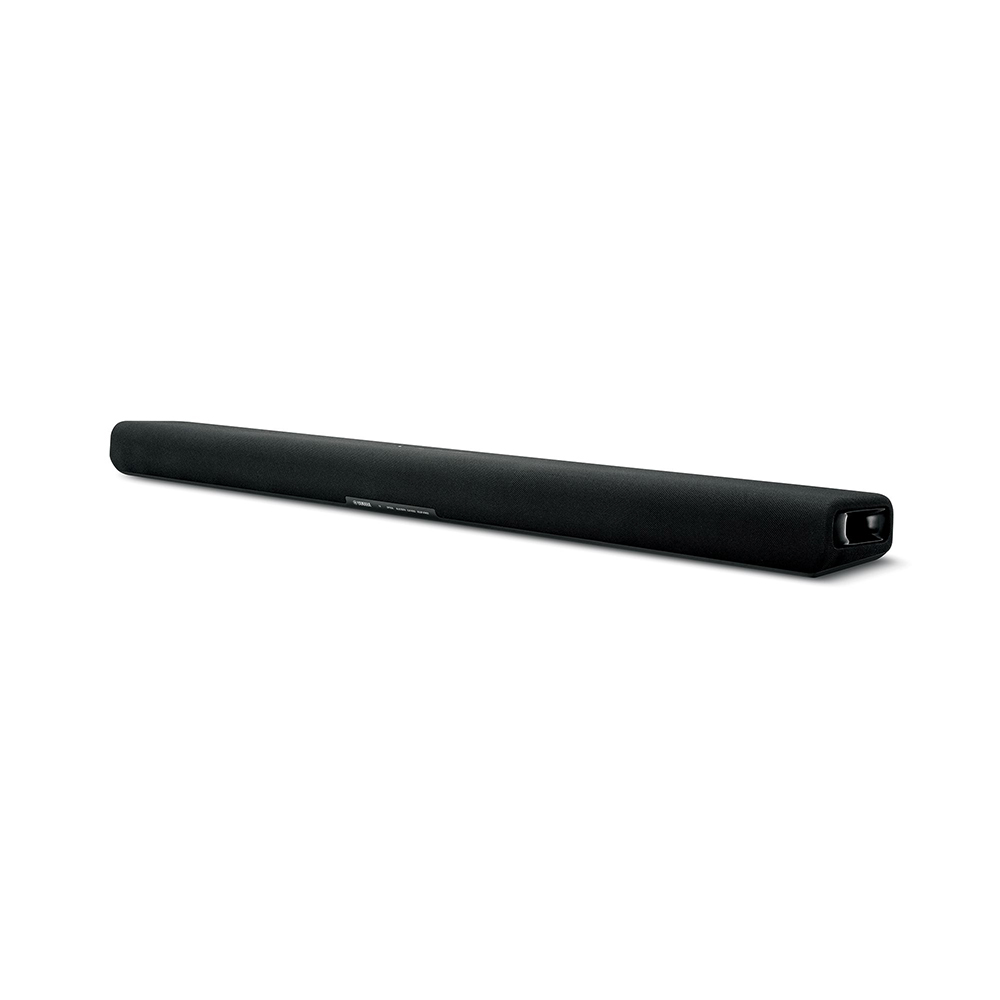
Yamaha SR-B30A puts front speakers and built-in bass into one relatively slim soundbar, with eARC, optical and Bluetooth handling ordinary sources. Virtual Atmos broadens the feature list without adding physical height or rear speakers. Unlike the separate-subwoofer SR-B40A, this model starts without a floor-standing bass cabinet and provides a wired subwoofer output for a possible later addition. This research-based review considers that practical role, the boundaries of its source platform and the qualified original lab evidence, rather than presenting it as a full networked home-cinema system.
Research-based review. This assessment draws on manufacturer documentation and the original published evaluations linked below. Audio Review has not performed a hands-on test of this model.
A modest sound case with clear qualifications
Labo Fnac’s original laboratory assessment finds the SR-B30A competently built, reasonably resistant to distortion and suitable for a secondary room. It qualifies the precision of bass and treble reproduction, with the midrange more satisfactory. Those findings are useful evidence for a modest upgrade, but they are not an Audio Review measurement or proof of a flat response in the reader’s room.
Use ordinary dialogue, a familiar vocal recording and a demanding film passage in a comparative audition. Check whether the sound remains comfortable over time, not simply whether it is louder than the television. A built-in-bass design can improve weight without requiring another cabinet, but it should not be expected to reproduce the deepest effects like a substantial separate system. Listen at the level actually used in the room. A secondary bedroom or smaller television area may place different demands on the product from a large open living space. Its value depends on a useful audible improvement within that real role, rather than an ambitious label alone.
Built-in bass keeps the initial installation simple
The official specification identifies two small built-in bass drivers alongside the front speaker array. A separate subwoofer is not needed to use the basic system. The European comparison table also documents a subwoofer output, distinguishing this model’s possible wired bass route from the supplied-wireless-bass SR-B40A package.
Choose the initial arrangement according to the available space. If a separate cabinet is unacceptable, assess the bar alone rather than assuming that expansion is necessary for every listener. If external bass is likely later, check the exact active-subwoofer connection and cost before treating the output as a free upgrade. Position and level integration still matter. More bass is not automatically better if it obscures speech or sounds detached from the main bar. A sensible purchase may remain a simple one-piece television system throughout its life. Another buyer may prefer to start with a complete two-piece package. The output is useful flexibility, but it should support an informed plan rather than postpone an essential decision about the intended sound and room.
Atmos remains a front-only virtual approach
The SR-B30A’s driver arrangement does not include physical height speakers or rear units. Dolby Atmos compatibility is implemented through virtual spatial processing. It therefore belongs in a different physical category from a system with separately placed surrounds or up-firing modules.
Place the bar openly beneath the screen and judge the ordinary seating positions with suitable material. Decide whether the added sense of width and involvement is worthwhile without expecting effects to appear identically to a complete speaker array. A front-only arrangement can be an excellent practical compromise when rear placement is impossible. It is less suitable when clearly localised sound behind the listener is the main objective. Do not assume that another Yamaha wireless speaker can become a surround channel merely because of shared branding. The documented lack of MusicCast Surround is relevant here. Choose a system with the necessary supported hardware if that future role is essential, rather than buying a simpler bar on an unverified expansion assumption.
The television must supply the required soundtrack
The bar has one HDMI eARC/ARC television connection and optical input, without a separate HDMI source input. Yamaha’s European table also identifies no DTS Digital Surround decoding. Those boundaries matter for a disc player or console collection as well as internal television apps.
Check the display’s actual audio-return handling and configure each source deliberately. Sound from one programme does not establish that every source is sending the intended format. If a required soundtrack cannot pass through the television, decide whether a supported source setting resolves the requirement before purchasing adapters. Verify synchronisation and normal volume control after standby. Optical offers a useful route for simpler or older displays, with different format limits from eARC. A clear connection plan avoids confusing the presence of an HDMI socket with a source-switching function. The SR-B30A is most straightforward when the television already acts as a reliable hub. A more complex equipment arrangement may call for different inputs or a more extensive home-cinema platform.
Bluetooth and an app do not imply Wi-Fi music
Yamaha documents Bluetooth 5.1 with SBC and AAC, while independent Wi-Fi streaming, AirPlay and MusicCast are absent. Sound Bar Remote provides useful control rather than a separate music-service platform. Stereo, Standard, Movie and Game modes sit alongside Clear Voice and Bass Extension adjustments.
Test the app with the actual handset and check the tasks repeated most often: volume, mode changes and returning to television audio. For occasional phone music, Bluetooth may be sufficient. For an existing network-music household, the lack of direct casting or grouping could be a more important limitation than the initial price. Compare the appropriate ordinary mode with a familiar album rather than leaving film processing engaged automatically. Make a controlled adjustment and replay the same passage if voices or bass need attention. A simpler control arrangement can be pleasant to live with when it fits the sources. It becomes restrictive when expected network functions were never part of the product in the first place.
A realistic furniture and value check
The official furniture-installation dimensions are approximately 910 mm wide, 68 mm high and 133 mm deep, with a weight around 3.9 kg. The wall-mounted dimensions differ because of the supplied spacing arrangement, so the intended method should be checked rather than relying on one measurement for every setup.
Allow cable clearance and confirm that the bar does not obstruct the picture or television remote receiver. Keep its sound path unobstructed and follow the manufacturer’s mounting guidance. Compare the current complete local price, warranty and condition against alternatives, especially for remaining stock. Do not use an older review’s contemporary price as a permanent value statement. The SR-B30A is strongest when the one-piece arrangement, basic source set and sound at normal levels meet the requirement already. If the purchase immediately needs a streamer, additional switching and substantial external bass, a different starting system may be simpler and better value. Settle those needs before treating a discount as the main reason to buy.
Alternatives to consider
Sonos Beam Gen 2: Compare the more extensive network platform and musical presentation if those justify a higher complete price for the room.
Sennheiser AMBEO Soundbar Mini: Consider a different compact virtual-surround approach, checking connections, dimensions and any desired optional bass against the actual television installation.
Yamaha SR-B30A key specifications
- Arrangement
- Single bar with built-in bass
- Bass drivers
- Two 7.5 cm / 3-inch cones
- Front array
- Four 4.6 cm cones; two 2.5 cm tweeters
- Spatial approach
- Virtual Dolby Atmos; no physical height or rear speakers
- TV audio
- HDMI eARC/ARC; optical
- Separate HDMI source input
- None
- Subwoofer output
- Provided for a compatible wired active bass setup
- Wireless music
- Bluetooth 5.1; SBC / AAC
- Wi-Fi / AirPlay / MusicCast
- Not supported
- Controls
- Remote; Yamaha Sound Bar Remote
- Modes
- Stereo; Standard; Movie; Game; Clear Voice and Bass Extension options
- Furniture dimensions
- 910 × 68 × 133 mm
- Weight
- Approximately 3.9 kg
- Physical speaker layout
- Two front channels and built-in subwoofers. Yamaha lists 30 W per front channel and 60 W for the built-in bass section.
Verdict
SR-B30A offers a straightforward one-piece television upgrade with built-in bass and a useful wired subwoofer route. Original lab evidence supports a competent modest role while qualifying frequency precision. Confirm the television formats, app routine and actual sound before purchase. It is best considered for a simple room-specific requirement rather than an assumed route to a full Yamaha network surround system.
Documentation and original reviews
Yamaha official European SR-B30A / SR-B40A comparison table · Yamaha official SR-B30A technical specifications · Labo Fnac original SR-B30A laboratory evaluation
Editorial record
Sources and updates
Product specifications and factual claims were checked against Official Yamaha SR-B30A product page ↗. Scores and buying advice follow our category-specific editorial methodology.
- Published
- November 17, 2026
- Last updated
- November 18, 2026