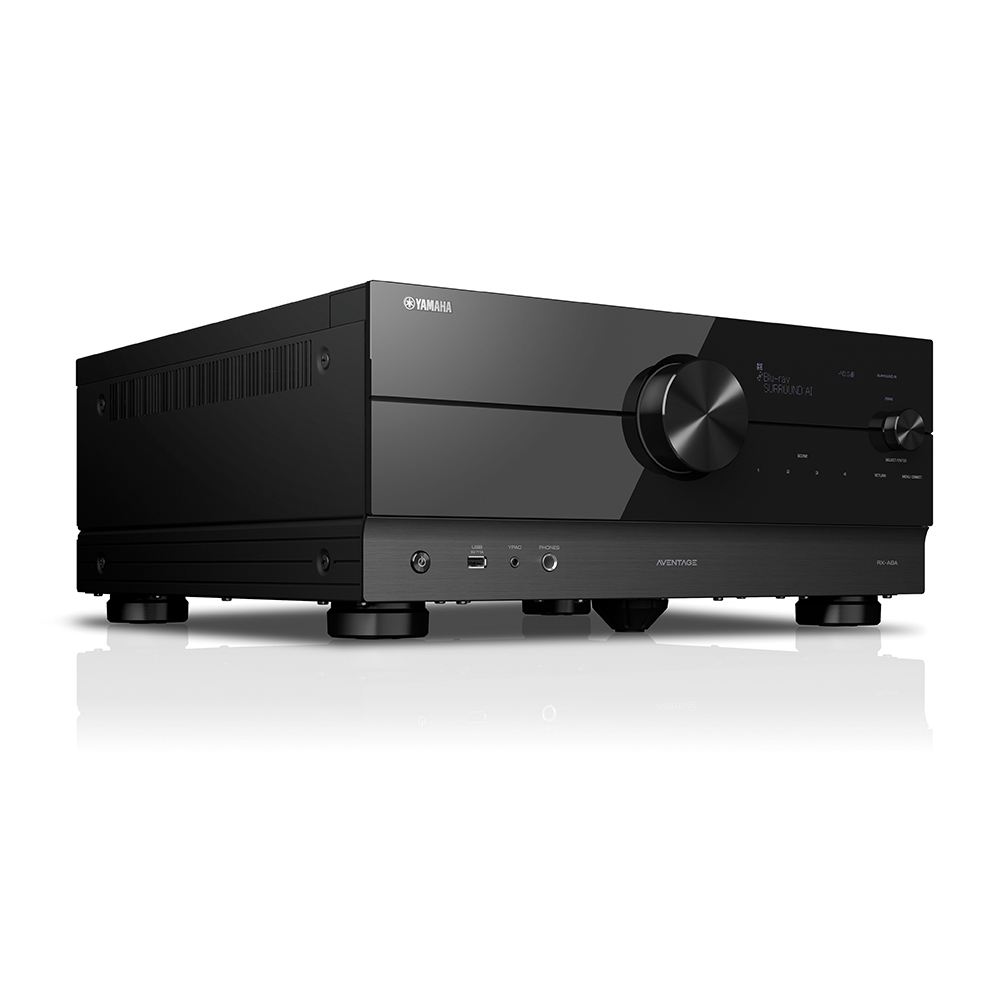
The Yamaha RX-A8A is the high-capacity option in its AVENTAGE generation, providing eleven internal power channels and a broad range of listening modes. Its strongest appeal is a complete 7.2.4 cinema in one main chassis, with MusicCast integration and substantial construction. It should be judged against a real installation plan, with current HDMI documentation taking precedence over the promises made when the model first appeared.
Yamaha RX-A8A — Eleven channels and flagship construction
The RX-A8A has eleven powered speaker channels. That supports a seven-speaker bed with four height speakers without adding another main-speaker power amplifier. Its extra binding posts provide assignment flexibility rather than thirteen simultaneously powered channels, so the connection count must not be mistaken for internal amplifier capacity.
Two subwoofer outputs feed suitable powered subwoofers or external amplification. They do not supply speaker power. A second subwoofer can be useful for coverage, but placement and integration determine whether it improves the room rather than simply adding output in the same problematic locations.
Yamaha rates output at 150 watts per channel into eight ohms over the audio band, with 0.06 percent distortion and two channels driven. That is a stated two-channel condition, not a measured eleven-channel continuous result. Speaker sensitivity, seating distance and bass-management choices remain part of the system calculation.
The A8A’s substantial chassis and internal construction distinguish it from a compact living-room receiver. These features are relevant to a flagship product, but the buying decision should follow the complete system result. A heavier component is not automatically the preferred tonal match or a substitute for suitable speakers.
Sound quality and layout
Sound+Image’s original review, published through What Hi-Fi?, reports excellent movie and music performance, particularly with surround material. It also highlights complexity in Yamaha’s speaker-layout terminology during setup. Both points matter: the acoustic promise is strong, but the desired result depends on configuring the actual overhead arrangement correctly.
Yamaha often uses Presence terminology in its menus and guidance. Match the manual’s assignment to the speakers physically installed rather than choosing an option because the label sounds similar to another brand’s. Verify each position with test signals before beginning calibration.
For an audition, use dialogue, ambient detail and a demanding action passage at a consistent master level. The benefit of eleven channels should be convincing placement and continuity, not merely more sound from more directions. A coherent smaller layout can outperform a badly spaced larger one.
Music is worth testing in both conventional stereo and an appropriate surround presentation. Additional sound fields can be enjoyable without becoming the correct setting for every recording. Keep a straightforward reference mode available so that the effect of processing remains clear.
An amplifier at this level also deserves a suitable listening environment. Strong early reflections, an obstructed centre speaker or poorly integrated bass can dominate the experience. Its capabilities are most useful when the room and speaker arrangement allow them to be heard.
YPAO and surround processing
YPAO supplies Yamaha’s automatic measurement and correction approach. Use the correct microphone procedure and a representative listening-area pattern, then inspect distances, crossovers and levels. Calibration is more reliable when the initial speaker configuration and wiring have already been verified.
The A8A offers Yamaha’s extensive Cinema DSP and Surround:AI options. These create different presentation choices rather than a requirement to keep every processor active. Compare the result with straightforward decoding on familiar content, especially if dialogue clarity is more important than an expanded sense of ambience.
For lower-volume listening, assess the settings in the actual household routine. A mode that seems impressive at demonstration level may alter the balance differently when the room is quiet at night. The preferred setup should make full programmes enjoyable without constant changes.
The eleven-channel architecture provides substantial flexibility, but it is not a promise that every zone and speaker assignment operates simultaneously. Plan secondary-room use alongside the main cinema. Repurposing an amplifier channel can affect the active main-zone layout, which is easier to understand before installation than after all cables are connected.
If considering the A8A against a receiver built around a different correction platform, compare the complete measurement and operating process. The available tools need to suit the owner’s willingness to configure them, not merely look extensive in a specification table.
HDMI and current feature status
Yamaha’s current UK specification identifies 40 Gbps HDMI paths with the relevant 4K/120 Hz and 8K/60 Hz support, seven inputs and three outputs. Those capabilities require a compatible source, display, cable and settings. They should not be confused with the more restricted high-rate arrangement in the RX-A2A.
The A8A is not part of the early A2A board-exchange group identified in Yamaha’s historical compatibility notice. However, firmware still matters because some facilities arrived after launch. Read current documentation rather than repeating an early review’s future-update list as though it described the present state.
QMS is specifically excluded from that optimistic approach. Yamaha withdrew the planned Quick Media Switching support after the specification change exposed a hardware limitation. It should not be described as a feature still expected through a later update. This is separate from useful gaming functions such as supported high refresh rates and variable refresh.
For multiple displays or another room, check the output-assignment rules in the manual. Three HDMI sockets do not imply three unrestricted independent main-zone paths. Test the intended television-and-projector combination, especially if their supported formats differ.
Television-app audio over eARC also depends on the television’s capabilities. A directly connected disc player is a different path. Atmos support in the receiver does not establish that every app, pass-through route or optical connection can provide the same audio format.
MusicCast, installation and value
MusicCast and AirPlay 2 make the A8A useful as a music hub, particularly in a home already using compatible Yamaha equipment. Analogue and digital connections, including a moving-magnet phono input, provide additional routes. Check current service support for any platform essential to the purchase.
The substantial weight and depth need a suitable rack or cabinet, with space for attached leads and ventilation. Plan access to the rear panel and calibration connection. A flagship receiver is less satisfying when normal maintenance requires dismantling the furniture around it.
Its clearest comparison is with the RX-A6A plus external amplification. If eleven channels are needed now, the A8A’s single-chassis arrangement can simplify the system. If nine internal channels are sufficient or a suitable external amplifier is already owned, the A6A may offer a better balance of spending.
Also compare current eleven-channel alternatives outside Yamaha, including the complete correction and licence costs. MusicCast familiarity and preferred processing are legitimate reasons to stay in the ecosystem, but they should have practical value in the household rather than simply preserve a brand collection.
For European buyers, exact regional facilities, mains requirements and support matter, especially with used or imported stock. Confirm the supplied microphone and remote. The strongest purchase is a known, supported unit that serves a planned room, with enough budget left for speakers and integration.
Alternatives to consider
Yamaha RX-A4A: A smaller-channel option to compare if the room and seating do not justify eleven powered speakers.
Denon AVC-X3800H: A different expansion and correction route, especially relevant if external amplification is already available.
Anthem MRX 740 8K: A contrasting calibration approach to assess with every required external amplifier included in the comparison.
Yamaha RX-A8A key specifications
- Powered speaker channels
- 11
- Example layout
- 7.2.4
- Rated output
- 150 W/ch, 8 ohms, 20 Hz–20 kHz, 0.06% THD, two channels
- Subwoofer outputs
- 2 line-level outputs
- HDMI
- 7 inputs / 3 outputs; eARC
- Video
- 40 Gbps paths; 4K/120 Hz and 8K/60 Hz with compatible equipment
- Calibration
- YPAO
- Music platform
- MusicCast and AirPlay 2
- QMS
- Planned support withdrawn
Verdict
The RX-A8A is a capable flagship for a planned eleven-speaker MusicCast cinema, supported by strong original-review evidence for movies and surround music. Its setup terminology, physical demands and current HDMI qualifications deserve attention. Choose it when eleven internal channels and Yamaha’s operating approach simplify a real system, rather than for unused flagship capacity.
Primary documentation and independent reviews
Yamaha RX-A8A official UK specifications · Yamaha official RX-A8A user guide · Yamaha official QMS notice · Yamaha historical HDMI compatibility notice · Sound+Image original RX-A8A review
Editorial record
Sources and updates
Product specifications and factual claims were checked against Official Yamaha RX-A8A product page ↗. Scores and buying advice follow our category-specific editorial methodology.
- Published
- November 7, 2026
- Last updated
- November 8, 2026