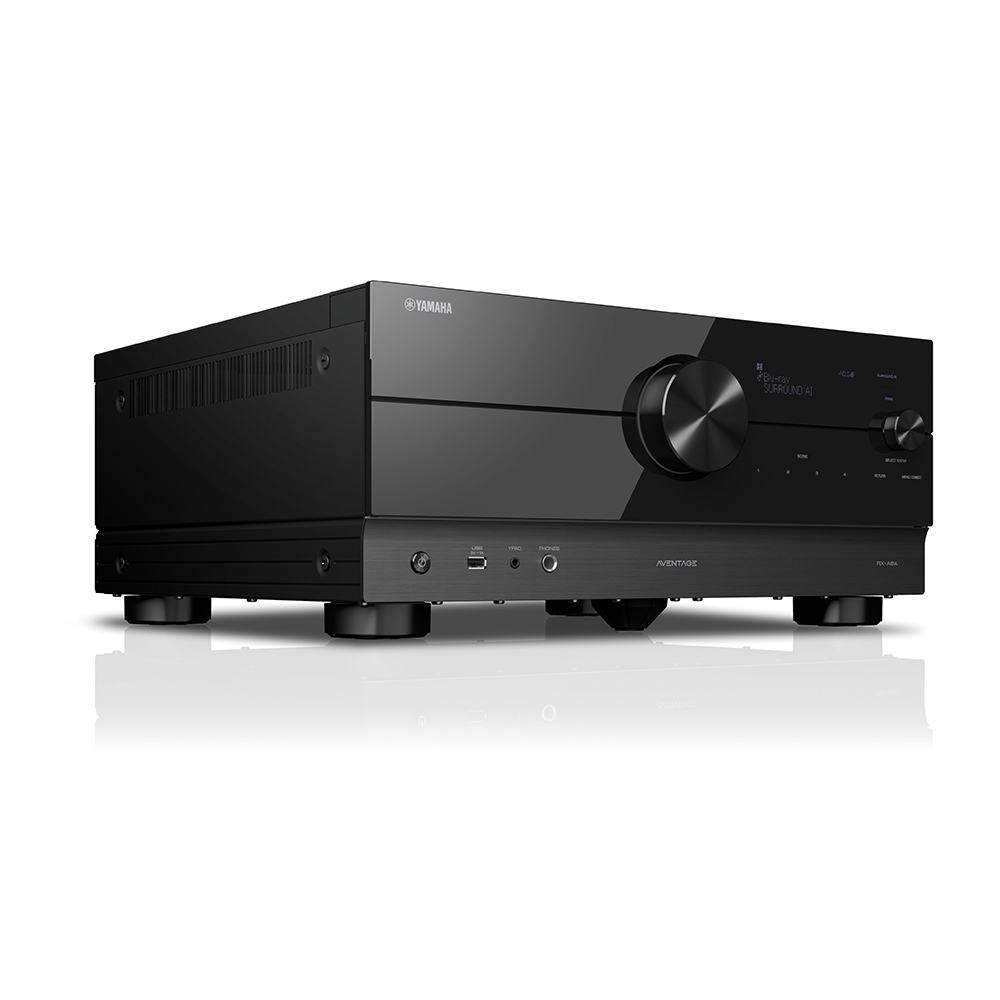
The Yamaha RX-A6A combines nine internal amplifiers with much of the flexibility of the larger RX-A8A. It is especially interesting to someone who wants Yamaha’s MusicCast ecosystem, YPAO calibration and distinctive surround processing without paying for eleven internal channels immediately. Its expansive feature set rewards careful setup, while speaker matching and current firmware deserve more attention than launch-era future-proofing claims.
Yamaha RX-A6A — Channel capacity and amplification
The RX-A6A has nine powered channels and 11.2-channel processing. A five-speaker bed with four heights or seven bed speakers with two heights is possible using internal amplification. Moving to an eleven-speaker arrangement requires suitable external amplification and the correct assignment settings.
Yamaha’s manual identifies more connection terminals than active internal power channels. Those terminals provide assignment flexibility, not an unlimited set of simultaneous outputs. Check the main-zone layout and any additional-room requirement together before assuming every connected speaker can operate in every mode.
The rated output is 150 watts per channel into eight ohms across the audio band, with 0.06 percent distortion and two channels driven. That should not be described as a continuous nine-channel measurement. The speakers’ efficiency and the listening distance remain essential to judging required headroom.
Two subwoofer outputs allow a suitable powered-subwoofer arrangement. A pair can improve coverage when placed and calibrated thoughtfully, but two sockets do not by themselves solve room modes. Start with the seating plan and likely sub positions rather than adding a second unit without a clear integration goal.
Sound quality and speaker matching
What Hi-Fi?’s original review reports a clean, dynamic and spacious presentation, with particular emphasis on high-frequency detail and rhythmic precision. It also advises care with speaker matching because the upper range can feel insistent according to taste. That reservation is useful alongside the positive assessment, especially in a reflective room.
A buyer should audition with a realistic speaker balance and comfortable playback level. Bright speakers, a hard-furnished room and an already explicit presentation can combine in a way that a short demonstration does not reveal. Include a full dialogue scene and a familiar music recording, not only effects chosen for impact.
The A6A offers several approaches to playback. Straight decoding preserves a different experience from Cinema DSP sound fields, while Pure Direct changes the active processing path. Compare those modes deliberately. A result with less room correction is not automatically more accurate at the listening seat if the room has significant problems.
For stereo music, listen for whether vocals and percussion stay comfortable over several tracks. A presentation that initially seems more detailed may become tiring at an unnecessarily high level. Match volume carefully when comparing with another receiver so that gain differences do not decide the preference.
The published evidence makes the A6A a strong shortlist candidate for a lively, precise cinema system. It does not remove the need to choose speakers and setup according to the owner’s room and taste.
YPAO, Surround:AI and format choices
YPAO provides Yamaha’s automatic measurement and correction route, with the A6A’s more advanced implementation intended for a flexible cinema installation. Follow the microphone procedure carefully and inspect speaker distances, levels and crossovers afterward. An automated process remains dependent on the physical layout and measurement conditions.
Surround:AI analyses the scene and adjusts the presentation using elements such as dialogue, ambience and effects. Yamaha documents it as a processing option; it should be compared with ordinary decoding rather than treated as a compulsory improvement. If it helps speech in a particular routine, that is useful. If it changes a familiar mix in an unwanted way, leave it off.
Cinema DSP HD3 provides additional sound-field choices. These can be enjoyable for some music and films, but more apparent room ambience is not necessarily more faithful to the source. Start from a known reference mode and explore options one at a time.
The current manual includes Dolby Atmos, DTS:X and AURO-3D facilities. Check firmware and the actual speaker configuration before relying on a particular mode. A decoder’s presence cannot create physical height-speaker placement, and some encoded formats need the appropriate selection rather than being inferred from a streaming-service logo.
Yamaha’s calibration platform is a different proposition from buying a receiver primarily for a Dirac licence path. Compare the complete setup approach that will actually be used instead of treating all automatic correction systems as interchangeable.
HDMI and MusicCast today
The A6A offers seven HDMI inputs and three outputs, with the current specification supporting 40 Gbps paths and the relevant 4K/120 Hz and 8K/60 Hz modes through compatible equipment. Its platform is not part of the early RX-A2A board-exchange group identified in Yamaha’s historical notice.
Firmware history still matters because several features arrived after launch. Use current official documentation and a supported update rather than treating an old review’s promised facility as either permanently absent or guaranteed. Verify the desired gaming resolution, refresh rate, HDR and variable-refresh behaviour together.
QMS is an explicit exception: Yamaha withdrew the planned Quick Media Switching support after a specification change revealed a hardware limitation. It should not be listed as an upgrade still expected in the future. This qualification is separate from the receiver’s useful high-refresh video capabilities.
HDMI OUT 3 is identified in the manual as a dedicated zone output. Multiple outputs therefore need to be understood through their actual assignment rules, particularly for a television and projector or a second room. Do not assume they are three unrestricted independent main-zone paths.
MusicCast, AirPlay 2 and network playback make the A6A useful for everyday music as well as cinema. Confirm current service and device compatibility if a particular multiroom routine is central to the purchase. Existing MusicCast equipment can make this ecosystem advantage more relevant than a small difference in headline power.
Installation and value
The A6A is a substantial receiver, so check shelf strength, chassis depth with cables and ventilation. Its uncluttered front is attractive in a modern room, but the installation must still allow practical access for the microphone, wiring and future source changes.
Its strongest value case is a nine-channel system that benefits from Yamaha’s processing and network platform, with an optional eleven-channel route later. If eleven powered speakers are needed immediately, price the external amplifier and compare the complete arrangement with an A8A or another eleven-channel model.
Compare current European offers with the lower RX-A4A and competing nine-channel receivers. A higher model is useful only when its additional facilities serve the real room. Funds spent on unused channels cannot also improve the centre speaker, subwoofer positioning or acoustic treatment.
For older or used stock, confirm the exact regional version, accessories and firmware status. A local warranty and a sensible return route matter for a complex component. The best purchase is a supported unit whose sound and operating approach fit the system, rather than the one described most confidently as future-proof.
Alternatives to consider
Yamaha RX-A4A: Compare the smaller-channel alternative if the room does not need nine internal amplifiers or the higher model’s processing facilities.
Denon AVC-X3800H: A different nine-channel and calibration proposition to compare against the complete Yamaha setup.
Onkyo TX-RZ50: An alternative worth assessing when the included correction package influences value more than MusicCast integration.
Yamaha RX-A6A key specifications
- Powered speaker channels
- 9
- Processing
- 11.2 channels
- Rated output
- 150 W/ch, 8 ohms, 20 Hz–20 kHz, 0.06% THD, two channels
- HDMI
- 7 inputs / 3 outputs; third output dedicated to zone use
- Video
- 40 Gbps paths; 4K/120 Hz and 8K/60 Hz with compatible equipment
- Calibration
- YPAO
- Processing options
- Surround:AI and Cinema DSP HD3
- Music platform
- MusicCast and AirPlay 2
- QMS
- Planned support withdrawn
Verdict
The RX-A6A is a strong nine-channel cinema option with precise published sound performance, flexible processing and useful MusicCast integration. Careful speaker matching is important, and current HDMI information should replace old launch promises. It is especially convincing when nine internal channels meet the immediate need and the eleven-channel expansion route has a realistic purpose.
Primary documentation and independent reviews
Yamaha RX-A6A official UK specifications · Yamaha official RX-A6A manual specifications · Yamaha official Surround:AI explanation · Yamaha official QMS notice · What Hi-Fi? original RX-A6A review
Editorial record
Sources and updates
Product specifications and factual claims were checked against Official Yamaha RX-A6A product page ↗. Scores and buying advice follow our category-specific editorial methodology.
- Published
- November 7, 2026
- Last updated
- November 8, 2026